|
=============O=============
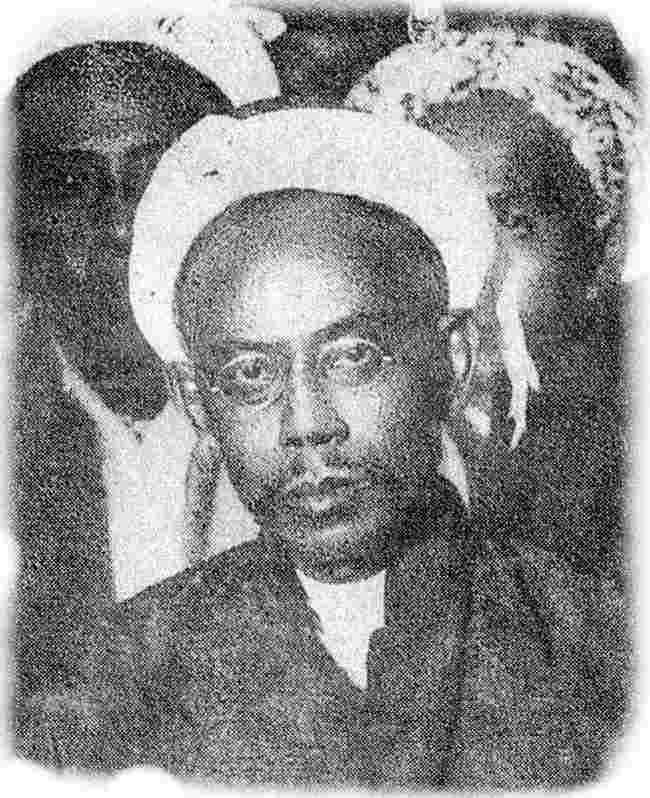
Wan Sulaiman bin Wan Sidek (1874-1935)
Sheikhul Islam of Kedah Darul-Aman.
A rare photo released after his death contains
a caption that reads :
Al-Marhum Al Haj Wan Sulaiman bin Wan Sidek
kembali ke Rahmatullah pada 28 Muharram
1354 dan dikebumikan di Maqam di Raja, di
Langgar. Di masa hayatnya yang berbahagia
menjadi Chief Qadi dan kemudiannya menjadi
Sheikhul Islam Kedah. Dan beliaulah yang
membawa Tariqat Naqshabandiah kepada
orang-orang di sebelah sini. Ya Tuhanku !
Cucurkanlah RahmatMu ke atasnya.
Amin.
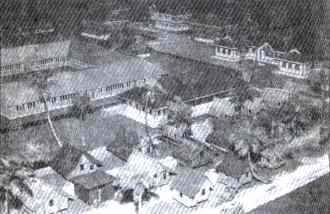
A model of a religious complex in Pokok Sena
belonging to Tuan Hussain Nasir, a contemporary of
Wan Sulaiman. Another school in Bohor belonging
to Tuan Hussain won the admiration of G.C Hart,
the Financial Advisor from the Court of Siam for
it's high discipline and well organization. At
one point in the 1900s the complex housed
300 pondoks.
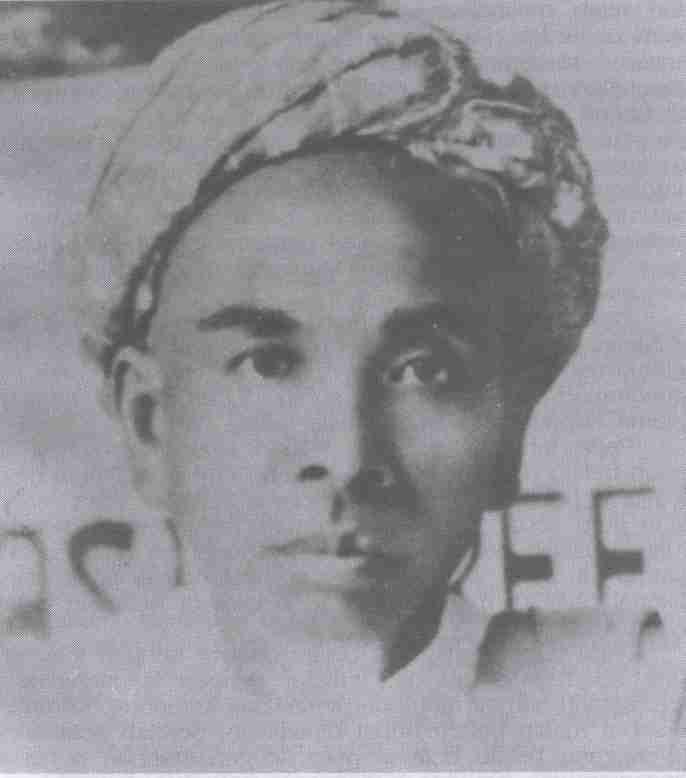
Tuan Hussain Nasir Ibni Muhammad Taib
Al-Masudi Al Banjari (1863-1936).
A prolific writer and Teacher, Tuan Hussain wrote 18
kitabs (books) and opened many religious
complexes. By Tariqa, he was a Shatari
(a particular Sufi Order). He was againts the decree
issued by Wan Sulaiman that required a
Tauliah (official State approval) to teach
and a critic of Wan Sulaiman's "liberal"
dispensation of the Sufi teaching.
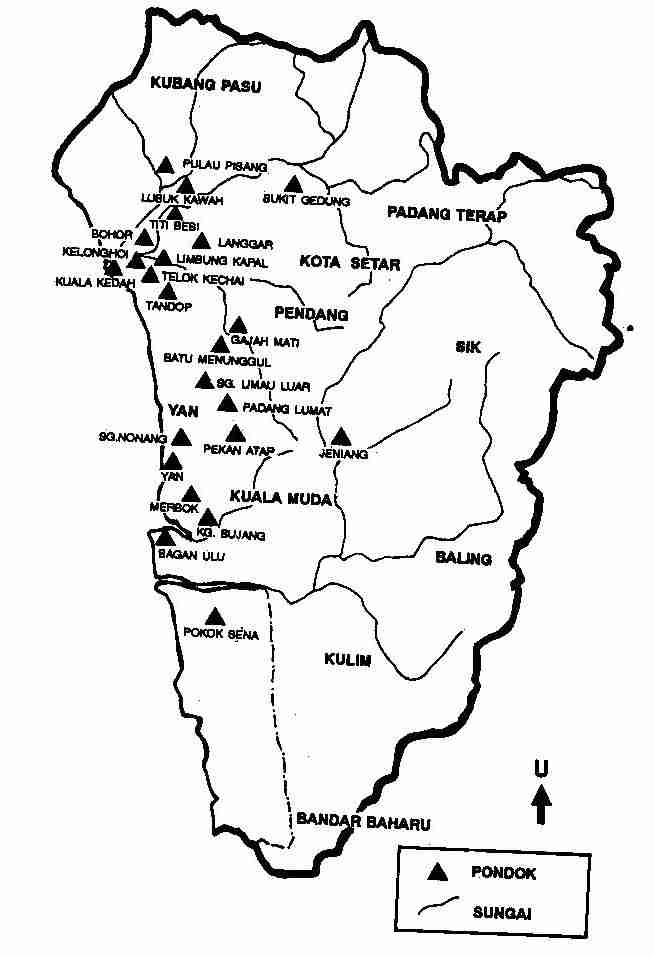
Distribution of Pondoks in the late
19th and early 20th centuries.
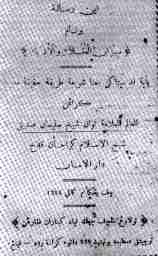
Mizanul Uklaii wal Uddabai
A treatise on Shariat (law), Tariqat (Path) and
Haqiqat (Truth) by Wan Sulaiman. This work
was used in discourses in the Zahir mosque
on Thurday evenings. Sufism was taught in the
state mosque by the highest official
authority in Kedah.
=============O=============
|
|
THE
SUFI..cont
Next, let’s look at the religious atmosphere of the period for some other
clues to prove that Sultan Abdul Hamid did practice Sufism, perhaps of
a particular school, or at the very least that he was influenced by it.
Kedah of the late 19th century saw the emergence of many religious centers,
arranged in the form of communes. This “Pondok" style centers survive till
today. According to one study, there were as many as 60 such centers in
the 1850s and that almost all districts in Kedah had its own Pondok. Another
interesting aspect was the close link between Kedah, Kelantan, Terengganu,
Acheh, Java, parts of Sumatera and Mecca in the development of these schools.
It was common to find religious figures of one state to spend time and
teach in the schools of other states before or after the completion of
their studies in Mecca. One suspects that such dissemination was not altogether
haphazard and that perhaps Mecca had a say in it. By this I mean the group
of Teachers in Mecca at that time. This is an interesting possibility that
merits further study.
Inter-wined with these developments was the diffusion of Sufism,
the inner dimension of Islam and its related discipline called Tariqa (Arabic
for “Path”, “Method”, “Way”). This dimension is very much wedded with the
outer aspect of the religion, called Sharia (“Law”) and as such its diffusion
in 19th century Kedah together with the already mentioned religious
centers was seen as something natural and mainstream. In stark contrast,
Sufism today is seen as an aberration and viewed with a lot of suspicion
by the religious authorities.
In 1906, a young man returned to Kedah from a 17 years sojourn in Mecca.
This man, Wan Sulaiman bin Wan Sidek, was related to Sultan Abdul Hamid
on his mother’s side. In Mecca Wan Sulaiman studied under various
Teachers, the Arabic language, Quran, Hadiths (Sayings and Acts of the
Prophet ; their transmission), Usuluddin (Fundamentals of the way of life)
and Fiqh (Jurisprudence) in addition to Astronomy. In Astronomy
he studied under a famous Teacher, Sheikh Muhammad Khayat. In the last
3 years of his stay in Mecca, Wan Sulaiman engaged in Sufi spiritual discipline
under Sheikh Fakir Muhammad Al-Bukhari and received the Bai’ah (pledge)
into the Naqshabandiyah Mujaddiyah Ahmadiyah Sufi Order. He was also appointed
by the said Teacher as the 34th Khalifah (Representative) of the Order.
This information is relevant for our discussion. Being a Khalifah, Wan
Sulaiman bin Wan Sidek was authorised to teach and guide students in Sufism.
I would like to propose that the source of the Sultan’s Sufi influence
was derived from this man.
During his study in Mecca, Wan Sulaiman bin Wan Sidek was in the same study
circle of Sheikh Abdullah Fahim (the Mufti of Penang), Haji Yusuf
Awang (Tok Kenali) and Sheikh Muhammad Said (Linggi, Negri Sembilan) and
according to one source befriended Tuan Hussain Nasir Ibni Muhammad Taib
Al-Masudi Al-Banjari, with whom a controversy arose in 1929. These individuals
were also known to be Sufis.
On his return to Kedah, Wan Sulaiman was appointed by the State Council
as Qadi. In 1910 he was promoted to the position of Grand Qadi and in due
course the position of Sheikhul Islam. In this capacity he was responsible
for the administration of religious laws in the state. In addition Wan
Sulaiman taught in the Zahir mosque and in the Madrasah at Limbong Kapal.
It was said that he taught Sufism quite openly and conducted night vigils
(Arabic “Tawajjuh”) in the Zahir mosque. This openness was criticized by
Tuan Hussain Nasir who was of the opinion that Sufism should only be taught
to persons with the capacity to understand. Wan Sulaiman wrote many books
including on the Naqshabandi Order. At least one book on the Order was
written at the request of Tunku Mahmud.
Sufism then, was very much alive in Kedah, propagated at the highest religious
position and supported openly by Tunku Mahmud and the Sultan. It would
seem highly improbable that the Sultan was altogether impervious to this
development and not affected by it given his inclination for Zikr.
Wan Sulaiman was refered in passing by many a writer as the “Teacher” of
Sultan Abdul Hamid on account of the fact that he was appointed as the
religious Teacher to the royal household. I propose that this relationship
was more than ordinary. It was a Master-Disciple relationship in the highest
Sufi tradition.
Wan Sulaiman passed away in 1935 and was interred at the Langgar Royal
mausoleum. Eight years later, his pupil, the Sultan followed suit and was
buried besides his Teacher.
Salim (September 2004).
This page is dedicated to Zawiyah Omar
in recognition of her support
)0(
Ilahi Anta Maqsudi wa Redho
ka Matlubi
|