deaddrift.com reports
I
have reviewed the information submitted by Mr. Schupbaugh and the supporting
data from Sue Lackey of UNL-CSD, as well as my review of the ground water
monitoring plan for the facility and Brad Routt's original review of the
facility which recommended monitoring. In
regard to Mr. Schupbaugh's concerns about the sediment below the facility, he's
probably right in that those sediments are very similar to those encountered in
CSD test hole 28N-7W-36dddd located about 1/2 mile north of the facility.
As indicated by the test hole, subsurface
sediments in this area are mostly mixtures of silt (which can range from
clayey to sandy) and sand (which can range from silty to as much as 60% gravel).
It was in part this considerable fraction of coarse-grained material in the
subsurface which led to Brad's original recommendation for ground water
monitoring at this facility, since any seepage from the facility could move
fairly readily downward into ground water. The water levels calculated by Sue
Lackey show the possibility that ground water discharges to the East Branch of
Verdigre Creek, therefore if significant
seepage from the TeVelde facility does enter ground water, I believe that it is
possible that such seepage could impact the East Branch. Exactly how much
impact this would amount to is open to question; it would depend on such
variables as the amount of seepage from the TeVelde facility (if any), chemical
changes in this seepage as it enters ground water, amount of dilution before
discharge to the creek, etc. I'm not as concerned about Mr. Schupbaugh's
conception of the sediments below the facility acting as a "wick" to
pull lagoon seepage toward the creek. Typically such "wicking" action
is caused by capillary action which operates over relatively short distances
(say, inches to feet) and is much more prominent in finer-grained sediments. In
fact, surface discharge from such tension-saturated zones is not possible, since
fluid pressures in this zone are below atmospheric pressure (cf Freeze and
Cherry, Groundwater, 1979, p. 44-45).
As
to the amount of clay in the onsite material and its use as a liner, I agree
with Sue that probably much of the
material which is described as "clay" in well logs is in fact silt or
clayey silt, thus its use as a liner is not as straightforward as in soils which
are in fact clay-rich. Beyond that, my expertise in geotechnical
engineering, like Sue's, does not extend.
So,
in summary, I agree that there is a
concern over ground water discharge into the East Branch of Verdigre Creek,
should that ground water become contaminated from seepage from the TeVelde
facility. I don't believe the magnitude of that concern can be adequately
evaluated without further study. Installation
of monitoring wells and ongoing ground water monitoring as recommended should
help evaluate that concern to some extent.
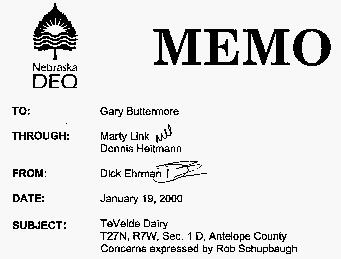
This is a memo from the NDEQ. The heading is a scanned image while the body is OCR text from the original document. In the interest of download speed I have chosen this method to display this memorandum. Misspellings of Rob Schupbach's name were left uncorrected.
If
you would like to see a copy of the original document contact me and I will
provide it for you.