
5th Hour IPS
Thursday, January 24, 2002
(last updated)
First, James, Erin and Stephanie explained how heat travels from warmer things that possess more heat to cooler things and all the ways that this occurs.
Everything that you come in contact with has some heat. Scientists have not yet been able to reach absolute zero (when all particles stop moving and have no heat theoretically). The particles in everything that you touch, breath, and smell have energy and are moving around - vibrating. They hold heat energy.
So, if heat is energy, if it is kinetic, than what is cold? It is merely a lack of heat.
Heat has a natural tendency to move from warmer things to colder things. There are three ways heat travels and they are described as conduction, convection and radiation.
When heat travels between solids by physical touch, then heat is traveling between the two-substant matters by conduction. It is said that when a person is suffering from hypothermia (a condition where the body is thrown into shock due to a lack of heat), you should use your body heat to keep them from suffering serious damage or even death.
As you mix salt with water, it mixes evenly. This same principle is the idea of convection between fluids. The particles arrange themselves in such a way to get an overall average temperature for the whole volume.
 | Radiation is most commonly associated with the sun. The rays travel, passing through literally nothing, eight minutes before reaching the earth by radiation. Radiation is also incorporated your microwaves as well as some medical treatments. It also roots from radiating powerful gamma rays from radioactive materials like Uranium. |
Microwaves work by converting electric energy to microwaves through a magnetron. Depending on the wavelength of a particular machine, certain "hot spots" will be created in a microwave oven (sometimes five centimeters apart to give you a rough idea). This distance is mathematically calculatable and is equidistant throughout the microwave oven.
| James, Erin and Stephanie demonstrate this by putting marshmallows in the microwave at random places and observe the marshmallows growing larger at different rates. Then, they make smores for the whole class. |  |
While they're in the nook, Erin asks the class why you use small sticks to start a fire instead of big logs.
Surface area directly relates to a substance burning. If you have smaller surface area, oxygen can surround the particles more and it will burn easier.
Now we're going to simulate that grain elevator explosion using a coffee can and some lycopodium powder. Lycopodium powder isn't considered combustible, but when it gets into it's fine dust form it will light quickly.
Then Erin grabs a 
and shuts out the lights. She uses a lighter around the sock, touching lightly here and there and watching as the flame climbs up the whole sock. Then Stephanie explains about how this happens in grain elevators. There gets to be so much dust from the grain, that a single spark, sometimes, can light up the place and cause an explosion. 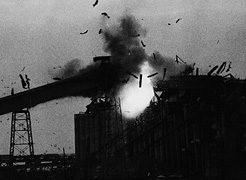
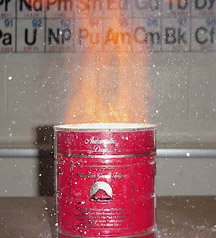
Mr. Teacher comes in to show us some more cool things about lycopodium powder. He runs a one-hole stopper through a hole in the counter with a glass tube and a rubber hose running to a foot pump. He pours the lycopodium powder near the end of the hose through the hole in the counter and holds a candle near the hole. When the air rushes through the hole, the powder rushes into the air and catches fire from the candle resulting in a four-foot flame!!!
