



NOCTURNAL HEMODIALYSIS
An Overview
 |
|
 |
INTRODUCTION
Nocturnal hemodialysis was started by Dr. Robert Uldall at the Wellesley Hospital in Toronto in 1994. The first patient was trained to use the nocturnal hemodialysis system in April 1994. After Dr. Uldall's death in 1995, Dr. Andreas Pierratos took over as chief nephrologist in the project at Humber River Regional Hospital in Toronto.
Dialysis is a procedure in which a patient with kidney failure has waste and fluid removed from his/her body. There are two main types of dialysis:
Hemodialysis - purification involving the blood flowing through an artificial kidney
Peritoneal dialysis - involving fluid being placed in the abdominal cavity for purposes of absorbing wastes and excess body fluid.
Hemodialysis by nature is an intermittent process. Wastes accumulate between dialysis sessions and are removed by the dialysis procedure. Standard dialysis as practiced by most U.S. centers today, consists of 3 treatments weekly, Mon-Wed-Fri or Tu-Th-Sat, lasting typically 3-4 hours each. The 3-4 hour dialysis treatment is designed to remove 48-72 hour of wastes and fluids, which have accumulated since the last treatment. Removing this much waste and fluid accumulation in a short period of time can lead to blood pressure instability and a "washed out" feeling after the dialysis treatment.
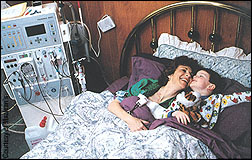
Nocturnal hemodialysis is designed to shorten the time between dialysis sessions, usually 6 nights per week, and lengthen the time of dialysis, usually 8 hours, so that there is less accumulated waste and fluid to remove over a longer period of time. This leads to a gentler treatment, which is better tolerated by most patients. The patient at home performs nocturnal hemodialysis after sufficient training and certification of ability to safely perform and troubleshoot the dialysis treatment. Not all patients are good candidates for nocturnal hemodialysis as it takes motivation to care for oneself and attention to detail and procedure to perform a safe and effective dialysis treatment. Anyway, a trained professional can monitor the performance of the system remotely through a computer-telephone or Internet connection. The machine will occasionally alert patients to any problems. (Most problems are minor and usually require pressing a "reset" button.) However, if the patient does not respond within a reasonable period, the hospital monitor will contact them by phone.
EVIDENCE (OR LACK) OF SCIENCTIFIC PRINCIPLES
To be implemented on a larger scale, nocturnal hemodialysis must become a recognised treatment and qualify for government support.
In the May issue of the Journal of the American Society of Nephrology, Dr. Andreas Pierratos has reported that the removal of toxins such as phosphate and beta-2 microglobulin from blood was twice as high in the "nocturnal" group, compared with conventional dialysis. Throughout the 3-year study, it is found out that all of the patients were able to discontinue treatment with phosphate-binding drugs and to increase their dietary phosphate and protein intake, and fewer drugs were needed to control their blood pressure, in which high blood pressure is a common complication of kidney failure.
Apart from that, a study was undertaken to determine the effect of nocturnal hemodialysis on sleep apnea. The study took place between November 1993 and November 1998 and included 14 of the first 15 patients in the nocturnal dialysis program at St. Michael's Hospital in Toronto, Canada. The patients had been treated by conventional hemodialysis for 1 to 15 years. Based on their study, the authors concluded that nocturnal hemodialysis corrects sleep apnea associated with chronic renal failure, resulting in a marked improvement in patients' quality of life. In addition to improving quality of life, this may also improve the cardiovascular complications and mortality associated with chronic renal failure and sleep apnea.
Researchers at the University of Toronto, in Toronto, Ontario, Canada, presented their findings on 14th October 2001 at the inaugural World Congress of Nephrology (WCN), a joint presentation of the American Society of Nephrology and the International Society of Nephrology, held here October 10-17th in San Francisco, California. The investigators concluded that when compared to the traditional dialysis, or self-care, nocturnal dialysis causes less cardiac enlargement, lowers blood pressure, improves blood count and provides enhanced toxin removal, all directly associated with left ventricular hypertrophy. The presentation is published in an article "Nocturnal Hemodialysis May Cause Less Cardiac Enlargement and High Blood Pressure" by the Doctor's Guide Publishing Limited.
Volume 3 of Hemodialysis Today is a short report from the 7th International Symposium on Hemodialysis, part of the Annual Conference on Dialysis. In this report, J .Kenneth Leypoldt and Jules Traeger has made a review on the eight papers presented in a forum which describe clinical experiences with the nocturnal hemodialysis. According to him, the growing interest in daily hemodialysis was evident during this slide forum. The conclusions were all positive, showing clinical and biological improvements after the initiation of daily hemodialysis with either short daily or long nocturnal strategies.
Among all, two presentations in the conference described improvements in cardiac function when using either daily or nocturnal hemodialysis. Chris Chan, MD, University of Toronto, Ontario, Canada, reported improvements in left ventricular function after 36 patients were switched to nocturnal home hemodialysis. Ingegerd Odar-Cederl?f, MD, Karolinska Hospital, Stockholm, Sweden, winner of the Best Hemodialysis Abstract award, delivered an interesting paper on the ability of short daily hemodialysis to decrease plasma concentrations of brain natriuretic peptide. This peptide is an index of left ventricular dysfunction.
POTENTIAL HAZARDS TO THE USER
The subject of nocturnal hemodialysis always raises the issue of access safety. The complications encountered with the procedure include clotting of the central venous catheter and catheter infections. With the increasing use of catheters, clotting in the catheter and subsequent decreased blood flow presents a major problem. A review of previously used protocols for urokinase demonstrated the need for an innovative method for intradialytic urokinase in varying dosages and regimens. A protocol combining intradialytic urokinase and warfarin to maintain patency was described.
The central access method, which involves the use of an internal jugular catheter, also creates a risk of blood clotting. Hence, most of the patients require an anticoagulant. That in turn, increases the risk of bleeding, so physicians involved are working on a secure peripheral vascular access method.
On the other hand, when the patients are connecting or disconnecting to the machine, the inside of the catheters maybe exposures to air. As a result, catheter infection occurs. As of September 1999, the infection rate for 132 patient months on NHHD is one septic event in 66 patient months. Fibrin sheaths and clotting are normally the cause of catheter failure. Safety measures utilized for this catheter include the "interlink" system to prevent air embolism (air bubble obstructing a blood vessel).
The pressure holding test verifies that ultrafiltration system of the machine is functioning properly. If this part of the test fails, the amount of fluid removed during the treatment may be significantly higher (or, in some cases, lower) than the prescribed amount, which could cause serious complications. In nocturnal hemodialysis, special precautions are made to ensure that the patient is not accidentally disconnected from the equipment as they sleep. For the first four years of the project only central venous catheters were used for fear of disconnection of dialysis needles during the night. For the last year, almost all patients have been equipped with fistulas and less often with grafts. A "nocturnal locking box" that fits around the connection prevent accidental disconnection of the blood lines from the catheter.
During dialysis, there is risk of infiltration of the fistula. Instead of steel dialysis needles, patients use plastic cannulas, which resemble the cannulas used for intravenous infusions. They are longer and soft. Therefore, there is only a minimal risk of infiltration of the fistula during dialysis. And because of their length, the chance of disconnection is remote. Special taping further ensures stability.
The three current techniques for needle insertion with illustrations of "rope-ladder puncture" (equal distribution of punctures along the whole length of the fistula vein), area puncture (confining many sticks to the same small area), and the buttonhole, which utilizes the same needle hole track for each cannulation. The area puncture leads to aneurysmatic dilatation and stenosis of the fistula and may cause serious complications.
Apart from that, the question of potential "over-dialysis" has been raised. Is it possible that too much dialysis can remove "useful" chemicals? No problem yet encountered, therefore it has not been able to be easily corrected.
Despite all the complications encountered, nocturnal hemodialysis can now be safely implemented in the mainstream since most problems have been resolved.
RECOMMENDATION OF USE
This technology offers high quality of dialysis. Because it is long and frequent, Nocturnal Hemodialysis can offer a very high dose of dialysis. When it comes to toxins like urea, NHHD can offer results as effective as normal kidneys, compared with 15-20% clearance with conventional hemodialysis.
Phosphate binders are not required because the procedure provides good phosphate removal, and patients become anabolic. Many patients stop taking calcium pills and are, in fact, encouraged to eat more phosphate in their food. Probably one of the most welcome changes is the lifting of almost all dietary restrictions. Restrictions on dairy products, nuts and colas are lifted, so most patients are able to return to work. Since dialysis is done nightly, there is no limit to the amount of water patients can drink or even the amount of salt they eat. In addition, the amount of EPO necessary decreases in most patients and some come off the blood-producing drug altogether.
Hemodynamic stability is ideal for compromised patients, blood pressure control is excellent, erythropoietin requirements are reduced and most patients no longer require antihypertensive medications. Nocturnal hemodialysis has been found to improve the quality of sleep and daytime cognitive functioning. On quality-of-life questionnaires patients have reported significant improvement in most areas. Patients have noted increased energy levels, better appetites and improved skin colour and condition. Many patients have also found their need for medications to combat such things as high blood pressure has diminished or ended altogether.
The cost for this procedure is two-thirds that of conventional hemodialysis done in a medical center, but it is higher than conventional hemodialysis at home. However, a decrease in average medical expenses, including the cost of prescription drugs and hospital admissions and societal benefits from increased employment are anticipated.
The only disadvantage of this device is the training for Nocturnal Hemodialysis is complicated and not all patients feel comfortable going through the learning process. There are also fewer complaints of other symptoms like itchy or dry skin or "restless leg syndrome."
Since the advantageous are much higher than the disadvantageous and the industry is working to produce more "user friendly" machines to expand the user pool, this home use device is recommended for those patients who are younger and healthier, can handle their own treatment and want to be independent of dialysis centers, on jobbers and disable patient.
REFERENCES