



QUARTZ CRYSTAL STIMULATOR
"PIEZO-DX Quartz Crystal Stimulator "
 |
|
 | The PIEZO-DX Quartz Crystal Stimulator is a piezo needleless acupuncture device. When press against the skin (around a painful muscle or area of the body), the devices generate a low electronic pulse brought on by the spark of a quartz crystal, creating a piezo electrical charge. The flow from the massager is about 6 millionths of an ampere at 18,000 volts for 12 millionths of a second. The treatment can be given through a layer of clothing, but the stimulation is less strong. Applying the piezo device directly to the skin is better. Its purpose is to normalize the acupuncture meridians. |
Based on Chinese Acupuncture Theory, the meridians being "out of balance" can "cause" physical difficulties with particular organs of the bodies associated with specific meridian lines which flow through the body. If the meridian energy flow is sluggish , the Piezo will be a catalyst to speed it up, and if the energy flow in the meridian is too hyper, the Piezo can slow it down. Basically it normalizes the flow of 'energy' /�qi� within the meridians in the body. | 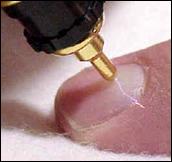 |
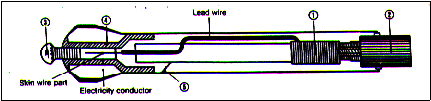 | The device works with a quartz crystal, much in the same way that a watch works. It needs no batteries, nor electricity. The unit should last 3 years, |
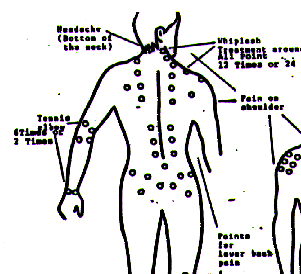
although it may last up to 10 years. Always clicking on a body part will let the unit last longer. Instead, clicking it into thin air will help dissipate the energy, and it will not last as long. Makers of the device claim it can relieve headache, low back pain, lost voice, shoulder pain, arm pain, knee and ankle pain, stiff shoulders, tiredness, sleeping problems, muscle aches, neuralgia, stress, insomnia, joint-pain or tennis elbow, as well as any other conditions of disease of the body. It is most effective for disorders of joints such as the knee, elbow or ankle. The effect of piezo devices includes to facilitate the circulation of the blood, to power up antiphlogistic as it increases the number of blood corpuscle, to resist inflammation - antiphogistic, to increase life power along with activated adrenal, to adjust an autonomic nerve system , and to encourage the recovery spontaneously from illness. |
EVIDENCE (OR LACK) OF SCIENTIFIC PRINCIPLES
According to Dr. Yamaguchi of Japan, the inventor of Piezo stimulator, electricity is being produced all over the body, from organs like the heart, the brain and each individual cell. Voltaic current is generated by muscular contractions, neural stimulation. ECG-electrocardiogram and brain waves tests utilize the method of testing the voltaic current generated by the body. Electric phenomenon of man and animals is called bioelectricity which is so faint that you could hardly feel it. Although it cannot be easily felt, bioelectricity is playing a very important role in maintaining human life.
It stands to reason that stimulation by weak voltaic current is most fundamental and effective for everyday life activity and Chinese acupuncture treatment is based on this principle. Upon physical stimulations like piercing with needles, bioelectrical charge can be stimulated areas and electric current will be generated. Using this method, various diseases like low back pain, numbness and stiff shoulders could be cured. The Piezo stimulator is based on the electric current principle.
The PIEZO-DX Quartz Crystal Stimulator is a kind of acupuncture without needle. That is, it is based on the acupuncture principle. Though acupuncture is widely used for treatment, convincing scientific evidence for its efficacy is lacking. It's not even clear that acupuncture is all that effective in treating pain, its most basic use. Acupuncture is not routinely used as an anesthesia substitute in China; reports to the contrary in the early 70s were based on observation of surgical patients who'd been selected for high pain tolerance and who in at least some cases were secretly given morphine. At best acupuncture can be said to alleviate rather than eliminate pain, and even then we don't know whether it's blocking the pain pathway or simply having a placebo effect.
In 1996 the Food and Drug Administration declared that acupuncture needles were no longer experimental but would henceforth be considered standard medical equipment, along with syringes, trusses, and arch supports. In 1997 a conference sponsored by the National Institutes of Health concluded that acupuncture was sufficiently effective to warrant increased use in clinical practice. However, part of the problem with acupuncture is the dopiness of the underlying theory. Traditional Chinese Medicine (TCM) holds that disease is the result of imbalanced qi, or vital energy. 'Qi' supposedly flows through the body in channels called "meridians," with branches to the various organs. Acupuncture, along with breathing exercises, "moxibustion" (burning of certain herbs placed on the body), etc., restores the body's yin/yang to equilibrium and ameliorates "channel obstruction," "blood stasis," organ "vacuity," and so on. Many acupuncturists accept the qi business at face value. But there's no scientific basis for it, and it's of little use even in the practical sense of telling you where to place the needles. One study of recommended treatment for lower-back pain in 16 traditional texts found that fewer than 20 percent of the "acupoints" were recommended by more than half the texts. Numerous articles and reports on acupuncture have appeared in the media over the years. Most, however, are limited to anecdotal reports and results of poorly designed case studies. Compared to herbs and supplements, there are relatively few properly designed trials of acupuncture.
 |
How acupuncture may relieve pain is unclear. One theory suggests that pain impulses are blocked from reaching the spinal cord or brain at various "gates" to these areas. Another theory suggests that acupuncture stimulates the body to produce narcotic-like substances called endorphins, which reduce pain. Other theories suggest that the placebo effect, external suggestion (hypnosis), and cultural conditioning are important factors. Melzack and Wall note that pain relief produced by acupuncture can also be produced by many other types of sensory hyper stimulation, such as electricity and heat at acupuncture points and elsewhere in the body. They |
conclude that "the effectiveness of all of these forms of stimulation indicates that acupuncture is not a magical procedure but only one of many ways to produce analgesia [pain relief] by an intense sensory input." In 1981, the American Medical Association Council on Scientific Affairs noted that pain relief does not occur consistently or reproducibly in most people and does not operate at all in some people. |
The makers of the device claim that 'By simply clicking the Piezo on any part of the body, (ie. around a painful muscle or area of the body), 2, 3, 7 or 10 or more times... you are bound to hit some of the acupuncture meridans...', 'But for the piezo to work...just click on the body 3- 20 times, and lots of times, you get results. Because, it's bound to hit at least one of the important meridians...' This apparently shows that the maker itself does not have a clear picture of where and how many times exactly the device should be used. It is simply some kind of trial-and-error, which can hardly convince people of its effectiveness. It also claims that 'They say it's sort of cumulative.... in that if you have a pain, and 20 clicks gets it to feel less painful or go away... and then it comes back in an hour... another session of clicks may make the pain go away for maybe 2 or 3 hours instead of 1. And then... after a few months, you may not need to use it but every 2-4 weeks.' This shows that the device cannot effectively relief the pain, since it needs such a long 'cumulative' time to really have significant cure at the pain.
Successful quack medical devices inspire copycats. The commercial success of 'the Stimulator' has helped to promote the Acupoint Pulse Stimulator, the Piezo-DX Quartz Crystal, and the Crystaldyne Pain Reliever. 'The Stimulator' is essentially an electric gas barbecue grill igniter outfitted with finger grips which had been proven by FDA as a medical quackery. The PIEZO-DX Quartz Crystal Stimulator works very similarly as 'the Stimulator', which makes its efficacy remains doubtful. Secondly, the piezo stimulator is claimed to be able to cure a long list of diseases, yet the maker does not show any scientific study that proves the claim. They only use a lot of testimonials from individuals to back them up.
POTENTIAL HAZARDS TO THE USER
By applying small electric pulses into human body, there will not be any adverse effects. Besides, the frequency of the electric pulse will not be large enough to give any effects because a pulse will only be generated with each push of the stimulator button by the user. The user will not be fast enough to generate a high frequency pulse.
According to the principles of acupuncture, if the patient is over stimulated, then this may cause a temporary worsening of the condition. Since the stimulator is based on the principles of acupuncture, and it requires the user to push down 16-20 times (sometimes even more) at the general area of pain until the user hits the acupuncture points. So, the possibility of the user of getting over stimulated is there.
The stimulator claims to relieve pain. For instance, headaches, migraines, painful joints, stiff joints, swollen joints, Sciatica, shoulder pain, back pain, Arthritic pain, TMJ, neck pain, heal spurs, menstrual cramps, muscle strain, abdominal pain, allergies, numbness and tingling, foot cramps, and Carpal Tunnel. It may cause the patients refuse to receive medical treatments because they believe the stimulator will help them. For example, headache might be caused by brain tumor. If the patient uses the electric pulse to stimulate the acupoints around his head by following the instruction given, it will be hazardous. The stimulation of the point will usually makes the condition worse.
RECOMMENDATION OF USE AND COMMENTS
The energy stimulator seems very convincing and efficient in pain relieving. It employs the principles of Acupuncture. The electric pulse weaves its way through the network of the meridians and restores the harmonious flow of energy between the various organs, the nervous systems, the blood and the vital energy. Illness may have two sources. One at meridian level where it�s superficial and where it can be easily corrected, or in the organ itself where additional treatment by western methods should be adopted. However I do not recommend patients to use this product because of the reasons as follows. Most of the reasons given will base on the acupuncture principles and theories.
First of all, the cost of the stimulator is expensive which ranges from $40 to $110 and this medical device is not effective. The manufacturer keeps on emphasizing that the stimulator employs the principles of acupuncture. It is using electrical stimulation. It is impossible to be dogmatic about the use of electrical stimulation as so much work is being done in the area at the moment. However, in general the stimulator is used in anesthesia and when it is used therapeutically for conditions of severe pain, acute conditions, scalp acupuncture and conditions where ordinary needling has failed. The practitioners do not use it very much for treating disease. According to acupuncturists, needle is the most effective way. Massage, various types of electrical stimuli, mechanical vibrators, heating, magnetic oscillators are not quite as effective.
Besides, in acupuncture, the points are widely distributed over the body surface. The effectiveness of treatment is directly dependent on precision and skill in locating these points. The only importance in acupuncture is to stimulate the right place. At any particular juncture, of all the 1000 or so acupuncture points possible to choose form there are about 50 which if stimulated will help the patient. On the contrary, there are about 50, which, if stimulated, will make the patient worse (certain of them even grievously ill), while remaining 900 or so are more or less neutral. The practice of acupuncture closely resembles the practice of medicine in that the acupuncturist must base his decisions on the physical makeup of the patient and the nature of the illness: severe or mild, acute or chronic. Curative combinations of points must be selected. Imaging the user of the �Stimulator� does know about the points, and he keeps on pushing the button in order to stimulate the right place. He can go on and on until he feels that he has hit the �point� around the pain area. Meanwhile, he might hit the wrong point or he may over stimulate the points unconsciously. Will there be any adverse effects of stimulating the wrong points? We do not know.
Just give an example on the treatment of headache, which I adapted from a book on acupuncture. According to oriental medicine, headaches may be due to exogenous factors such as wind and heat, or wind and cold. They can also be caused by endogenous factors such as hyperactivity of yang of the liver. Excess anger depresses the qi of the liver and causes ascent of fire, giving rise to headaches. There may also be xu or deficiency of blood. This causes headaches because the brain has an inadequate circulation of qi and blood. Different points correspond to various symptoms. For a frontal headache: use Yang Bai and Yin Tang. For a migraine: use the tender points on the gull bladder channel, TaiYang (extra), Touwei and Shuaigu. It is obvious that the right points are not necessary located near the area of pain. So, by applying electrical pulse at the pain area will not necessary work.
Moreover, harm can also ensue if the user does not note the alterations in the pulse, after the point is stimulated, showing that the patient is responding to the stimulus in the correct manners. Not everyone has the knowledge on this matter. So, it is not advisable to use the stimulator.
Finally, we have to realize that the acupuncture involves complex laws and techniques of the therapy. The stimulator uses those laws. So, will it work in such a simple way? I personally do not think so. One thing for sure, if it is used incorrectly, it may, as many methods, no help to relive pain, but actually cause it.
Recently, the Food and Drug Administration has been receiving inquiries and consumer complaints about the Stimulator which has been widely promoted for relieving pain and treating a variety of other medical problems. We cannot be sure whether this product has been approved by the FDA because the manufacturers, however, have not complied with any FDA regulations that govern the marketing of medical devices still sell it on the market. ( Note: this product is in the market of USA)
Manufacturer
MOMENTUM98
3509 N. High St., Columbus, Ohio 43214
phone 800/533-4372 (800/533-HERB) or 614/262-7087
fax: 614/262-0532
e-mail: [email protected]
hyperlink:http://www.momentum98.com/index.html
REFERENCES
Skrabanek P. Acupuncture: Past, present, and future. In Stalker D, Glymour C, editors. Examining Holistic Medicine. Amherst, NY: Prometheus Books, 1985.
Wells D. Think acu-practic: Acupuncture benefits for chiropractic. Journal of the American Chiropractic Association 35(3):10-13, 1998.
Tang J-L, Zhan S-Y, Ernst E. Review of randomised controlled trials of traditional Chinese medicine. British Medical Journal 319:160-161, 1999.
Streitberger K, Kleinhenz J. Introducing a placebo needle into acupuncture research. Lancet 352:364-365, 1998.
Vincent C. The safety of acupuncture. BMJ 323:467-468, 2001. Acupuncture needle status changed. FDA Talk Paper T96-21, April 1, 1996
White A and others. Adverse events following acupuncture: Prospective surgery of 32,000 consultations with doctors and physiotherapists. BMJ 323:485-486, 2001.
MacPherson H and others. York acupuncture safety study: Prospective survey of 24,000 treatments by traditional acupuncturists. BMJ 323:486-487, 2001.
Vincent C. The safety of acupuncture. BMJ 323:467-468, 2001.
Acupuncture needle status changed. FDA Talk Paper T96-21, April 1, 1996
Sampson W and others. Acupuncture: The position paper of the National Council Against Health Fraud. Clinical Journal of Pain 7:162-166, 1991.
Acupuncture. NIH Consensus Statement 15:(5), November 3-5, 1997.
Sampson W. On the National Institute of Drug Abuse Consensus Conference on Acupuncture. Scientific Review of Alternative Medicine 2(1):54-55, 1998.
CONSUMER ALERT ON THE STIMULATOR
www.fda.gov/bbs/topics/ANSWERS/ANS00817.htmlSCHEME TO SELL GAS GRILL IGNITERS FOR PAIN RELIEF BACKFIRES...
www.fda.gov/bbs/topics/answers/ANS01059.html"Acupuncture, Qigong, and "Chinese Medicine" by Stephen Barrett, M.D.
The Twelve Primary Qi Channels by Yang, Jwing-Ming
An FDA Guide to Choosing Medical Treatmentsby Isadora B. Stehlin
Your localBetter Business Bureau
Your regional FDA office or e-mail the Washington DC office.
How to Spot Health Fraud by Paula Kurtzweil
The consumer protection office within your state government. In Minnesota, this department is within the State of Minnesota Office of the Attorney General
Our Quack Links - especially the Contemporary Quackbusters.
FDA Investigators' Reports--July-August 2000 FDA Consumer
www.fda.gov/fdac/departs/2000/400_irs.html [ More results from www.fda.gov ]FDA Update
www.mdiconsultants.com/FDA/fda_update-Dec_4_00.htm