



The Medical "Air Cleaner"
"Negative Ion Generator"
 |
|
 |
|
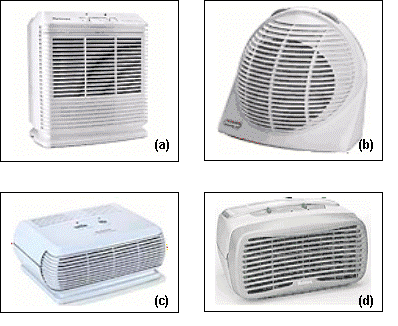
Figure 1: Different types of negative ion generator. |
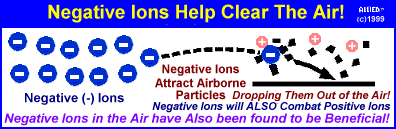
The principle of operation of negative ion generators is similar to electrostatic generators such as VandeGraaff or Wimshurst machines but the ion generator's high voltage ("static electricity") is created with electronics rather than with moving parts. Negative ions are emitted from small, sharp needles and bond with pollutants or microscopic particles floating in a room, magnetically attract them back to its positively charged center collection band and fall to the floor where they can be vacuumed up.
 |
|
Figure 2: Figure taken from an advertisement web page |
Manufacturers claim that negative ions can improve psychological and physical well-being. Some of the claimed benefits are:
Effectiveness for allergies and asthma by removing solid pollutants such as pollen, down, smoke, chemical fibers and dust.
Substantially reduces the airborne bacteria count by halting the growth of bacteria, staphylococci, and fungi.
Helps concentration, alertness and overall mental functions and relieves irritability, depression, weather-related problems and other mental disorders by balancing serotonin in the body. There are also claims of negative ions effectiveness for sleeplessness and tension, and even as a substitute for tranquilizers.
Helps improve the body's pH and hormonal balance as well as detoxify the body.
Builds the human immune system and reduces susceptibility to colds and flu.
Makes nutrients more available to the body, especially vitamins C and B complex.
Increase lung capacity by cleaning the cilia (microscopic hair in the windpipe), which filter air that enter the lungs.
EVIDENCE (OR LACK) OF SCIENCTIFIC PRINCIPLES
Scientific evidence points to the ineffectiveness of negative ion generators in improving air quality. Daniell et al. [1] conducted a study examining the effects of a "negative ion-generator" device on air contaminants and symptom reporting in two office buildings. No detectable direct or residual effects of negative ion generator use on air ion levels, airborn particulates, carbon dioxide levels, or symptom reporting were noticed.
Zylberberg et al. [2] and Jones et al. [3] have refuted claims that negative ion generators help asthmatics.
For ion generators that do not trap the charged particles, experiments show that free charged particles are deposited in the respiratory tract when inhaled and the particle deposition increases linearly with charge. Therefore, the use of ion generators may not reduce the dose of particles to the lung [4].
Manufacturers' claims to the effectiveness of ion generators are mostly based on testimonials from the public and paragraphs taken from the book "The Ion Effect" by Fred Soyka (1991, published by Bantum Premium, U.S.). However, these claims cannot be taken seriously as the public may be susceptible to the placebo effect and the book is not impartially or scientifically written, and did not provide proper references.
Although there are literatures (e.g. [6]) that support the use of negative ion generators, there are still insufficient well controlled and valid scientific studies to assure their effectiveness as a method of disease treatment.
POTENTIAL HAZARDS TO THE USER
Ozone Emission
Ion generators introduce negatively charged ions into the air. However, whenever an electrical discharge takes place in the air, ozone, a toxic gas, is produced.
The US Food and Drug Administration (FDA) requires ozone output of indoor medical devices to be no more than 0.05 ppm (parts per million) while the US Environmental Protection Agency (EPA)'s National Ambient Air Quality Standard for ozone is a maximum 8 hour average outdoor concentration of 0.08 ppm.
The potential health effects from exposure to ozone are:
Decreases in lung function
Aggravation of asthma
Throat irritation and cough
Chest pain and shortness of breath
Inflammation of lung tissue
Higher susceptibility to respiratory infection
Manufacturers claim very small amounts of ozone emission by their products. Still, improperly maintained units can produce high levels of ozone. Some products even deliberately emit a fair amount of ozone to facilitate removal of harmful gases. Results of one study to ascertain the safety of an ion generator indicate that the tested ion generator potentially elevate the user's exposures to ozone levels greater than the health-based air quality standards for outdoor air in California(0.09 ppm, 1 hour average) and the EPA (0.08 ppm, 8 hour average)[5].
RECOMMENDATION OF USE
The FDA considers negative ion generators misbranded until the medical claims can be supported with well-controlled and valid scientific studies. The FDA also asks for verification to the absence of, or very low levels of ozone production by negative ion generators claimed by manufacturers.
The Asthma Foundation of Victoria, Australia (www.asthma.org.au) does not recommend the use of negative ion generators, and warns of the dangers of ozone. The EPA advises the public to use proven methods of controlling indoor air pollution such as pollutants source control and ventilation and only to use ion generators as an adjunct to source control and ventilation.
Still, if consumers decide to use a negative ion generator, they should take the following precautions:
Check product's specifications to determine their compliance with established safety standards. The FDA prohibits the production of more than 0.05 ppm (parts per million) of ozone. Negative ion generator with higher voltages and low current to reduce the production of ozone are currently available.
Account for maintenance costs, such as costs for the replacement of filters, in addition to the initial cost of purchase because maintenance costs can be significant.
Follow the safety guidelines provided by manufacturers because ion generators involve high voltages and improper installation or maintenance can produce high levels of ozone.
There is a potential for soiling of walls and other surfaces, especially from the use of ion generators without a filter to attract the charged particles back to the unit. This is because ion generators are generally designed not to remove particles from the air but to deposit them on surfaces around the room. Consumers should be careful when a product is claimed to provide suspiciously too many health benefits. They should also go seek medical attention when there is a health problem and not fully rely on ion generators as a method of treatment.
REFERENCES
[1] | Daniell W, Camp J, & Horstman S. Trial of a negative ion generator device in remediating problems related to indoor air quality. Journal of occupational medicine. 1991 June. 33(6):681-77. |
[2] | Zylberberg B, & Loveless M.H. Preliminary experiments with ionised air in asthma. Journal of Allergy. 1960. 99 30-4. |
[3] | Jones D.P., O'Connor S.A., Collins J.V., & Watson B. W. Effects of long-term ionised air treatment of patients with bronchial asthma. Thorax 1976,31. p42~32. |
[4] | Offermann FJ, Sextro RG, Fisk WJ, Grimsrud DT, Nazaroff WW, Nero AV, Rezvan KL, Yater J. 1985. Control of respirable particles in indoor air with portable air cleaners. Atmospheric Environment 19(11): 1761-1771. |
[5] | T.J. Phillips, D.P. Bloudoff, P.L. Jenkins, & K.R. Stroud. Ozone emissions from a "personal air purifier. Journal of Anal Environ Epidemiol. 1999 Nov-Dec. 9(6):594-601. |
[6] | M Terman, JS Terman. Treatment of seasonal affective disorder with a high-output negative ionizer. J Altern Complement Med. 1995 Jan; 1(1): 87-92. |
[7] | US Environmental Protection Agency (EPA). |
[8] | US Food and Drug Administration (FDA) |
[9] | The Allied Enterprises, 1998-2001migro.com |
[1] | AMCOR air purifier and ionizer |
[10] | ALL ELECTRONICS CORP. |
[11] | Pure n Natural Systems, Inc. |
[12] | ControlSupply.com |
[13] | electrocorp. 1996-2002 |
[14] | Allied Technologies, � 1998-2002 migro.com |
[15] | Michigan Mineral, Michigan Mineral Water and Watershed Inc. The Clairity CN-11 High Density Negative Ionizer. 1997 |
[16] | What negative ions can do for you |