



GLUCOSE MONITORING DEVICE
"THE GLUCOWATCH �BIOGRAPHER"
 |
|
 |
DIABETES OVERVIEW
Diabetes is a chronic disease characterized by the body's inability to produce or properly use insulin, a hormone that is needed to convert sugar, starches and other food into energy needed for daily life.
Without proper management of the disease, diabetes can lead to severe long-term health complications, including blindness, kidney disease, heart disease, and nerve damage, potentially leading to amputation. Diabetes is a leading cause of death in the U.S., and the complications of uncontrolled diabetes result in nearly $100 billion in medical costs annually. Published studies demonstrated that frequent glucose monitoring, together with appropriate insulin adjustments, reduced several long-term complications of diabetes.
Due to the pain of traditional blood glucose monitoring and the associated disruption of daily life, most people with diabetes currently test their glucose levels less often than their caregivers recommend. This means they possibly miss revealing information about glucose levels at other important times, such as after meals or during sleep. The result is poor control of glucose levels, potentially leading to serious complications later in life and high health care costs.
Clearly an unmet need exists for ongoing, easily obtained and accessible information about glucose levels. To address this unmet need, Cygnus has developed the GlucoWatch? Biographer, the first and only monitoring system that provides glucose readings automatically and non-invasively, up to three times an hour, day or night.
THE GLUCOWATCH�BIOGRAPHER FROM CYGNUS, INC.
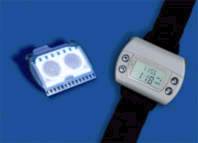
The GlucoWatch Biographer is a glucose monitoring device that is worn like a watch. Glucose readings are taken non-invasively through the skin. The Biographer provides automatic glucose readings as frequently as every 20 minutes for up to 12 hours at a time.
Every glucose reading is displayed to the wearer and stored in memory
A built-in alarm system can sound an alarm if glucose readings are too high, too low, or declining rapidly
The Biographer automatically creates an "electronic diary", storing up to 4,000 readings in memory
This device uses a very low electric current to pull glucose through the skin, where it is collected in two gel disks in an AutoSensor component. An electrode in the AutoSensor then measures the glucose level.
Many people with diabetes rely on taking a few finger-stick glucose tests throughout the day. The GlucoWatch Biographer does not replace finger-stick glucose testing, but can be used along with it to provide more frequent readings. This gives the user a better understanding of glucose levels during the day.
The unit stores up to 4,000 readings, which can be reviewed by the user to help detect patterns and trends in glucose levels, which may help them manage these levels more effectively.
The GlucoWatch Biographer is a prescription device that can be used awake or asleep by adults 18 or older with diabetes. It received FDA approval in March 2001, based on the clinical testing results presented by Cygnus. In September 2001 Cygnus submitted a supplemental pre-market approval (PMA) application to the FDA for use of the device by children and adolescents (ages 7-17) with diabetes, and in October 2001 the FDA granted expedited review status to this application.
"We believe the GlucoWatch Biographer will usher in a new era of glucose monitoring and thus improved ability for patients and their doctors to manage diabetes," said John C Hodgman, chairman, CEO, and president of Cygnus.
Operation/Features
The GlucoWatch Biographer uses technology that has never been available before, differing from conventional blood glucose testing devices in several ways. Most significantly, it is non-invasive, measuring glucose collected through the skin, not from blood. It measures and displays glucose levels automatically, as often as every 20 minutes, for up to 12 hours. It also creates an "electronic diary," storing up to 4,000 values that can be reviewed at the touch of a button, helping to detect trends and track patterns in glucose levels. In addition, users can set personal glucose alert levels so that an alarm sounds if readings are too high or too low. With the GlucoWatch Biographer, people with diabetes have access to additional information that may help them make better-informed decisions about diet, medication and physical activities. This may eventually lead to a better quality of life and lower health care costs. The GlucoWatch Biographer is not intended to replace the common "finger-stick" testing method, but is indicated as an adjunctive device to supplement blood glucose testing to provide more complete, ongoing information about glucose levels.
The GlucoWatch Biographer will offer the following unique combination of features:
Non-invasive, automatic and frequent measurements
Alerts for high and low glucose levels
Upward and downward trend indication
Event markers to record seven different activities (e.g., meal, insulin)
Programmable display in 14 languages
Discreet, portable device
Time and date default display
The GlucoWatch Biographer system has two main parts:
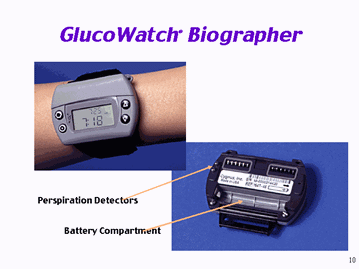
The GlucoWatch Biographer is worn like a watch. It calculates, displays, and stores glucose readings.
The AutoSensoris a single-use component that can provide readings for up to 12 hours. It snaps into the back of the Biographer and adheres to the skin.
 |
 |
This diagram shows the multiple layers that make up the AutoSensor.
The base is a plastic tray that snaps into the back of the biographer. A series of electrodes are screen-printed on a plastic sheet that is anchored to the tray. Two hydrogel collection discs are contained in an adhesive pad that makes up the outer layer of the AutoSensor. Removable protective liners are placed in-between the electrodes and the adhesive pad, and on the outer skin-contacting surface of the adhesive pad.
The GlucoWatch Biographer measures glucose collected through the skin, not from blood like standard glucose testing meters. It uses a process called reverse iontophoresis to collect glucose samples through intact skin. This means that an extremely low electric current is applied, which draws interstitial fluid (the fluid around the body's cells) through the skin. The glucose in this fluid is then collected in a gel that is part of a single-use AutoSensor. A chemical process then occurs. This generates an electrical signal, which is converted into a glucose measurement. This measurement is then displayed on the GlucoWatch Biographer and stored in its memory.
 |
This entails the application of a low level electric current across intact skin.
In response to this current, charged ions move through the skin towards the anode and cathode. Glucose and other neutral species are transported by convective or electro osmotic flow and are collected primarily at the cathode. Relative to a blood glucose meter, this procedure results in a lower glucose concentration but in a much cleaner sample.
Only small compounds pass through the skin, and many potentially interfering species are collected predominately at the anode because they are negatively charged. The biographer glucose readings are based only on the signal generated at the cathode.
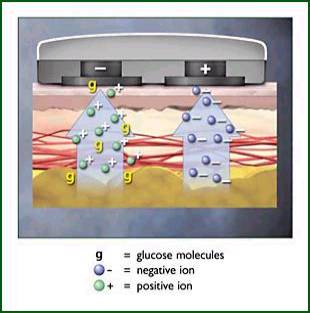
The glucose is collected in the gel collection discs, which consist of a hydrogel matrix containing the enzyme glucose oxidase. Using conventional electrochemical detection, the collected glucose reacts with oxygen to form hydrogen peroxide and gluconic acid. When the platinum biosensor is activated, the hydrogen peroxide reacts and releases two electrons, which are measured by the biosensor. Thus, one molecule of collected glucose yields one molecule of hydrogen peroxide and, subsequently, two electrons, which are measured by the device.
Before this can take place the device has to go through a three-hour warm-up period to ensure that it is correctly calibrated. The device must also be calibrated against a finger prick blood test each time a new AutoSensor is used. The AutoSensors must be replaced every 12 hours to ensure continued accuracy and the GlucoWatch Biographer must then go through the three-hour warm-up period again. The finger prick is vital to calibrate the device each time. Without proper calibration the device will not be able to give readings.
During each 10 minutes testing period, the Biographer spends 3 minutes absorbing glucose and 7 minutes measuring its concentration. The reading displayed is derived from two samples and computed by comparison with a "finger-stick" blood sample which must be taken each time the device is worn.

Accuracy
The GlucoWatch Biographer has now obtained both FDA approval (the body that looks at the safety of medical devices in the USA) and has had a CE mark since 1999, which allows it to be sold in the European Union. This approval has involved the consideration of studies on the accuracy of the GlucoWatch Biographer. Published studies show general consistency between readings from the GlucoWatch Biographer and blood glucose measurements using finger prick blood samples. However, it was found that up to 25 per cent of the time, the results differed by more than 30 per cent.
It is recommended that people should never decide to alter their medication based on a GlucoWatch Biographer reading without doing a finger prick test to double check the result. Some concern has also been expressed that the device is better at detecting high levels rather than lows, and further post marketing research is likely.
As with all blood glucose monitoring devices, the GlucoWatch Biographer will only give accurate readings if it is used properly. If it is not correctly calibrated or the AutoSensor is not in proper contact with the skin, results may be less accurate. Other factors, such as excessive hairiness or movement in the wrists may also invalidate results. Excessive perspiration will be detected by the GlucoWatch Biographer and indicated on the display. As this can be due to hypoglycaemia, an alarm will sound. Glucose monitoring will resume when skin returns to normal.
Advantages
The GlucoWatch Biographer is designed to enable adults with diabetes (age 18 and older), physicians and other caregivers to identify trends and to track patterns in glucose levels that would be difficult to detect with current testing techniques alone. The frequency of the automatic and non-invasive readings gives patients and their caregivers more complete information about glucose levels, allowing them to make better-informed decisions regarding diet, medication and physical activities. The GlucoWatch Biographer is not intended to replace the common "finger-stick" testing method, but is indicated as an adjunctive device to supplement blood glucose testing to provide ongoing information about glucose levels.
The GlucoWatch Biographer differs from other glucose measuring systems in several important ways. Most significantly, it is non-invasive, measuring glucose collected through the skin, not from blood. It measures and displays glucose levels automatically, as often as every twenty minutes, for up to twelve hours. It also creates an "electronic diary," storing up to 4,000 values that can be reviewed at the touch of a button, helping to detect trends and track patterns in glucose levels. In addition, users can set personal glucose alert levels. An alarm sounds if readings are too high or too low, or if readings decline rapidly.
Cost
At the moment it is very unlikely that the GlucoWatch Biographer will be made available on prescription, so anyone wanting to use it will have to pay for both the device and the AutoSensors. The current list price is ��350 for the GlucoWatch Biographer and ��50 for a box of 16 AutoSensors. The GlucoWatch Biographer is expected to last for about two to three years and the AutoSensors must be replaced every 12 hours.
Due to the cost, it is expected that people will not use the GlucoWatch Biographer every day but might use it at certain times, such as when driving, going on holiday or changing insulin regimes.
EVIDENCE (OR LACK) OF SCIENCTIFIC PRINCIPLES
One must still use a regular home blood glucose meter in the following situations:
To calibrate the Biographer each time a new AutoSensor is used. Calibration adjusts the Biographer for the selected skin site
To confirm Biographer readings before taking an insulin dose and when your symptoms do not match Biographer readings. The Biographer may not detect every instance when glucose levels are too high or too low
To monitor the blood glucose as directed by your diabetes care team. Since the Biographer is not designed to replace your regular blood glucose meter, never change how often you do finger-stick tests without first talking to your diabetes care team.
POTENTIAL HAZARDS TO THE USER
In clinical trials involving over 25,000 hours of use, the GlucoWatch Biographer was shown to be safe and generally well tolerated. Most patients experienced temporary irritation where the GlucoWatch Biographer was in contact with the skin. This usually mild irritation typically subsided within a few days.
Few complaints were reported recently. "The rash came up for me a couple of days later and took up to ten days to heal," said one of the users. Also it skips readings with the slightest disturbance in terms of change in temperature, perspiration and even using mobile phone in the same hand as you are wearing the watch. The warm up period is not 3 hours as they say, it is 3 hours then it is ready for calibration which takes a further 20 minutes if you get it right first time.
RECOMMENDATION OF USE
Due to the pain of traditional blood glucose monitoring and the associated disruption of daily life, most people with diabetes currently test their glucose levels less often than their caregivers recommend. The result is poor control of glucose levels, potentially leading to serious complications later in life and high health care costs. With the GlucoWatch? Biographer, that provides glucose readings automatically and non-invasively, up to three times an hour, day or night, diabetic patient can manage these levels more effectively. However, several modifications have to be made in order to reduce the allergy to the skin. As we know that diabetic patient have very sensitive skin. Besides that the the GlucoWatch? Biographer must be designed not to be sensitive with the disturbance in terms of change in temperature, perspiration and even using mobile phone. These might cause an inaccurate reading. It is recommended that people should never decide to alter their medication based on a GlucoWatch Biographer reading without doing a finger prick test to double check the result.
CONCLUSION
The GlucoWatch biographer provides frequent measurements of glucose over a 12-hour period with good clinical accuracy. It can detect trends and track patterns in glucose levels in diabetic subjects with diverse demographic characteristics. The GlucoWatch biographer should facilitate improved diabetes management by the diabetic patient and caregiver.
REFERENCES
http://www.diabetesstation.org/notes/notes_0801.htm
http://www.hbcollege.com/chem/biochem/GarrettGrisham/HotTopics/GlucoWatch/GlucoWatch.html
http://www.diabetesnet.com/news/news120599.html
http://www.glucowatch.com/us/default.html
http://www.saludytecnologia.com/articulos/99183319639845.html
http://www.diabetesinterview.com/archive/may01/may1-01.shtml
http://www.uic.edu/classes/bioe/bioe550/jamie/Future.htm
http://www.fluent.com/solutions/examples/x17.htm
http://www.diabetesliving.com/manage/glwatch.htm
http://www.mendosa.com/meters.htm
http://www.publinet.it/diabete/news/n81.html
http://www.cwdfoundation.org/gluco.html
http://www.space.com/businesstechnology/technology/space_gear-7.html
www.childrenwithdiabetes.com/d_06_e30.htm
www.cygn.com/monitor/diabetes.html
www.medforum.nl/reviews/evaluation_of_the_glucowatch_biographer.htm