 |
 |
 |
 |
 |
 |
 |
 |
 |
Icons Of Pride

These select icons are widely used in our community. They help identify, protect, and even remind us of what and who we are. Being Gay or Lesbian has never been easy, but it has been worse. Will there ever be a time when these symbols are not needed? Maybe when the world accepts us for who we are. Until then, these icons and symbols will act as our guides.
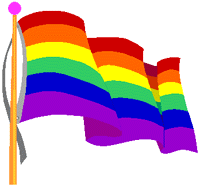   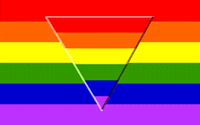 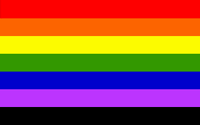 > |
Use of the rainbow flag by the gay community began in 1978 when it first appeared in the San Francisco Gay and Lesbian Freedom Day Parade. Borrowing symbolism from the hippie movement and black civil rights groups, San Francisco artist Gilbert Baker designed the rainbow flag in response to a need for a symbol that could be used year after year. Baker and thirty volunteers hand-stitched and hand-dyed two huge prototype flags for the parade. The flags had eight stripes, each color representing a component of the community: hot pink for sex, red for life, orange for healing, yellow for sun, green for nature, turquoise for art, indigo for harmony, and violet for spirit. The next year Baker approached San Francisco Paramount Flag Company to mass-produce rainbow flags for the 1979 parade. Due to production constraints -- such as the fact that hot pink was not a commercially-available color -- pink and turquoise were removed from the design, and royal blue replaced indigo. This six-color version spread from San Francisco to other cities, and soon became the widely-known symbol of gay pride and diversity it is today. It is even officially recognized by the International Congress of Flag Makers. In 1994, a huge 30-foot-wide by one-mile-long rainbow flag was carried by 10,000 people in New York's Stonewall 25 Parade. The Victory Over AIDS Flag modifies the rainbow flag by adding a black stripe at the bottom. Suggested by a San Francisco group, the black stripe commemorates those we have lost to AIDS. Sergeant Leonard Matlovich, a much-decorated Vietnam Veteran dying of AIDS, proposed that when a cure is eventually found the black stripes should be removed from all the flags and ceremoniously burned in Washington, D.C. |
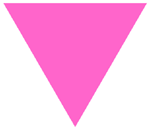
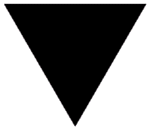
The pink triangle is easily one of the more popular and widely-recognized symbols for the gay community. The pink triangle is rooted in World War II times, and reminds us of the tragedies of that era. Although homosexuals were only one of the many groups targeted for extermination by the Nazi regime, it is unfortunately the group that history often excludes. The pink triangle challenges that notion, and defies anyone to deny history. The history of the pink triangle begins before WWII, during Adolf Hitler's rise to power. Paragraph 175, a clause in German law prohibiting homosexual relations, was revised by Hitler in 1935 to include kissing, embracing, and gay fantasies as well as sexual acts. Convicted offenders -- an estimated 25,000 just from 1937 to 1939 -- were sent to prison and then later to concentration camps. Their sentence was to be sterilized, and this was most often accomplished by castration. In 1942 Hitler's punishment for homosexuality was extended to death. Each prisoner in the concentration camps wore a colored inverted triangle to designate their reason for incarceration, and hence the designation also served to form a sort of social hierarchy among the prisoners. A green triangle marked its wearer as a regular criminal; a red triangle denoted a political prisoner. Two yellow triangles overlapping to form a Star of David designated a Jewish prisoner. The pink triangle was for homosexuals. A yellow Star of David under a superimposed pink triangle marked the lowest of all prisoners -- a gay Jew. Stories of the camps depict homosexual prisoners being given the worst tasks and labors. Pink triangle prisoners were also a proportionally large focus of attacks from the guards and even other inmates. Although the total number of the homosexual prisoners is not known, official Nazi estimates were an underwhelming 10,000. Although homosexual prisoners reportedly were not shipped in mass to the death camps at Auschwitz, a great number of gay men were among the non-Jews who were killed there. Estimates of the number of gay men killed during the Nazi regime range from 50,000 to twice that figure. When the war was finally over, countless many homosexuals remained prisoners in the camps, because Paragraph 175 remained law in West Germany until its repeal in 1969. In the 1970s, gay liberation groups resurrected the pink triangle as a popular symbol for the gay rights movement. Not only is the symbol easily recognized, but it draws attention to oppression and persecution -- then and now. Today, for many the pink triangle represents pride, solidarity, and a promise to never allow another Holocaust to happen again. Like the pink triangle, the black triangle is also rooted in Nazi Germany. Although lesbians were not included in the Paragraph 175 prohibition of homosexuality, there is evidence to indicate that the black triangle was used to designate prisoners with anti-social behavior. Considering that the Nazi idea of womanhood focused on children, kitchen, and church, black triangle prisoners may have included lesbians, prostitutes, women who refused to bear children, and women with other "anti-social" traits. As the pink triangle is historically a male symbol, the black triangle has similarly been reclaimed by lesbians and feminists as a symbol of pride and solidarity. |
    |
 |
The AIDS Awareness Ribbon, or red ribbon, is commonly seen adorning jacket lapels and other articles of clothing as a symbol of solidarity and a commitment to the fight against AIDS. The Ribbon Project was conceived in 1991 by Visual AIDS,a New York-based charity group of art professionals that aims to recognize and honor friends and colleagues who have died or are dying of AIDS. Visual AIDS encourages arts organizations, museums, commercial galleries, and AIDS support groups to commemorate those lost to AIDS, to create greater awareness of AIDS/HIV transmission, to publicize the needs of Persons With AIDS, and to call for greater funding of services and research. Inspired by the yellow ribbons honoring American soldiers of the Persian Gulf War, the color red was chosen for its "connection to blood and the idea of of passion -- not only anger, but love, like a valentine," as stated by Frank Moore of Visual AIDS. the Ribbon Project remains a powerful force in spreading awareness of AIDS and stressing the need for further action and research of the disease. The sincerest hope for the Ribbon Project is that it will one day no longer be needed. |
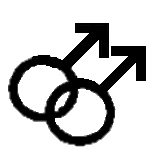
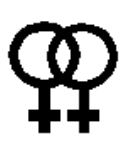
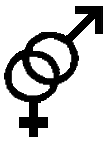
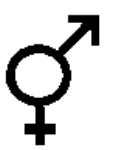
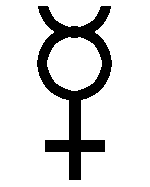
Gender Symbols are common astrological signs handed down from ancient Roman times. The pointed Mars symbol represents the male and the Venus symbol with the cross represents the female. Double interlocking male symbols have been used by gay men since the 1970s. Double interlocking female symbols have often been used to denote lesbianism, but some feminists have instead used the double female symbols to represent the sisterhood of women. These same feminists would use three interlocking female symbols to denote lesbianism. Also, some lesbian feminists of the 1970's used three interlocking female symbols to represent their rejection of male standards of monogamy. Also in the 1970s, gay liberation movements used the male and female symbols superimposed to represent the common goals of lesbians and gay men. These days, the superimposed symbols might also denote a heterosexual aware of the differences and diversity between men and women. A transgendered person might superimpose the male and female symbols in such a way that the arrow and cross join on the same single ring. The astrological sign of Mercury is traditionally the symbol of transgendered peoples. In Greek mythology, Hermes (the Greek version of the Roman god Mercury) and Aphrodite (the goddess of love) had a child named Hermaphroditus. That child possessed both male and female sexual organs, hence the term hermaphrodite. Also, rituals associated with the worship of Aphrodite are believed to have been highly sexual, involving castration, transvestism, and homosexual relations. In the symbol itself, the crescent moon at the top is supposed to represent the masculine, and the cross at the bottom represents the feminine. The ring represents the individual, with the male and the female balanced at either side. |
     |
 |
The lambda symbol seems to be one of the most controversial of symbols in regards to its meaning. There are several differing opinions as to why the lambda was chosen as a gay symbol and what it really means. However, most sources agree on a few things: The lambda was first chosen as a gay symbol when it was adopted in 1970 by the New York Gay Activists Alliance. It became the symbol of their growing movement of gay liberation. In 1974, the lambda was subsequently adopted by the International Gay Rights Congress held in Edinburgh, Scotland. As their symbol for lesbian and gay rights, the lambda became internationally popular. But where history ends, speculation begins. No one seems to have a definitive answer why the lambda was originally chosen as a gay symbol. Some suggest that it is simply the Greek lower-case letter l for liberation. Others disagree, lambda may also denote the synergy of the gay movement, the idea that the whole is greater than the sum of its parts. The lambda also may represent scales and balance, and the constant force that keeps opposing sides from overcoming each other -- the hook at the bottom of the right leg signifies the action needed to reach and maintain balance. The ancient Greek Spartans regarded the lambda to mean unity, while the Romans considered it "the light of knowledge shed into the darkness of ignorance." Reportedly, Ancient Greeks placed the lambda on shields of Spartan warriors, who were often paired off with younger men in battle. |
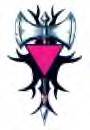
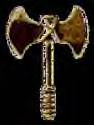
The labrys is a double-sided hatchet or axe commonly used in ancient European, African, and Asian matriarchical societies as both a weapon and a harvesting tool. Greek artwork depicts the amazon armies of Europe wielding labrys weapons. Amazons ruled with a dual-queen system in which one queen was in charge of the army and battle, and the other queen stayed behind to administer the conquered cities. Amazons were known to be ferocious and merciless in battle, but once victorious they ruled with justice. Today, the labrys is a lesbian and feminist symbol of strength and self-sufficiency. In addition, the labrys also played a part in ancient mythology. Demeter, the goddess of the earth, used a labrys as her scepter. Rites associated with the worship of Demeter, as well as Hecate (the goddess of the underworld), are believed to have involved lesbian sex. |
   |