Frightening Reality in a Fantasy World
By Carissa Creveling, 2003
(DISCLAIMER: Due to recent research and looking around, I can't credit any of the information in this report anymore. So, in other words, most of the presented "facts" are absolute crap. ^_^ Please don't take them for truth, and only read this as a piece of entertainment. I've found that I've been linked and ripped up and all sorts of things, and I apologize for any confusion that I've caused. Thanks! -Reesa)
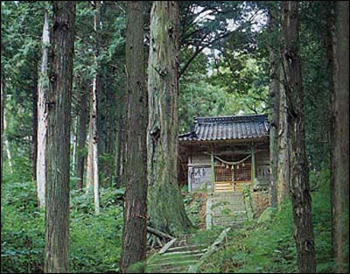
A small glimpse of the Himuro Mansion outside Tokyo, Japan.
Lately, videogames have been focusing on adrenaline-pumping action, stylized violence, and the most ridiculous and outrageous storyline (or a lack thereof) the creator can spend five minutes on. Chances are that such a game made as described above is worth playing only for a brief excitement. A game with an interesting and intricately woven tale behind it has become a rare, shining gem in a vast mud puddle of bland, vacuous concepts; though many fantasy games are exciting and well liked, sometimes a story based on a true account outshines any of its fantastic competition. Incorporating a mysterious reality into a videogame adds an enticing twist to the game�s storyline.
The main point of a videogame is to allow the player to experience adventures that are not possible, safe, or legal in real life. Although a smattering of life simulation games, such as The Sims and Animal Crossing, have been successful with the gaming population, basing a game on normal, every day occurrences and routines is unexciting to the player. Yet while gameplay relating to life should generally be avoided, the same does not go for the plot or backstory. Videogames based on true stories are few and far between, but most have been successful with gamers and done well on the market. One of the best examples of this is a survival-horror game called Fatal Frame, developed by the company Tecmo.
Fatal Frame is loosely based around the true story (and also the legends) surrounding Himuro Mansion in Japan. The Mansion is rumored to be the gruesome death site of a Japanese family and several of its associates a few decades ago. Tecmo took advantage of its horrifying reputation and put it to use in Fatal Frame, creating a morbid but compelling concept that drew gamers into a place they never would have thought existed in the recent world.
The Himuro family participated in a specific enigmatic Shinto ritual, dubbed the �Strangling Ritual ,� which was used to seal off bad karma from the Earth. The karma, called �Malice,� would emerge on a specific date near the end of the year from a portal in the Mansion�s courtyard. (�Coolmik� 20) In order to prevent this, a maiden was chosen at birth and isolated from the outside world to be raised as a sort of sacrificial lamb. This was done to prevent her, the �Rope Shrine Maiden,� from developing any ties to the outside world, which would ruin the ritual. Before the �Strangling Ritual�, another maiden would be chosen to perform the �Blind Demon Ritual� � tied down, her face would be forced upon a wooden mask with spikes where its eyeholes should be. (�CoolMik� 12) The relation of this practice to the main �Strangling Ritual� is not known but appears to be necessary for the latter to be successful.
After the proper time has passed for the �Rope Shrine Maiden� and the day of the �Strangling Ritual� comes, the �Rope Shrine Maiden� is bound by ropes on her ankles, wrists, and neck. The ropes are then tied to teams of oxen, which proceed to pull away from each other and the girl�s body, wrenching her limbs from her body. (�Coolmik� 9) It is not known whether she is dead before her limbs are severed; however, it seems logical that the rope around her neck would suffocate her, though she would be in excruciating pain until her neck broke or all the air was expelled from her body. The ropes used to bind her appendages would then be soaked in her blood and criss-crossed on the gateway of the �Malice.� Thus, the portal would be sealed for approximately seventy-five years before the ritual had to be repeated.
For generations, this tradition had been passed down through the Himuro family. The family master [the head of the household, usually a man] always oversaw the proceedings, doing tasks such as tying the ropes and blinding the �Blind Demon� himself. (�CoolMik� 7) He was assisted by the �Headless Priests� (usually the holy men of the neighborhood or relatives), who would hold the Maidens still and chant any incantations or words that had to be said to make the ritual legitimate. The family master was a man of honor, which was (and still is) typical in Japan.
However, the honor of the family master led to disaster. During the last recorded �Strangling Ritual,� it is said that the �Rope Shrine Maiden� caught sight of a man outside the Mansion several days before she was to perform the �Strangling Ritual.� She fell in love with him instantly, and her newfound tie to Earth tainted her blood and spirit; the Ritual and her sacrifice failed miserably. The master learned what had happened and lost his sanity. He went on a rampage throughout his Mansion, murdering his family members, the Priests, and any unfortunate soul who had been visiting him at the time. Shamed because of his failure to prevent calamity, he fell upon his own katana, committing suicide. (�CoolMik� 7) The Himuro family and the rituals it performed were now dead.
The local people of the neighboring town kept quiet about the story; the gruesome reality frightened them, and they were not eager to find out the details of the murders. Apparently, the rituals were kept very quiet; still today, efforts to find out more information about the family and its tragedy are put forth, but records are slim. A team of researchers was sent to the Mansion to obtain as much information as they possibly could, which is how a majority of the true story was uncovered. (�Fatal Frame backstory?� 4) The story itself was swathed in local legends and mysteries, leading people to believe that the vengeful souls of the murdered family wandered the Mansion, repeating the failed rituals to those who dared enter the abandoned edifice.
What is perhaps the most terrifying part of this story is that a majority of it is very true, including the ritual itself and the horrific murders. Any holes in the story have been filled in by local legend, by the people in the village in the vicinity of the Mansion, who do indeed attempt to ignore the stories of the malicious apparitions not far from where they live. The real Mansion itself now lies abandoned deep in a forest, miles outside Tokyo, where few dare venture inside it to find out whether the rumors are true. (Boulding 1)
So how did Tecmo translate this into a videogame? Being that the backbone of the story was already constructed for them once they found it, the team that made the game simply had to fill in any plot holes they came across and add in a few missing elements, such as characters and the gameplay part itself. They took painfully careful precautions to replicate the Mansion, both in the architecture itself and the general Japanese feel of the building. (Boulding 2) Looking at genuine photographs before playing the game, one may recognize more than one area of the Mansion to be the same as in the photographs. Small trails of blood may be found scattered across the floor as one wanders through the game, identifying with the spatters discovered by researchers years after the murders had taken place.
Tecmo also used other local legends and superstitions to elaborate upon the horrors of the Himuro story. A pair of lovers used to meet at a tree outside the Mansion before the murders took place. The girl�s family told her she was not allowed to see her lover; she eventually hung herself from that very tree, torn between the honor of her family and her love for the boy she met with. After she hung herself, many accounts of car accidents and deaths were recorded near the tree. A local man who chopped down the tree years later died inexplicably, along with all the villagers with whom he had shared the wood. (Boulding 3) Many people who have wandered into the woods nearby have mysteriously disappeared, and have never been heard from again. A common superstition, that taking a picture of a person therein captures their soul, was turned into the main point of the game; this is where the idea of the main character of Fatal Frame using nothing but a camera to ward off spirits originated.
After figuring out the main background of the game, all Tecmo had to do was create characters, a situation as to why these characters would be associated with the Mansion, and how they would progress through the Mansion. This is the only fictional part of Fatal Frame � a majority of the characters involved and their purposes, and the exorcism of the ghosts. Tecmo also included the obligatory puzzles, as well as taking pictures of spirits, as a means to progress through the game. (�Fatal Frame: The Story� 1) Even these, though, had elements of truth to them. Real researchers found the strange, bloodied Buddha statuettes and dolls used to pass from room to room in the game; severed heads, ropes, and other strange amulets were discovered throughout the Mansion, along with very bizarre and bloody Buddhist shrines. Another device used to progress through the game is taking pictures of perhaps a wall or a garden, in which absolutely nothing is happening. (Kuvin 2) This relates back to the superstition of capturing souls in a picture and also to another part of the Himuro past - often real photographs taken of such nondescript objects and places in the Mansion reveal a ghostly image of girl in white, who is believed to be the �Rope Shrine Maiden� who failed her task decades before.
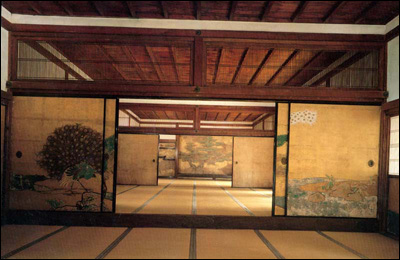
A real photograph of a hallway of the Mansion; it is a very memorable hallway in the game, as well.
Put all these details together and one has a truly terrifying videogame experience. Fatal Frame has been acclaimed as the scariest game ever made, beating out other reputable horror games such as the Silent Hill and Resident Evil series. These other games are filled with twisted concepts themselves and are extremely scary in their own right, but are chock-full of automatic machine guns and many other violent weapons for the player to bring down his ghastly opponents. Guns are often a sign of security and have become a staple in the survival-horror genre of videogames, but Tecmo�s decision to make the main weapon in Fatal Frame something as mundane as a camera makes the player feel less secure and more helpless. (Kuvin 3) This adds to the frightening atmosphere of the game, compelling more people to play it.
Fatal Frame was definitely the sleeper hit of 2002; it received rave reviews from thousands of contently terrified fans and professional game journalists. (Kuvin 4) The intriguing story of the Mansion in the game generated interest in the legends of the family and the bizarre rituals they practiced, and friends drove friends to play the game so they could also experience the chilling tale of the Himuro family. Tecmo has done an outstanding job of tying together a discrete Japanese legend and story with believable characters and a unique style of gameplay, leading to a new and exceptional use of the �based on a true story� subtitle to create Fatal Frame.
Works Cited