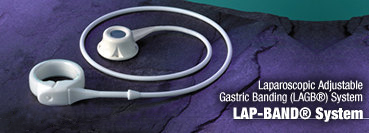
| The LapBand was invented by two doctors, one from Sweden and the other from the US. It is the most widely used weight loss surgery (WLS) in Europe by far, and has been used there for ten years with excellent results. Excellent results would be defined as optimum weight loss at a stable rate, weight kept off in the long-term, minimal complications, if any, and patients who are able to live normal, healthy lives. The LapBand allows the patient to feel full after ingesting a small meal, and it offers a feeling of satisfaction that often eludes obese people. Patients must adjust their lifestyle to insure that their protein and fluid intake is sufficient and they must exercise regularly if the band is to work. So the LapBand is not for patients who are unwilling to "work" the band. Part of this involves avoiding high-calorie foods that move through the pouch easily, such as milkshakes and ice cream. Most patients cannot tolerate carbonated beverages after surgery, so this may be a consideration for some people. The device is a silicone band that is placed around the upper section of the stomach. This band is connected by a thin tube to a small port, which is attached just under the muscle/fat layers in the abdomen, usually below the left side of the ribcage, occasionally below the sternum. The port is used to access the band in the future, allowing the surgeon to add or remove saline solution, thereby increasing or decreasing the tightness of the opening of the pouch created at the top of the stomach. In the initial surgery, the band is placed unfilled, and later, gradual fills can bring the band fluid level up to a total of 4ccs. (Also note that there is a Swedish version of this band that holds more fluid, but "fills" can be harder to coordinate in the US.) Fills are usually done in the surgeon's office or a hospital, and are proceeded by a shot of lidocaine in the port area. The Doctor uses a special needle to access the port. Many doctors will then have a radiologist perform a fluoroscopy to make sure liquid moves through the stomach opening at an adequate rate. Fills are based on rates of weight loss. If the patient is losing 1-2 lbs per week, no fill is needed. If the patient has not lost any weight for 2-4 weeks, then a fill is called for (doctor�s opinions vary on this timeframe). This customization to each person's needs is a fundamental strength of the device. Website links on the LapBand Research Page offer diagrams of the device, its placement, and access to sites that offer greater explanation of this process. Several years ago the company that manufacturers the actual LapBand device, BioEnterics, began FDA trials in the US in order to get their procedure approved in this country. Many surgeons participated in the trials, and the FDA approved the device based on the results of these trials. Unfortunately, many weight loss surgeons have a negative view of this procedure, as it is still relatively new to them, and they are more likely to recommend the more dramatic WLS that they feel comfortable with (Roux-N-Y, Duodenal Switch, etc.). Unlike these drastic surgeries, the LapBand procedure is fully reversible should the patient change their mind or develop a complication that necessitates removal. The surgery is almost always done laproscopically, using four tiny incisions and one larger incision (approx. 2" long) for the port site. Most patients stay in the hospital for one to two days, and are advised to take two weeks off of work, although many people do not feel that they need this much time to recover. Some critics say that the LapBand does not yield good results, or that it is not suited to people who are morbidly obese and have very large amounts of weight to lose (BMI over 50). It is easy to dispute these claims however, with the phenomenal results of European patients for over a decade, the experiences of US patients who have skilled surgeons and a strong educational/support program, and the results reported by morbidly obese patients. Those patients who have had bad experiences with the band are usually found to have been given no support post-op, no advice on lifestyle changes, and/or their surgeons made errors when placing the band, causing complications for the patient. The ideal surgeon for LapBand placement is one who has extensive experience in the area of weight loss surgery and laproscopic surgery, who has had training through the BioEnterics mentoring program, and who has faith in the procedure/device. The top surgeons performing this procedure in the world are located in Italy (Favretti), Germany (Weiner), Mexico (Rumbaut, Ibarrola, and Kuri), and France (Frering). These are just a few surgeon�s names, and they are by no means the only ones. There are also many skilled surgeons in the US who have high success rates with the LapBand. See the Bandsters website for lists of surgeons. My surgery was performed by Dr. Mary Estakhri in Pleasanton, California (scroll down the page if using this last link). Many people find that their insurance companies are willing to cover this procedure fully or partially. Some companies simply refuse to cover any WLS. Your employer's policy may or may not cover WLS; research this first. If you are considering this surgery, you might use your open enrollment period to switch to a company that supports the procedure. More and more people are considering the LapBand as their only weight loss surgery option, as they do not wish to endure the highly invasive procedures that cut/rearrange the stomach and intestinal tract, and that require long recuperation periods. Also, most WLS are based on malabsorption (bypassing most of the intestines so that the body does not absorb calories from the food ingested), which can cause extreme health problems in the long- or short-term. These surgeries are not reversible, and a high percentage of patients require "revisions," additional surgeries to correct complications of their intestinal tract. There are many other side effects to these procedures, such as "dumping" (extreme cramping and diarrhea brought on by any type of sugar, and many other random foods), increased/uncontrollable gas, and stronger-smelling bowel movements. The rate of death is also higher for those who have these types of surgeries. The LapBand is a viable alternative for those who do not want to experience the aforementioned problems, and who wish to eat more normally. Please remember that you must feel 100% comfortable with the weight loss option that you choose, no matter what it is. I have the LapBand, and am obviously biased towards the procedure. It is vital that you do your own research before making your final decision. Do not let anyone, including your surgeon, push you into a procedure that you have doubts about. Your doctor is hired by you, to serve your needs. Interview more than one until you �click� with one. Surgeons are human, they have their own opinions and preferences that influence their recommendations to patients. Remember this when you talk to them. If you are not comfortable with them for any reason, just say thank you and move on. Be prepared, this is a long process that requires a great deal of work and introspection; as well it should. It is not to be taken lightly. I wish you the best, no matter what you decide. |
| General LapBand Information |
 |
 |
|