| Learning Your Notes |
| Sit in front of your piano. Look at all the keys. Notice that there are both black and white ones. It would be overwhelming to tell you that each of those keys has a name, and you need to learn all of them before you can even begin to play. But don't worry! Take a closer look. Do you notice a pattern in the sequence of the keys? Really, there are only seven white keys and five black ones that repeat themselves. Here is a diagram of a keyboard with the names of the notes on the keys. Compare this diagram to your keyboard. |
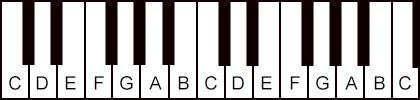 |
| Notice that the black keys are in between the white ones. Therefore the names of the black keys must have something to do with the white ones, right? Right! The black keys take on the name of the white key either to the left or right of it, making it either sharp or flat. For example, the black key to the right of C is C sharp, however, the same key is to the left of D, making it D flat. So this means that a black key can be either sharp or flat, depending on which note is used in your music. But what about E and F or B and C? There are no white keys between these notes! In this special case F becomes E sharp and E becomes F flat. Now we need to learn how to read these notes in music. |
 |
| Study this diagram. What does it look like to you? If you recognize this as the staff in the treble clef, you're on your way! You see, when writing music, it would be hard to write out diagrams of the keyboard, so this method of writing notes is used universally. The symbol at the far left of the staff is the treble clef. This means that most of the time the notes shown will be played with your right hand. For now, though, notes in the treble clef will be played with your right hand. Next to the treble clef are two numbers that indicate the time signature. This will be discussed in a later chapter. Next to the time signature comes your first note! The first note is C, the second D, the third E, and so on until we get back to the last note (on this staff), C. There is an easy way to remember these notes on the staff - just remember that the notes in the spaces (starting from the bottom) are F, A, C, and E, which spells FACE. As for the notes on the lines (starting from the bottom) are E, G, B, D, and F, which could stand for 'Every Good Boy Deserves Fudge.' That wasn't so hard, was it? But what about sharps and flats? I will explain it on the next page . . . |
 |
 |
 |