 |
 |
 |
 |
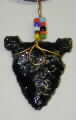
| Obsidian Point Pendant | Dark Smoke Obsidian
Approx 2 1/8 inches long |
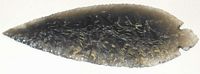
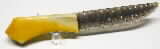
Dark Smoke Obsidian Turkey Tail Point. Approx 5 1/4 inches | Obsidian Blade w/Italian Carrara Handle
Approx 8 inches long |
' Kaught Knapping '
Flint cannot easily be sculpted or carved in a traditional
manner. Flint knapping refers to a gradual reduction process that
causes flakes of stone to break off of the original piece. The process,
both in ancient and modern times, generally begins with a technique called
direct percussion. This is accomplished by directly striking the
target stone with a tool, such as a hammer stone or bone, to remove large
flakes. The main purpose of direct percussion is to thin the stone
to the desired thickness. The next step is generally pressure flaking.
This is achieved by placing a pointed tool, such as an antler tip or copper-tipped
pressure flaker, on the edge of the stone, and applying an inward pressure
to the tool. Pressure will result in removing a small, thin flake
from the stone. Pressure flaking, shapes and refines the piece.
Part of the art is knowing where and how to apply this pressure to a particular
piece of a stone. The final finishing of the implement can include
techniques such as notching, stemming, fluting, etc.
| POINTS & KNIVES MADE FROM 'Flint' & 'Obsidian' |
|
|
|
|
| Obsidian Point Pendant | Dark Smoke Obsidian
Approx 2 1/8 inches long |
Dark Smoke Obsidian Turkey Tail Point. Approx 5 1/4 inches | Obsidian Blade w/Italian Carrara Handle
Approx 8 inches long |
Email: [email protected]