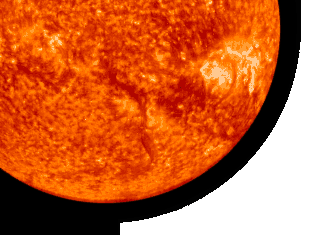
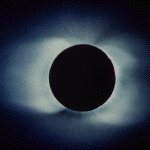
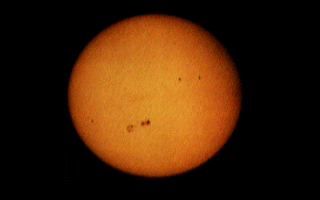
The Sun is an ordinary G2 star, one of more than 100 billion stars in our galaxy. Diameter: 1,390,00 km.
Mass: 1.989e30 kg.
Temperature: 5800 K (surface) – 15, 600, 00 K (core)
The Sun is by far the largest object in the solar system. It contains more than 99.8% of the total mass of the Solar System
(Jupiter contains most of the rest).
The Sun is personified in many mythologies: the Greeks called it Helios and the Romans called it Sol.
The Sun is, at present, about 75% hydrogen and 25% helium by mass (92.1%
hydrogen and 7.8% helium by number of atoms); everything else (metals) amount to 0.1%. This changes slowly over time as the Sun converts hydrogen to helium in its core.
The outer layers of the Sun exhibit differential
rotation: at the equator the surface rotates once every 25.4 days; near the poles it's as much as 36 days. This odd behavior is due to the fact that the Sun is not a solid body like the Earth. Similar effects are seen
in the gas planets. The differential rotation extends considerably down into the interior of the Sun but core of the Sun rotates as a solid body.
Conditions at the Sun's core are extreme. The temperature is 15.6
million Kelvin and the pressure is 250 billion atmospheres. The core's gases are compressed to density 150 times that of water.
The Sun's energy output (3.86e33 ergs/second or386 billion megawatts) is produced by
nuclear fusion reactions. Each second about 700,000,000 tons of hydrogen are converted to about 695,000,000 tons of helium and 5,000,000 tons (=3.86e33ergs) of energy in the form of gamma rays. As it travels out toward
the surface, the energy is continuously absorbed and re-emitted at lower and lower temperatures so that by the time it reaches the surface, it is primarily visible light. For the last 20% of the way to the surface the
energy is carried more by convection than by radiation.