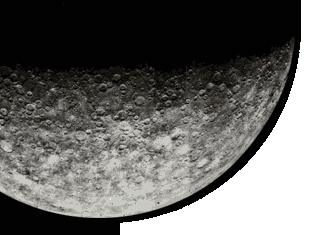
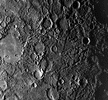
Mercury is the closest planet to the Sun and the eighth largest. Mercury is smaller in diameter than Ganymede and Titan but more massive.
In Roman mythology, Mercury is the god of commerce, travel and thievery, the Roman counterpart of the Greek god Hermes, the messenger of the Gods. The planet probably received this name because it moves so quickly
across the sky.
Mercury has bee known since at least the time of the Sumerians (3rd millennium BC). The Greek gave it two names: Apollo for its apparition as a morning star and Hermes as an evening star. Greek
astronomers knew, however, that two names referred to the same body. Heraclitus even believe that Mercury and Venus orbit the Sun, not the Earth.
Mercury has been visited by only one spacecraft, Mariner 10. It flew by
three times in 1973 and 1974. Only 45% of the surface was mapped (and, unfortunately, it is too close to the Sun to be safely imaged by HST).
Mercury's orbit is highly eccentric; at perihelion it is only 46 million-km
from the Sun but at aphelion it is 70 million. The perihelion of its orbit precesses around the Sun at a very slow rate. 19th century astronomers made very careful observations of Mercury's orbital parameters but could
not adequately explain them using Newtonian mechanics. The tiny difference between the observed and predicted values were a minor but nagging problem for many decades. It was thought that another planet (sometimes
called Vulcan) might exist in an orbit near Mercury's to account for the discrepancy. The real answer turned out to be much more dramatic: Einstein's General Theory of Relativity! Its correct prediction of the motions
of Mercury was an important fact in the early acceptance of the theory.
Until 1962 it was thought that Mercury's "day was the same length as its "year" so as to keep that same face to the Sun much as the Moon does to
the Earth. But this was shown to be false in 1965 by Doppler radar observations. It is s known that Mercury rotates three times in two of its years. Mercury is the only body in the solar system known to have an
orbital/rotational resonance with a ratio other than 1:1.
This fact and the high eccentricity of Mercury's orbit would produce very strange effects for an observer would see the Sun rise and then gradually increase in
apparent size as it slowly moved towards the zenith. At that point the Sun would stop, briefly reverse course, and stop again before resuming its path toward the horizon and decreasing in apparent size. All the while
the stars would be moving three times faster across the sky. Observer at other points on Mercury's surface would see different but equally bizarre motions.
Temperature variations on Mercury are the most extreme in the
solar system ranging fr5om 90 K to 700 K. The temperature on Venus is slightly hotter but very stable.