Ever since I've started on the research of the history of our home, I've been facinated with every detail I find. Well, after months of research, and countless hours tracking down ancestors, I now have a complete picture of this house, and the settlers of Paw Paw, IL. I thought I would share a synopsis of what I found. There's so much more, but I don't want to bore you!
Paw Paw is located on what used to be called Galena-Chicago Road. Now named Chicago Road, it is also known as "Old Chicago Trail". This trail was a stagecoach line from Chicago to Galena, IL. The road was founded on a well used indian route, and was discovered by General Winfield Scott while tracking the indians during the Black Hawk War. People found this area attractive, because there was a large forested area of about 2,000 acres (with a grove of Paw Paw trees), and little disease or hardship. So, Paw Paw it became, and we're located on the Western edge of the 850 person village.
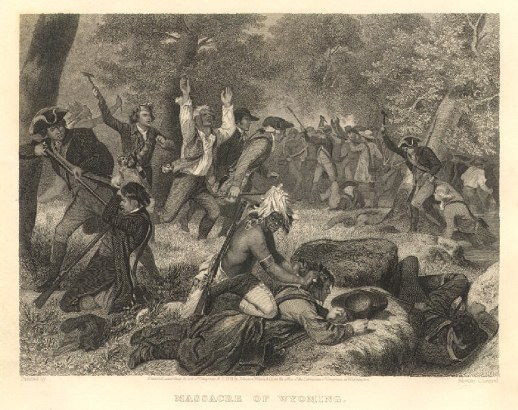
We live in what is called Wyoming Township. This township was named for Wyoming Valley, in Pennsylvania, where the majority of the original settlers came from. For you history buffs, Wyoming Valley is an important piece of our American history. This was an influential battle during the Revolutionary War. The British allied with the Native Americans (called the Six Nations in that area), and used them as a tool to wipe out American settlers in the valley. What was so horrid about this battle, was not the battle itself, but what took place after the fact. After the settlers conceded to defeat, they drew up a treaty with the natives to stay on the land and farm, but not to draw up in arms again. The natives did not hold up their end. They came in, and no matter the age, sex, or abilities of the people of Wyoming, they captured and brutally tortured who they caught. There are tales of decaptitation, mutilation, and even eating infants alive by the savagery of the Iroquois. Even the indian "queen" danced around prisoners and smashed their heads in with a tomahawk. Who ever was able to flee the scene of carnage, had to make way through swamp land, where they were ambushed and tortured once again. Fewer than a dozen men survived. Hundreds of women and children perished from exhuastion and torture in the swamps. One of these women was Hannah Rogers, who collapsed from exhaustion, and she was documented as being buried under an upturned tree, with her epitaph written in charcoal.
The settlers that survived the massacre, wanted to return home, after hiding in neighboring settlements. One of the men, Josiah Rogers (Hannah's husband) is quoted to have said, "I will lay my bones in Wyoming". So, he and some of his neighbors attempted to return back to the valley, only to be persued again. These man fought the indians off, and while many minor battles occured for another couple years, the families remained. A generation later, the people of Wyoming Valley wanted to leave and forget the horrible memories. They traveled together, and headed West, eventually settling in Paw Paw. Many of the surnames that were listed in the battles, are were also listed in the early censuses of Paw Paw, Illinois (Wyoming Township).
Sometime in the 1890's Paw Paw anticipated new growth, and partitioned off some lots for development. The man who sold off the land was known as F.E. Rogers, and his family owned quite a bit of land surrounding the area. Francis Edwin Rogers (who later changed his name to Frank), is the great-great-grandson of Hannah Rogers, the woman who died of exhaustion while fleeing the Iroquois. Francis's grandmother (Rhoda Drake) was the daughter of General Drake, who tried to defend the settlement, and was mortally wounded. Stephen Wright (a "real-estate profiteer" according to census records) purchased this lot from Rogers in 1895, and Wright built what is now our home. Then, the brand new home was sold to Ezra Betz, from Brooklyn, Illinois.
Other surnames from Pennsylvania, who also settled in Wyoming Township are: Jones, Keith, Roberts, Atkins, Hampton, Davis, Gorton, Benjamin, Siglin, Miller, Cole, Harding, Rosenkrans, and Marcus, taken from the 1860 & 1870 federal census.
Great link about the Wyoming Massacre: |