Action of Lenses
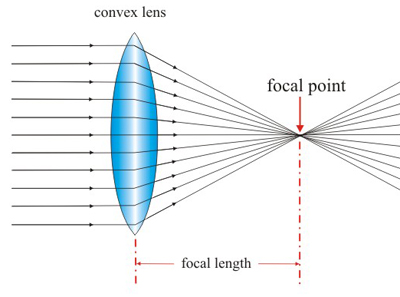
A lens is transparent block that causes light to refract (changes the direction the light travels in). A converging lens (or convex lens) is curved outwards on both sides or thicker in the middle than the edges. This means the light rays coming out of it come together at a point – they converge.
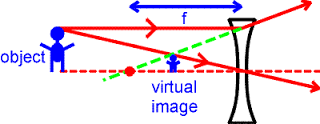
Any lens that is curved inwards or thinner in the middle than on the edges is called a concave lens and will function as a diverging lens when operating in air.
Definition of Terms
Principal Axis: A line which passes through the center of the lens, perpendicular to the lens surface.
Principal Focus: This is a point, marked F in the diagram, to which all rays parallel to the principal axis converge (in the case of a convex lens), or (in the case of a concave lens) from which the rays appear to diverge.
Focal length: This is the distance between the optical centre and the principal focus.
Focal plane: An imaginary plane located at the principal focus, perpendicular to the principal axis.
Magnification: The linear magnification or transverse magnification, m, is the ratio of the image size, h', to the object size, h. If the image and object are in the same medium it is just the image distance divided by the object distance.


m = h' /h
Image Formation
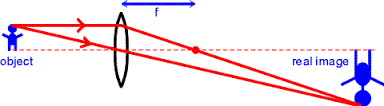
A real image is formed when light rays originating from a point on one side of a lens (i.e. the object) are refracted by the lens so that they focus (come together) to a point on the other side of the lens at the image location. This happens when the object is father away from the (converging) lens than the focal length.
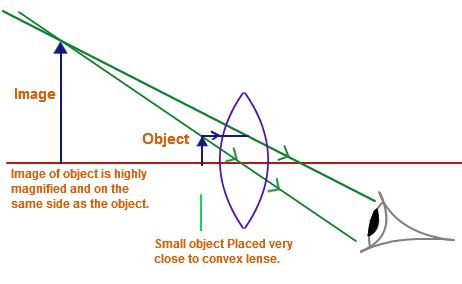
A virtual image is formed when light rays originating from a point on one side of a lens (i.e. the object) are refracted by the lens so that they diverge (move apart from each other) on the other side of the lens. When these rays are traced back in a straight line (ignoring that they were actually bent by the lens) then appear to diverge from a point on the same side of the lens as the object (this is the location of the virtual image). This happens when the object is closer to the (converging) lens than the focal length.
To learn more about magnification and the lens formula click on the links below. They will take you to a video where both concepts will be explained.
https://www.youtube.com/watch?v=cQ492W3VSfc
https://www.youtube.com/watch?v=I3W1-79BEn0
Reference:
http://www.bbc.co.uk/schools/gcsebitesize/science/edexcel/visiblelight_solarsystem/telescopesrev1.shtml
http://dev.physicslab.org/Document.aspx?doctype=3&filename=GeometricOptics_DivergingLenses.xml
http://www.physchem.co.za/OB11-wav/lens1.htm
https://www.physics.wisc.edu/undergrads/courses/spring08/208/Handouts/LensesFAQ.pdf
http://hyperphysics.phy-astr.gsu.edu/hbase/geoopt/lensdet.html