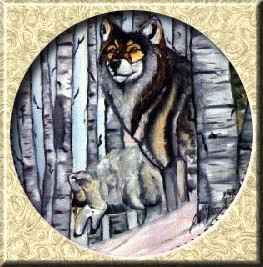
The Great Plains wolf (Canis lupus nubilus) is the most common subspecies of the gray wolf in the continental United States. It currently inhabits the western Great Lakes region of the United States. A typical Great Plains wolf is between 4 1/2 and 6 1/2 feet long, from snout to tail, weighs from 60 to 110 pounds, and may have a coat of gray, black or buff with red-ish coloring. Like all wolves, the Great Plains wolf is a very social animal that communicates using body language, scent marking and vocalization. The territory size for the Great Plains wolf depends on the type and density of prey. Typical prey for the Great Plains wolf consists of white-tailed deer, moose, beaver, snowshoe hare, and smaller birds and mammals.
The historic range of the Great Plains wolf was throughout the United States and the southern regions of Canada. By the 1930s, Great Plains wolves were extirpated, almost eliminated completely, in much of the western United States.
In Wisconsin and Michigan, the Great Plains wolf was eradicated by the mid- 1960s. Only a small group of wolves survived in northeastern Minnesota along the Ontario border. In 1974, the Great Plains wolf in the Great Lakes region became fully protected as an endangered species. By 1978, Minnesota's wolf population had increased enough that the wolf was reclassified as threatened in Minnesota. Minnesota is now awaiting new legislation to completely remove the Great Plains wolf from the endangered species list, and the process for reclassification of the Great Plains wolf to threatened in Wisconsin and Michigan is underway.
The estimated population for Great Plains wolves for 2000 in the United States was over 2,900 wolves. The population was distributed as follows: Michigan 216
Isle Royale 29
Wisconsin 266
Minnesota 2,450 (1997-98 winter estimate)
North and South Dakota officials have noted lone wolves, but evidence indicates that the wolves were dispersers from populations outside the Dakotas, and that a breeding population probably does not exist there. |