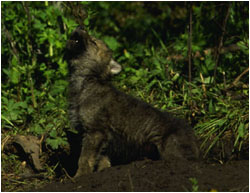
Indiscriminate howling is usually not a dangerous proposition for young pups, since they tend to be stuck at a rendezvous site that is relatively far from the neighbors, who likely have pups of their own to raise. More importantly, replying to an adult that howls often leads to a meal, since packmates returning with food frequently howl as they near the home site. But as summer gives way to fall, the benefits of indiscriminate howling decrease.
Once pups start to travel with the pack, they begin to enter less secure surroundings. Their neighbors are also traveling more. Distant howls may belong to strangers, so the risks of howling increase. Besides, by now they have had ample time to learn the voices of their own packmates and are able discriminate friend from foe. By six months of age, pups have become as selective as adult wolves about where, when and to whom they howl.
There is one member of the pack who will tend to howl more boldly: the alpha male. The alpha male is the dominant male of the pack, and father of the pups. He is most likely to howl to, and even approach, a stranger -- often with confrontation on his mind. One sign of this aggressiveness can be heard in his voice; his howls become lower-pitched and coarser in tone as he approaches a stranger. Lowering the pitch of a vocalization is a nearly universal sign of increasing aggressiveness in mammals, and in wolves it can sound quite impressive.
This behavior points to the second main purpose of howling: helping to maintain spacing between rival packs. When one pack howls, others nearby may reply. Very quickly, all the wolves know each other's location. By advertising their presence, packs can keep their neighbors at bay and avoid accidentally running into them.
But the use of howling in spacing is fraught with difficulties. If one pack howls, all its neighbors (within range, of course) now know its location. What if they choose to keep quiet, sneak up, and attack the howlers? Deliberate attacks by one pack on another have been seen, so there are costs to advertising your location. These risks have to be balanced with benefits. An example of this trade-off is sometimes seen during winter, when packs are traveling nomadically within (or even outside) their territories. A pack sitting on a fresh prey kill is very likely to stake its claim and howl, particularly if a stranger howls nearby. As time passes and the kill is consumed, the wolves become less invested in the site and are less likely to reply. Eventually, they may respond to a stranger's howling by silently moving away.
When two packs do meet, their relative size usually decides the outcome. Thus small packs are often quite reluctant to howl and draw attention to themselves, whereas large packs howl readily. But packs can fib to one another about their size.
When animals compete, they often engage in behaviors designed to exaggerate their size. Wolves stand tall, raise their hackles, ears and tails, and produce low, menacing howls, all to convince their opponent that a retreat from this "big, bad wolf" is the best option. Thus most confrontations involve a lot of bluff and very little bloodshed. Similarly, packs that are able to exaggerate their numbers are more likely to keep their neighbors at bay. The structure of a pack or chorus howl is well suited to this kind of deception.
Rather than using howls with a single pure tone, wolves howling in a chorus use wavering or modulated howls. The rapid changes in pitch make it difficult to follow one individual's howls if several others are howling simultaneously. In addition, as the sound travels through the environment, trees, ridges, rock cliffs and valleys reflect and scatter it. As a result, competing packs hear a very complex mix of both direct sound and echoes. If the howls are modulated rapidly enough, two wolves may sound like four or more. Indeed, during the Civil War, General Ulysses S. Grant reported hearing what he took to be a pack of "not more than 20 wolves" while traveling. A short time later he reached the pair of wolves that had been making all the noise! This phenomenon, called the Beau Geste Effect, may introduce enough uncertainty to make size estimates not only unreliable, but potentially lethal, if a pack underestimates the size of its rival and approaches.
So wolves howl to find their companions and keep their neighbors at bay. Popular imagination has long held that they also howl at the moon, but there is no evidence that this is so. Wolves may be more active on moonlit nights, when they can see better, or we may hear them more often on such nights, because we feel more comfortable tramping about in the light of a full moon, but a wolf howling at the moon would be wasting its breath. |