-
MUANG FA DAET SONG YANG
- PHRATHAT YAKHU
- WAT PHO CHAI SEMARAM
- FAMUE DAENG CAVE

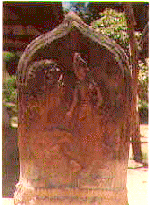 |
The town as currently seen the remains of brick and earth of doubled city moats and Phra-that Ya-khu is located in the vicinity of Amphoe Kamalasai. The City plan is of an oval shape of Dvaravati style but having doubled township areas which is believed that the expansion of its township area was the cause. Farmers in the area always found sae-ma stones with designs and without designs, made of sand stone, during their farm work. The number which has been registered at the Department of Fine Arts is 130 slabs. Other items found in the area are baked clay Buddha images showing the influence of the late Kupta craftmanship, aging 1,000-2,000 years, baked clay somking pipes having the designs of Amaravati period, i.e., curling stems making the shape of dragon, aging 7,000 years. The outstanding item is the same type of smoking pipe but made of bronze, aging 5,000-6,000 years. |
This is a confirmation that the metal
age of Suwannaphum was started before every source in the world. Muang Fa Daet Song Yang is, then, an ancient town having the age between A.D.757
- A.D.1057 and is now located at Ban SSae- ma, Tambon Nong Paen, approximately 19
kilometers from the province township along Highway No. 214 (Kalasin - Roi Et) where
a right turn is to be made, after travelling of the first 13 kilometers, at the Kamalasai
School intersection, Amphoe Kamalasai for another 6 kilometers distance along the
laterite road. lt is regarded an important place for archaeological education of
the province.

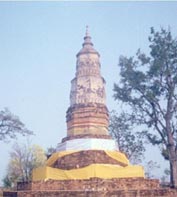 |
lt is located in the rice field north of Ban Sae-ma. Amphoe Kamalasai, about 19 kilometers from the province township. The construction is of Dvaravati arts and the constructional materials are brick and earth having an octagon shape at the base. The dimensions of the base is 10 meters is width and 10 meters in length and is built on top of one another in the design of four-gabled roofing totaling the height, from the base to the peak, of eight meters. lt is believed that the Phrathat houses ashes and relics of high ranking monks who were respected by the people in that area. This can be noticed from destruction’s caused by war, i.e., when Muang Chiang Som won a war, Muang Fa Daet was destroyed almost every thing but Phrathat Yakhu. This caused the Phrathat to be deserted in the rather perfect conditioned remains and was renovated later. The villagers arrange to have an annual festival during April to May having the purpose of rain begging. |

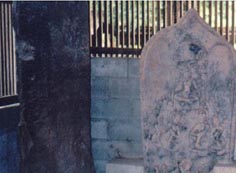 |
Another name of this monastery is Wat Ban Kom which is located in the vicinity
of Muang Fa Daet Song Yang and not far from Phrathat Yakhu. lt is an ancient monastery
having sae-ma stones made in Dvaravati period as interesting objects. Most of
sae-ma stones are fixed in the ground as the wall line while some of them are stored inside and on those sae-ma slabs there are various features concerning Buddhism are
carved. |

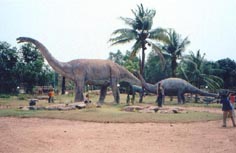 |
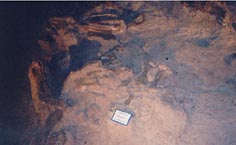
Famue Daeng cave or palm-print cave so called by villagers is also located on the Pha Phueng mountain. lt was discovered and publicized during 1973 and 1980. Paintings of as many as 174 red palms were disclosed during a prehistoric painting survey conducted by the Department of Fine Arts Division of Archeology at Phu Pha Phueng.
|
 |