Imagine you are producing a play or event set around 1900. You have a huge budget, but little time, and need to buy everything you need.
Costuming a play with no budget restrictions? Truly a costumer's fantasy!
First we could take the approach of purchasing genuine articles. Since we've suspended disbelief vis-à-vis the budget, we'll similarly suspend the reality of modern performers' bodies. Genuine vintage is virtually all too small for a modern-day actor or actress, most likely even a waif-like Calista Flockhart type. So we'll assume the entire cast can fit into 20"- to 24"-waist with busts no larger than 32". We'll also make the assumption that all finds are in wearable condition.
One site with beautiful clothes, much of it reasonably affordable, is www.vintagemartini.com. He offers both outfits and accessories -- including some great hats -- as well as a nice selection of actual vintage patterns.
For a truly extravagant production, Karen Augusta is auctioning the Suzi's Antiques estate later in April. These are museum-quality clothing and accessories. Visit http://www.whitakerauction.com/suzigallery.htm.
And there's always eBay, where everything and anything is available if you're willing to pay for it.
If there's time to sew from scratch, you'll still want patterns that make up quickly with a minimum of fuss. I recommend those by FolkWear, particularly the "Vintage & Romantic Collection," or Patterns of History from the State Historical Society of Wisconsin.
If you prefer to purchase reproduction garments ready-made, here are some options:
Nineteenth Century Tailoring: "Welcome to my web page, I hope to be able to show you that quality, authentic, military & civilian clothing can be obtained at an affordable price." Based in England, this site offers menswear with a British flavour, including selections from the Indian War (1872-1890) and Boer/Zulu war periods.
Michele's Sew it Seams: "All wool, cotton, cotton-linen blends & linen fabrics. Historically correct clothing for museums, re-enactors, or anyone needing clothing representative of the 1600's - 1890's. Custom Garments for any time period. Call for a quote on custom garments." Men's and women's.
Originals by Kay: "It is my aim to provide affordable and outwardly authentic looking garments and accessories to the re-enacting community. To achieve this aim I employ some modern machines and techniques. Hand finishing for the inside of garments is not included in the standard prices quoted in my price-lists, but is available upon request." Includes millinery and corsetry as well as outerwear. Both men's and women's clothing.
History in the Making: "History in the Making provides authentic period costume for use in living history sites, museums, reenactments, film, and special events. We provide costume and accessories for both 18th and 19th century civilian and military use." Men's and women's, with an emphasis on men's. Beautiful but very costly.
Premier Designs: "Welcome to the Premier Designs website. We are a leading designer of historic clothing, specializing in high quality constructed designs from Turn of the Century-1900, to the 1920's, for women and men. Our garments are sold mail order across the USA and overseas. Accessories of all types, too." Menswear is mostly accessories and knickers; women's wear is extensive.
Week Nine: Dress Reform
As early as the late 1700s, doctors were arguing against stays or corsets. In the 18th Century, it was believed that women's and children's weaker bodies required extra support, as provided by stays. However, doctors recognized the potential damage done to internal organs squeezed out of place.
By the mid-19th Century, a Dress Reform Movement began to take hold in earnest. While male fashion was influenced somewhat, the movement primarily focused on women's fashions, by now grown to extremes with corsets, bustles, crinolines, and the like.
There were three chief influences: the Aesthetic movement, feminism, and health concerns. This report will focus on the last of these.
An Ohio State University exhibition demonstrated that in the late 19th century, a fashionably dressed woman might wear up to 25 pounds of clothing -- layered undergarments (including drawers, chemise, corset, petticoat, and crinoline or bustle) plus a gown and mantle. Not only were a woman's internal organs squeezed by her corset, she often couldn't bend over, raise her arms very high, walk with a natural stride, run, or, in a cage crinoline or hoop, fit easily through an door.
Yet in a way, the crinoline itself was already a kind of reform, freeing women from multiple layers of petticoats that enveloped their legs, made walking difficult, and trapped unhealthy moisture.
According to a Columbus Dispatch article about the exhibition, "Women who were not bold enough to alter their outer garments often began change with underwear. The goal of underwear reformation was less weight, fewer layers and less constriction. One of the first innovations was the union suit -- a chemise and drawers combined into one garment."
Seventh-day Adventist leader Ellen Gould White initially argued against dress reform before the Civil War. But later (1874), in The Health Reformer, she wrote:
Fashion binds upon the heads of women needless appendages....These have a direct tendency to induce blood to the brain, because overheated by artificial braids of hair, cotton, or jute....[T]he limbs are left nearly naked, with merely one thickness of woolen or cotton. When the air circulates about these unprotected limbs, the blood is driven from the extremities to the internal and more vital organs of the body. The result is congestion, to a greater or less extent, of these organs....It is true the reform dress reveals the fact that women have feet and limbs, and when they are modestly and sensibly clothed, making exposure impossible, she is not ashamed of the fact. But the fact that women have feet and limbs is not, as we have said, concealed by the length of the dress. We have decided that health and modesty require that women clothe their limbs as thoroughly as they do other parts of the body.
Gould also felt Christian women squandered healthy "outdoor" time needlessly embroidering and trimming. However, there are indications her views were most influenced by the realization she could control the publication and sale of "church-sanctioned" bloomer-style dress patterns.
Dr. Helen Stern has studied the effects of tight-lacing. She noted that progressing from training corsets for young children, adults could end up with smaller waists than they had as children. Like the doctors of the 1700s, she saw, after ten or more years from earliest days perpetually locked up in more or less corset-like garments, the young lady already as a teen-ager found the support of a high corset not only comfortable, but even indispensable, due to her during all these years of constantly scaffolded, weakened and impaired back muscles with total lack of exercise....So no wonder that many young girls, particularly in the two decades of the 19th century and the beginning of the 20th, were reportedly much more tightly laced than their mothers. It also explains why you could find many tightly corseted older ladies still 50 years ago. You actually had a generation which never could get rid of a good support from their corsets.
Margie Knauff writes, In 1859, in a Paris newspaper, it was reported that a young woman had died due to an over-tight corset - her liver had been pierced by three ribs. Although the unhealthy effects of corsets (displacement or prolapsed uterus; atrophy of abdominal muscles; displacement and damage to the liver; displacement of the stomach and intestines, causing extreme digestive difficulties; constriction of the chest and malformation of the ribs, affecting one’s ability to breathe), they continued to be worn by trendy women.
The dress reformers of the 1870s concentrated on reforming the undergarments, rather than trying to change the fashion of the outer dress. The bustle was not considered hazardous, so it was allowed to be an acceptable part of reform dress. Reformers urged replacing the corset with a "waist," a short-sleeved, high-necked garment which supported the upper body. It also had buttons on its lower edges, so that one might button one’s petticoats to it, thereby using the shoulder to support the weight of the skirts. These outfits allowed greater freedom of movement, and were called "Emancipation Waists." Sources: Ludmilla Kybalova, Olga Herbenova, and Milena Lamarova, The Pictorial Encyclopedia of Fashion, The Hamlyn Publishing Group, Ltd., 1968, and Carolyn Sprinthall, Nineteenth Century Dress Reform: Changing the Shapes of Women’s Lives. Duke University, Diss.1986.
The Mayo Clinic website formerly had a page describing the detrimental effects of tight-lacing, including loss of muscle tone, various deformities, organ malfunctions, and blood clots.
Yet all these dire warnings weren't the main causes of dress reform. With the new interest by both sexes in sports in the last quarter of the 19th Century, there was a popular demand for "sensible" underwear. When it became apparent that bustles and petticoats weren't well-suited to strenuous exercise, women began to consider alternatives. Dr. Gustav Jaeger developed a woolen union suit, and "wool next to the skin" became de rigeur. On a hike, a progressive female might limit herself to merely flannel drawers, her woolen "Jaeger suit," and a petticoat under her dress. A cyclist might wear "warm combinations (an all-in-one type of garment), a thick woolen vest or knitted bodice, and a pair of tweed or cloth knickerbockers" under her skirts.
In 1880 Viscountess Harberton founded the Rational Dress Society "to promote the adoption of a style of dress based upon considerations of health, comfort, and beauty." It rejected tight-lacing, hampering skirts, and high heels, and recommended that the maximum weight of underclothes not exceed seven pounds! She also advocated divided skirts rather than draping the legs as though women never actually walked.
Her ideas were supported by medical information gathered at the London Hospital. The Society attempted to create dresses that achieved their goals yet didn't look greatly different from the prevailing fashions, understanding women's need to "fit in" to society.
1n 1890, a correspondent signing herself "Rational Dress" wrote to the Australian Chronicle in defense of her rational dress. "I abandoned a skirt and adopted rational dress for greater safety (twice being nearly killed by my skirt catching in the pedals), and not, as the enemies of cycling say of all women who wear rational dress, because of vanity. No woman is expected to ride horseback in a street dress, to play tennis in a tightly fitting visiting costume, or to walk miles in a tea gown. Why cycling should be the only pastime for which women would dress in a thoroughly unsuitable manner (as in skirts) is a mystery. Imagine men playing football in tweed suits and tight shoes, cricket in mackintoshes or rowing a race in evening dress. Men dress suitably for every sport, why not women?"
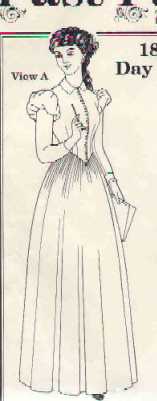
Eventually, underwear reform begat looser-fitting dresses and gowns that more naturally followed the shape of the body. The original of the late 1880s dress whose pattern is depicted here has neither bustle nor boning. The bodice is looser and it allows more freedom of movement than a "fashionable" garmet of the same vintage. You can see a real-life copy of this dress here. But it was not until after the First World War that true reform took place, and a brassiere and panties were considered adequate under a dance frock.
Print sources: The History of Underclothes, C. Willett and Phillis Cunnington, Dover Publications, 1992 Victorian and Edwardian Fashion: A Photographic Survey, Alison Gernsheim, Dover Publications, 1963
Assignment Part Two: Choosing a Vintage Garment for Study
For the final project in this course, I will be studying a bustle-era black silk jacket. To view this project, click here. The jacket appears in the portrait over the mantle in the photo at the top of this page.
Week Eight: Vintage Garments on eBay
eBay can be an excellent source for the collector. It allows the buyer to work with far more dealers, in infinitely more far-flung locations, than he might typically encounter in face-to-face commerce. Additionally, it can serve as a splendid resource for determining real market conditions, by reviewing the winning bids in completed auctions. However, as in any transaction, the buyer must beware, particularly as he is buying these items largely sight unseen.
I chose to research parasols, which offered a good variety of items (far more so than bustles, my first choice). My search criteria, run on the afternoon of March 19, were thus: Parasol in the title yielded 212 items. Parasol +victorian in the title and description yielded 128. Parasol +victorian in the title alone yielded 18. Parasol +victorian -doll in the title and description yielded 62 items. Of the 18 parasol +victorian items, eight actually were parasols, umbrellas, or parts of parasols (the others were prints, sculptures, dolls, etc.).
Item 1122991390, Victorian EQUESTRIAN Lace & Horn Parasol, is my favorite. It's described as a Victorian black lace and silk parasol with decorative horn handle and top piece in the form of a horse's leg and hoof - a real equestrian delight. The folding handle is made from animal horn and pivots in the center for folding. As you open the handle, a decoratively engraved tube in pulled down to hold the handle in one piece. The parasol has the normal latch as you open it that holds the frame in the open position. The parasol is covered with a fine black lace with scalloped edge as you can see in the photograph. The underside of the lace has a black silk lining. The parasol measures 26" tall and 17" in diameter. The condition of the leg and hoof handle as well as the hoof top decoration is excellent with a golden hue to the horn and some clarity that makes it quite rich looking. The condition of the lace is generally good but needs some repair at the top of the parasol so it will be sold "as is." The black silk lining has some tears and should be replaced if you want to restore the parasol completely. This is the most unusual parasol I have ever seen not even considering that I focused as a thermoplastics collector. Currently it was available for a reserve price starting at $65, with no bids. It expires March 20. Generally the reserve is considerably below the price the seller will accept for the item.
In completed auctions using the same search criteria, there were 55 items, of which 29 were actual parasols. Prices ranged from a high of $175 for the children's parasol described below, to a gold-filled handle with no bids at $125. Refurbished parasols, some pretty tacky, ranged around $40 to $65. Modern repros, in either Batterberg-style lace or nylon (!) were around $50. Frames alone, to be recovered, were $15 and up depending on carvings and condition. There were some bargains and some pretty sad examples fit only to poke up from an umbrella stand in someone's hall.
Some of the items were clearly marked as reproductions or refurbishments in the title. In other cases, you had to go onto the actual auction page to learn that. Photos were generally useful, though not always. Nothing can compare with holding an item in your hands, especially to assess age and true condition.
Some sellers offered comprehensive descriptions of condition: Up for auction, in wonderful condition, black lace childrens parasol, date this to be late 1800's to early 1900's. Blue silk lining inside, black lace on the outside. Adorable delicate ribbon bow tops off the accent on top. Bendable wooden arm with a metal slide loop that is used for folding or straightening the parasol. No serious rips or tears, this little jewel was stored properly with very little age wear. Length is 23", width fully opened is 19". Can really find no damage, will put condition to be a 9+. Others took this seller's approach: LOOK AT THE PHOTO...IT IS IN GREAT CONDITION!!!NO RESERVE!! BUYER PAYS S/H.
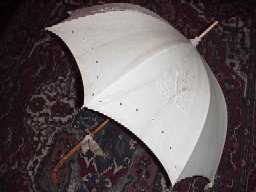
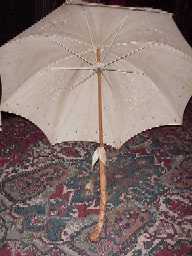
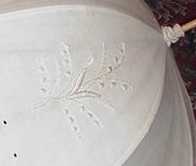
However, these auctions made me feel more confident about the parasol I purchased this summer for $125 plus tax from a dealer in upstate New York. Photos of the parasol are posted below. It is in fine working condition, and its sturdy cotton or linen cover, embroidered with lilies of the valley, is in very good condition except for some water staining and a half-inch split in a seam which doesn't affect performance. For me, and for items which I plan to use in my re-enactments, nothing beats being able to examine the item before any cash changes hands.
Update on 3/21/01: I was sent this link for Karen Augusta Antique Lace and Fashion. This site is selling the assets of the late dealers Sue Varner and Suzanne Arena of Farmville, VA. By selecting Ladies' Accessories then Fans & Parasols you will come to a selection of parasols much like the one illustrated above, although in "unused" condition. There is some minor staining from long storage. Prices range from $265 to $325.
Week Seven: Tying a Regency Neckcloth
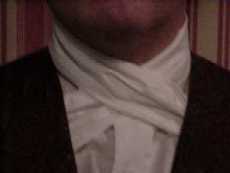
The directions for tying various neckcloths in Neckclothitania are directions in the same sense that an episode of Essence of Emeril is a recipe. In other words, if someone has provided a list of ingredients and their quantities, and you're already familiar with basic cooking techniques and how a given recipe should come out in terms of consistency, color, flavor, et cetera, you can produce the same dishes as Emeril. Similarly, if you were purchasing ready-made neckcloths (and therefore "knew" the dimensions), and already had been tying ties all your adolescent and adult life, and saw every other man around you wearing these styles, you could follow these "instructions."
The Neckclothitania illustrations are less helpful than one might first imagine, as they're sometimes ambiguous as to whether the "tall" portion is collar or neckcloth (it appears in some drawings and not in others). The simplest are the Osbaldston, Napoleon, Mailcoach, Horsecollar, Ballroom, and Maharatta. Most of these rely more on twisting fabric rather than tying it. Other styles seemingly defy creation. Depending on how you interpret the drawings, it would appear that a six-inch-wide cloth needs to be folded horizontally in the tying, or the wearer could never lower his chin at all!
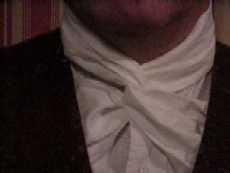
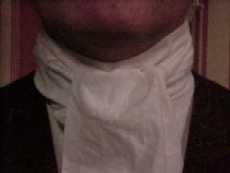
I used the suggested 46" x 6" cloth. This proved in many styles to be too short for my husband's 16" neck. I also omitted the step of starching the cloth between styles, so as not to further alienate my "volunteer," who agreed to be photographed only from the chin down. A vest proved, as indicated in several of the instructions, to be invaluable for securing the neckcloth ends, as well as adding to the overall finished effect.
Stays (18th C.) evolved into the corset (19th C.). The chief difference is that stays tended to be more completely boned -- "fully boned" ones were completely surrounded in boning, with virtually no fabric-only spaces in between. Also, the general shape of the body in stays was more columnar, with a more flattened chest, though the tiny waist was desirable in both eras.
The following is from http://speakeasy.org/~traceyb/corset/form8.html. This author's research indicates that a significant difference between stays and corsets is that the former became, during the eighteenth century, highly ornamented garments worn outside, rather than underneath, other clothing.
"...the bodice, now referred to as the Corps Baleine (probably the French for baleen), was really a corset worn over the blouse. It was also during this time that whalebone replaced wood or metal supports. Whale bone is the name given to the long horny plates or blades that are analogous to teeth. The busk was still flamboyant and a treasured piece. With the addition of whale bone, shoulder straps where introduced because the body stopped under the breast. The straps held the stays in place and the breasts up.
"The Corps Baleine of the 18th Century was devoted to the support of the bust and the extravagance of richness. It was a garment of such detailed ornamentation that it was always exposed to view. It was slim, tight fitting, long waisted, and usually with a point in front. It was an extreme contrast to the mammoth skirts held out by whalebone scaffold called a panier. This was also the time when the frivolous "shepherdess" style prevaded the upperclass which had no flocks to tend. The 18th century saw an enormous amount of whalebone used and the protests from doctors started. Court protocols, in 1773, permitted women who could not bare to wear a whalebone stiffened bodice to wear a corset which was a slightly stiffened bodice."
I occasionally wear a corset, for Victorian costume re-enactments. Personally, with the restriction of movement caused by tight-lacing (and I only go down two or three inches), I can't imagine wearing it for anything more intimate than croquet! The purchase of my corset was an adventure -- I'd been directed to a shop in New Hope, PA, a town noted for being hospitable to all kinds of alternative lifestyles. Since the shop was suggested by my re-enactment group, I was pretty much expecting lots of lace and brocade, and probably a cup of tea as well. I was *not* expecting 95 percent of the inventory to be leather, vinyl, chain mail, and the like. However, I do like how I look when I'm laced in, but after reading the Mayo Clinic's write-up on all the potential health hazards -- blood clots?!? -- I will stick to wearing it for special Victorian occasions.
 In 1880 Viscountess Harberton founded the Rational Dress Society "to promote the adoption of a style of dress based upon considerations of health, comfort, and beauty." It rejected tight-lacing, hampering skirts, and high heels, and recommended that the maximum weight of underclothes not exceed seven pounds! She also advocated divided skirts rather than draping the legs as though women never actually walked.