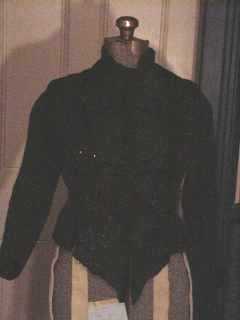
Fig. 1, Jacket front
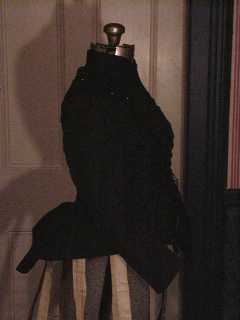 Fig. 2, Jacket side
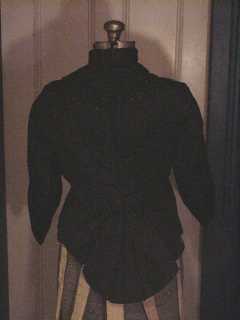 Fig. 3, Jacket back
Final Project: A Vintage Garment, Inside and Outside
ICOM description Per the Vocabulary of Basic Terms for Cataloguing Costume of the International Committee for the Museums and Collections of Costume,
1.22 Bodice, black silk(?) twill, tan cotton lining, black glass beading and soutache cord trimming, self-covered buttons with bead trim, probably American, mid-1880s.
Fig. 1, Jacket front |
Fig. 2, Jacket side |
Fig. 3, Jacket back |
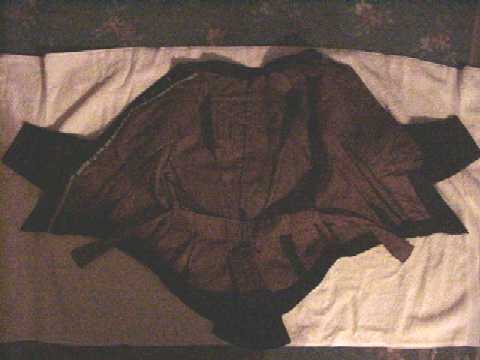 Fig. 4, Jacket interior |
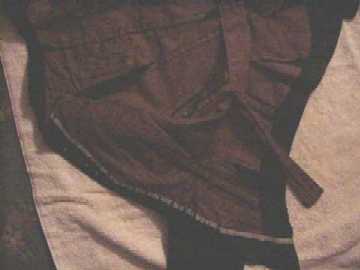 Fig. 5, Jacket inside right. Note white edge -- this is the fabric's selvage. Fig. 5, Jacket inside right. Note white edge -- this is the fabric's selvage. |
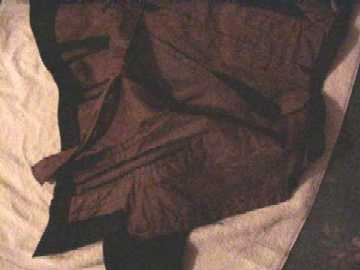 Fig. 6, Jacket inside left Fig. 6, Jacket inside left |
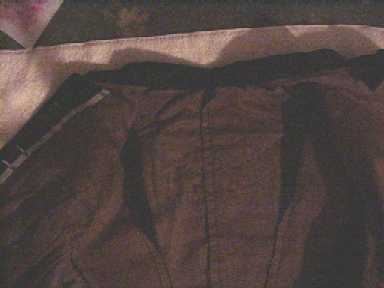 Fig. 7, Jacket inside neck showing hand stitching holding on beadwork |
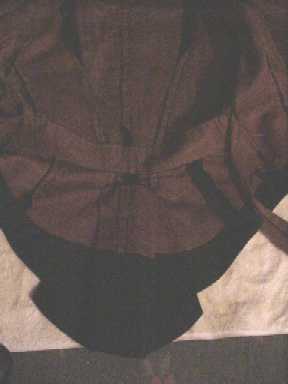 Fig. 8, Jacket inside "tail" for bustle |
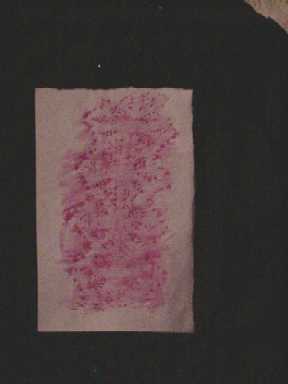 Fig. 9, Crayon rubbing to show beadwork detail |
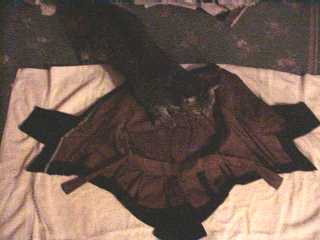 Fig. 10, How not to conserve vintage textiles (though he's supervised a number of modern-day and vintage reproduction sewing projects). I also realize that not wearing these pieces is one of the cardinal rules of costume conservation, which is why I sew most of my re-enacting costumes. |
Construction details
The bodice is primarily machine-stitched, with hand-stitching on certain details. Buttonholes are machine-bound. It is shaped by two darts on each side of the front, and by the back being constructed of three separate pieces on each side of a center back seam. The sleeve is two pieces, shoulder-to-wrist and underarm-to-wrist, with a gentle curve shaped in. While the bodice isn't boned, the center front darts and the side seams are made to accommodate boning -- a narrow strip of lining material, folded like bias tape, is hand-stitched over the pressed-open seams to create the casing open at top and bottom.
Sizing is unusually large compared to most pieces I've seen of this vintage. It's approximately a modern Size 8 -- bust 36", waist 30", shoulder width 14", sleeve length 18.5". This may have been for an older woman (a widow?) or, less likely, a stout younger woman.
Since I couldn't adequately photograph the beadwork, I made a rubbing. The entire beadwork design is on a mesh-type background and applied in a single piece with three parallel rows of long hand-stitches (see Fig. 7).
Admittedly, I am making educated guesses about the fabric content. I'm unaware of any tests that accurately determine material yest don't require the destruction (as by fire) of a portion of the fabric. The "hot pin" test on a bead in an inconspicuous place had no effect, meaning they're likely "French jet" or glass.
Condition details
The garment is in very good condition, with virtually no fabric wear on the silk. Most beading is intact, as are all 13 buttons. The lining is somewhat stained and worn in the underarms. The "tail" lining is separate from the rest of the lining and joined on with a seam that is hidden by the interior belt. The right side of the jacket's fashion fabric seems to have been cut along the selvage, which is white. There are no hooks on the inner belt, but there may never have been. I see no evidence of prior fasteners. There is wear on the right side of the stand-up collar, as though a hook were pulled off, but no evidence of a matching hook on the left side. It may have been secured with a brooch.
 Additional dating information:
The main rationale for estimating this garment's date as mid- to late-1880s is below, based on its similarities to numerous fashion plates of that era. But I've located additional support. I am currently completing construction of Past Patterns' late 1880s "rational dress reform" day dress for Victorian re-enactments. (To see this dress and others I've sewn, click here.) This pattern company adheres to original period construction techniques. I see a great number of parallels between this late 1880s pattern and my study garment:
Bodice shaping: Both garments use six back panels and are shaped in the front by two darts.
Two-piece sleeve: Both have two-piece set-in sleeves with a gentle arm-hugging curve sewn into the sleeve. Like the pattern, the vintage sleeve seems to have its lining cut shorter (by the hem's depth) than the fashion fabric, to eliminate one thickness of fabric where the sleeve hem is folded and stitched. And the "fashionable" sleeve of the era, as opposed to the more practical, longer, rational sleeve, is described in the pattern as being hemmed to one inch above the wrist; the vintage sleeve is appropriately short.
Lining: Both are constructed with lining and fashion fabric cut and sewn as though they're a single layer.
Overcast seams: Both have seams bound on the edges with an overcast stitch. Some seams (e.g., center back) are pressed open; others are not.
Button "lap": Both have a fold on the side to which the buttons are stitched. Buttons are numerous and almost hang over the edge of the jacket when buttoned.
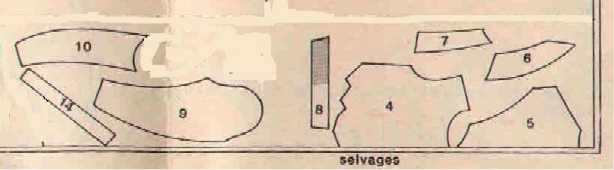
With minor changes to the bottom front and center back edges, the pattern for the bodice of this dress could be cut as the pattern for the study garment. In addition, I have a McDowell pattern-drafting "machine" (a series of joined, adjustable brass bars to create custom pattern templates based on the numerous measurements input into the device) and the pattern pieces created are very similar to those in this bodice. The drafting kit was patented in 1879. You can see my research on the McDowell Garment Drafting Machine here.
The pattern for this bodice would probably have resembled this one, with the addition of the sweeping "tail" on the center back panels and the lengthening of the points on the bottom front panels.
Who may have worn this, and why:
If this is indeed a mourning garment (see Tara's comments below), it was likely worn by an older woman -- which would also account for the sizing, which even accounting for corseting is fairly "cylindrical." It was probably a reasonably expensive piece, based on the heaviness of the fabric and the lavish trimming, and likely custom-made. It was not, as so often happened in those times, a regular garment dyed black for the mourning period, as the lining retains its original tan color and isn't dyed. The white selvage also remains. While I know nothing of the jacket's provenance, I can imagine that it belonged to a well-to-do older woman who was in mourning but still ready to participate in society once again.
Illustrative description
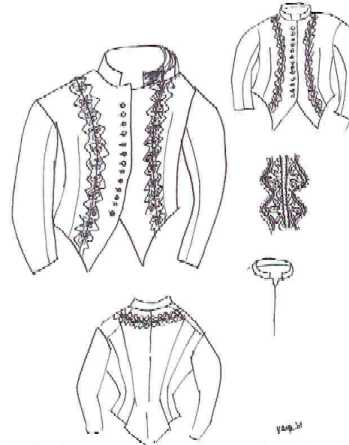
The jacket is black silk twill. It has a stand-up collar which doesn't fasten. There are eleven buttons, all fabric-covered and trimmed with tiny black beads in the centers. The front has a sort of peplum which sweeps away in the back to a pleated fish-tail sort of shape which fits over the bustle. Sleeves are long and fitted, with a slight curve stitched into them. The most striking feature of the jacket is a thick line of soutache and beading in a sort of floral net pattern, running across the back of the neck and down the front on both sides.
Tara replies: Your first stop should probably be the 1870's, 80's and 90's pages at http://www.costumes.org/pages/timelinepages/timeline.htm just to work out an approximate date. Then hunt further in the links from the
determined decade at http://www.costumes.org/pages/victlinks.htm. It also sounds like searches on "mourning dress" and "jet beads" might be relevent. The kind of black beadwork you describe is known as "French Jet" made of black glass, as differentiated from "English Jet" which is big lumpy clunky black jewelry made of a coal like substance mined mainly in Whitby.
My initial research following up on Tara's suggestions:
My study garment most closely resembles these items:
This puts it in the early- to mid-1880s. The short (above-the-wrist length), tight sleeves, tight bodice, bustle peplum, and high military-style collar all seem appropriate to that time. By contrast, the peplum seems too large for either the 1870s' or 1890s' smaller bustles, and the collar seems too severe, as well. The tightness of the jacket wouldn't accommodate the S-curve of the 1890s; there's not enough give for the pigeon-front look.
As for the beadwork, I visited Antique Jewelry Online. An article by Steven L. Jordan describes French Jet thus:
"French jet is a manufactured glass, as is an English version known as Vauxhall glass. Cold to touch and heavier than true jet, (specific gravity approximately 2.20), it cannot be scratched with a pin nor will a hot needle have any [e]ffect. It should be noted that a very small amount of true French jet has been produced."
I can now go and try the hot-pin test on a bead in an obscure place. I suspect the beads may be plain black glass. {Note: Subsequent testing supports the "glass" theory.)
I'm not entirely convinced this is an article of mourning wear. In Mourning in the Nineteenth Century: An Overview [reproduced from The Campbell Crier, the newsletter of the 42nd Virginia Infantry Regiment, March 1998 issue], Virginia Mescher writes:
"The length of time that someone mourned depended on the individual and the person being mourned. A woman mourning her husband's death could be in deep or full mourning for six months to two years, with the traditional time being one year plus one day. She was expected to wear all black with no trim or jewelry unless the jewelry was jet. After the first year, she would gradually lessen the mourning attire for an additional eighteen months, which was divided into three additional stages. Second mourning lasted for about nine months in which the widow was permitted to wear less crape ... and to wear white collars and cuffs. ... The next stage, or ordinary mourning, lasted three months in which shiny silks and velvets were allowed. Trims of lace, ribbon, embroidery, and beading were used, jewelry of gold, silver and precious stones could now be worn. The final stage of mourning, called half-mourning, lasted six months and colors were permitted...."
While an "ordinary mourning" garment could conceivably be of this material with this bead trim, this is a pretty flashy jacket. This widow could well be looking for a second husband!
http://www.costumes.org/history/victorian/women/fashionplates/1883lamode.jpg
http://www.costumes.org/history/victorian/women/fashionplates/sept83.jpg
http://www.costumes.org/history/victorian/women/fashionplates/1886promenenade.jpg
http://www.costumes.org/history/broderbund/misc/1880letter.jpg


