Pakistan
Pakistan, officially Islamic Republic of Pakistan, republic in South Asia, marking the area where South Asia converges with Southwest Asia and Central Asia. The capital of Pakistan is Islāmābād; Karāchi is the country’s largest city.
(This Website is made by Kamran Khoso)
The area of present-day Pakistan was the cradle of the earliest known civilization of South Asia, the Indus Valley civilization (2500?-1700 bc). The territory was part of the Mughal Empire from 1526 until the 1700s, when it came under British rule. Pakistan gained independence in August 1947. It initially comprised two parts, West Pakistan and East Pakistan, which were separated by about 1,600 km (1,000 mi) of territory within India. In December 1971 East Pakistan seceded and became the independent republic of Bangladesh.
| Area | 796,095 sq km 307,374 sq mi |
| Coastline | 1,046 km 650 mi |
| Highest point | K2 8,611 m/28,251 ft |
Highest Peak K2
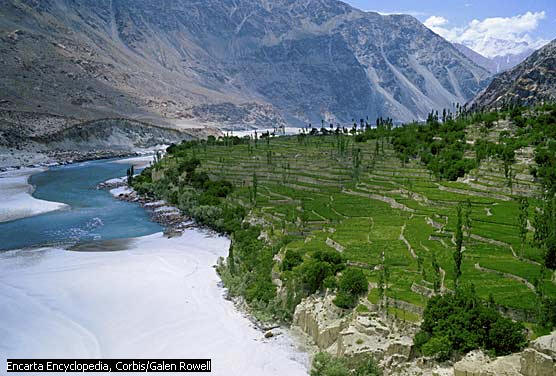
Pakistan has great extremes of elevation, reaching the highest point at the Himalayan peak of K2 (also known as Mount Godwin Austen) in the north and the lowest point at the Arabian Sea coast in the south. The Indus River flows the length of Pakistan from north to south. The Indus and its tributaries form a wide river valley with fertile plains in Punjab and Sind (Sindh) provinces. Pakistan is mountainous in the north and west. Earthquakes are frequent, and occasionally severe, in the northern and western areas.
Much of Pakistan is a dry, sun-scorched region. To the west of the Indus are the rugged dry mountains of the Sulaimān Range, which merge with the treeless Kīrthar Range in the south. Farther west are the arid regions of the Baluchistan Plateau and the Khārān Basin. A series of mostly barren low mountains and hills predominate in the western border areas. The Thar Desert straddles the border with India in the southeast.
The country also possesses a variety of wetlands, with the glacial lakes of the Himalayas, the mudflats of the Indus Valley plains, and the extensive coastal mangroves of the Indus River delta. The wetland areas cover an estimated area of 7.8 million hectares (19.3 million acres).
Rivers
The Indus River is the lifeline of Pakistan. Without the Indus and its tributaries, the land would have turned into a barren desert long ago. The Indus originates in Tibet from the glacial streams of the Himalayas and enters Pakistan in the northeast. It runs generally southwestward the entire length of Pakistan, about 2,900 km (1,800 mi), and empties into the Arabian Sea. The Indus and its tributaries provide water to two-thirds of Pakistan. The principal tributaries of the Indus are the Sutlej, Beās, Chenāb, Rāvi, and Jhelum rivers. In southwestern Punjab Province these rivers merge to form the Panjnad (“Five Rivers”), which then merges with the Indus to form a mighty river. As the Indus approaches the Arabian Sea, it spreads out to form a delta. Much of the delta is marshy and swampy. It includes 225,000 hectares (556,000 acres) of mangrove forests and swamps. To the west of the delta is the seaport of Karāchi; to the east the delta fans into the salt marshes known as the Rann of Kutch.
Plants & animals
The vegetation of Pakistan varies with elevation, soil type, and precipitation. Forests are largely confined to the mountain ranges in the north, where coniferous alpine and subalpine trees such as spruce, pine, and deodar cedar grow. The southern ranges of the Himalayas, which are of lower elevation, receive heavy rainfall and have dense forests of deodar, pine, poplar, and willow trees. The more arid Sulaimān and Salt mountain ranges are sparsely forested with a type of mulberry called shisham, a broad-leaved, deciduous tree. Dry-temperate vegetation, such as coarse grasses, scrub plants, and dwarf palm, predominates in the valleys of the North-West Frontier Province and the Baluchistan Plateau. The arid western hills are dotted with juniper, tamarisk (salt cedar), and pistachio trees. The area of Ziārat, Baluchistan, has juniper forests that are believed to be 5,000 years old; however, they are dwindling due to deforestation. Dry-tropical scrub and thorn trees are the predominant vegetation in the Indus River plain. Known as rakh, this vegetation is native to the region and can survive temperatures higher than 45°C (113°F). Riverine forests, found in the Indus floodplain, require six weeks of monsoon flooding to sustain them during the dry months. Irrigated tree plantations are found in Punjab and Sind. Mangrove forests in the coastal wetlands are an integral part of the marine food chain.
Animal life in Pakistan includes deer, boar, bear, crocodile, and waterfowl. The wetlands provide an essential habitat for a number of important mammal species, including coated otter, Indus dolphin, fishing cat, hog deer, and wild boar. During the migration season, at least 1 million waterfowl representing more than 100 species visit the extensive deltas and wetlands of Pakistan. Pakistan’s rivers and coastal waters contain many types of freshwater and saltwater fish, including herring, mackerel, sharks, and shellfish.
Threatened or endangered species include the snow leopard, Marco Polo sheep, blue sheep, and ibex (a type of wild goat). These animals can still be found in remote and protected areas of the Himalayas. The houbara bustard has been overhunted as a game bird in Pakistan and is officially protected.
Languages
Urdu is the official language of Pakistan. It is the first language of only a small percentage of the population, but it cuts across linguistic and provincial boundaries as the national language. More than 75 percent of Pakistanis can speak and understand Urdu. In urban areas about 95 percent of the people communicate in Urdu. Urdu replaced English as the official language in 1978.
Most Pakistanis speak at least two languages. A large segment of the population is trilingual, speaking English, Urdu, and an ethnic-based regional language. Punjabi, Pashto, Sindhi, Baluchi, and Brahui are the major regional languages. These languages have many regional dialects, including Saraiki, a widely spoken dialect of Punjabi. Regional languages are recognized as a potent force because language and ethnic identity are closely interrelated; even the national census categorizes groups according to their language, rather than their ethnicity. However, there is growing awareness among Pakistanis that for social mobility, national cohesion, and individual success, it is imperative to be fluent in Urdu and proficient in English.
Several factors contributed to the establishment of Urdu as the lingua franca of Pakistan. It was the language of the educated Muslims in northern India, who spearheaded the Pakistan Movement. Urdu helped foster a linguistic identity among Muslims in the region. Although similar to Hindi as a spoken language, Urdu uses a Persian-derived script and incorporates many Arabic words. Choosing Urdu as the national language provided a linguistic basis for the formation of a Muslim national identity. It also provided the country with a “neutral” language because Urdu does not have ethnic or tribal associations. Since the founding of Pakistan in 1947, state-controlled electronic and print media have promoted Urdu. In the public schools of the country, Urdu is the principal language of instruction.
For all practical purposes, however, English is the de facto official language. Pakistan’s legal system is based on British common law, and judicial and government documents are mostly written in English. Pakistanis of all social strata strive to learn English, which has a certain elite status. Although the quality of instruction in English has declined, English continues to be the language of the educated and those who want to move ahead in life.
Culture Groups
Pakistan is a multilingual and multiethnic nation. Most of the people belong to one of the country’s five major ethnolinguistic groups: Punjabis, Sindhis, Pashtuns (Pakhtuns), Mohajirs (Muslims who migrated to the newly formed nation of Pakistan after 1947), and Baluchis. Ethnically distinct subgroups exist within each of these five categories. Overall, ethnic identity is multilayered and complex and may be based on a combination of religion, language, ethnicity, and tribe.
Not all of the ethnolinguistic groups are equally represented in the power structure of Pakistan. Mohajirs, Punjabis, and Pashtuns are the dominant groups, while Sindhis and Baluchis struggle to advance and protect their interests.
Punjabis constitute 58 percent of the population. They have diverse origins, but over the centuries they coalesced into a coherent ethnic group in the historic Punjab region and developed a common language, Punjabi. Today most Punjabis prefer to read and write in Pakistan’s official language, Urdu, and their language-based ethnic identity is relatively weak. Many Punjabis are farmers in the fertile valley of Punjab Province. Punjabis also predominate in the military and the federal government.
Sindhis constitute 13 percent of the population of Pakistan. Their traditional homeland is the province of Sind, where they maintain the country’s largest concentration of large landholdings. Sindhis are a predominantly rural people. They have a strong sense of linguistic and cultural pride and identity. They have a rich literary and folk tradition and prefer to read and write in their own language, Sindhi.
Pashtuns constitute 12.5 percent of the population. Pashtuns are divided into many tribes, and their tribal structure is egalitarian. Pashtuns follow a strict code of conduct known as Pashtunwali (“Pashtun Way”). Pashtun identity, including their interpretation of Islamic law, is formulated and guided by Pashtunwali. The code is based on the absolute obligations of providing hospitality and sanctuary, even to one’s enemies, and exacting revenge at all costs in the defense of one’s honor. The code also requires Pashtuns to abide by the decisions of the jirga (council of tribal leaders) in matters of dispute. Many Pashtuns have blue eyes and claim to be descendants of the European soldiers who fought for Alexander the Great in the region 2,000 years ago. They have a rich oral tradition in their ethnic language, Pashto, but many Pashtuns prefer to read and write in Urdu. Pashtuns are primarily farmers, livestock herders, traders, and soldiers in the Pakistan military.
Baluchis constitute 4 percent of the population. Most Baluchis are nomadic, migrating wherever the desert-like conditions of their homeland, the Baluchistan Plateau, provide enough vegetation to raise their animals. Raising livestock, mainly sheep and goats, and selling their hides and wool is a way of life for the Baluchis. They also have apple, almond, and apricot orchards, and some grow wheat. Baluchi tribal organization is strictly hierarchical, and each tribe is headed by a sardar (tribal chief). Most Baluchis speak Baluchi (Balochi), a language that is similar to Persian. About one-fifth of Baluchis also speak Brahui, a Dravidian-derived language. Baluchis are the least educated and poorest segment of the population and are inadequately represented in government.
Mohajirs constitute about 8 percent of the population. They are Muslims who settled in Pakistan after the partition of British India in 1947. Unlike other cultural groups of Pakistan, they do not have a tribe-based cultural identity. They are the only people in the country for whom Urdu, the official language, is their native tongue. Mohajirs were the vanguard of the Pakistan Movement, which advocated the partition of British India in order to create the independent nation of Pakistan for Indian Muslims. After the partition, a large number of Muslims migrated from various urban centers of India to live in the new nation of Pakistan. These migrants later identified themselves as mohajirs, meaning “refugees” in both Urdu and Arabic. A large number of Mohajirs settled in the cities of Sind Province, particularly Karāchi and Hyderābād. They were better educated than most indigenous Pakistanis and assumed positions of leadership in business, finance, and administration. Today they remain mostly urban.
Sindhis felt dispossessed by the preponderance of Mohajirs in the urban centers of Sind. With the emergence of a Sindhi middle class in the 1970s and adoption of Sindhi as a provincial language in 1972, tensions between Mohajirs and Sindhis began to mount. The 1973 constitution of Pakistan divided Sind into rural and urban districts, with the implication that the more numerous Sindhis would be better represented in government. Many Mohajirs felt that they were being denied opportunities and launched a movement to represent their interests. The movement, which evolved into the Mohajir Qaumi Movement (MQM) in the mid-1980s, called for official recognition of Mohajirs as a separate cultural group and advocated improved rights for Mohajirs. Although factional rivalries and violence within the MQM tarnished its image and shrunk its power base, the movement continues to be a potent force in urban centers of the province, particularly Karāchi. The MQM has contributed to a more defined Mohajir identity within the country
Religion
Islam is the faith of about 97 percent of the people of Pakistan. About three-quarters of the country’s Muslims are Sunni, and about one-quarter are Shia. Some small Muslim fringe sects, such as the Ahmedis and Zikris, also exist. Hindus and Christians form the largest religious minorities, accounting for about 3 percent of the population. Other religious groups include Sikhs, Parsis, and a small number of Buddhists. The constitution defines Pakistan as an Islamic state but guarantees freedom of religion.
Natural Resources
More than 20 different types of minerals have been identified in Pakistan, but few are of sufficient quality or quantity to be commercially exploited. Most mineral deposits are found in the mountainous regions. Pakistan’s exploited natural resources include coal, natural gas, petroleum, gypsum, limestone, chromite, iron ore, rock salt, and silica sand. Pakistan has extensive natural gas reserves, notably in the vicinity of Sui, Baluchistan, from where it is piped to most of the large cities of Pakistan. Petroleum is limited, but exploration for additional reserves holds promise. Most of the country’s coal is of poor quality. The Salt Range in Punjab Province has large deposits of pure salt. Only about 3.3 percent of Pakistan’s total land area is forested, and timber is in short supply.