(This website is made by Kamran Khoso)

 |
Peshawar |
|
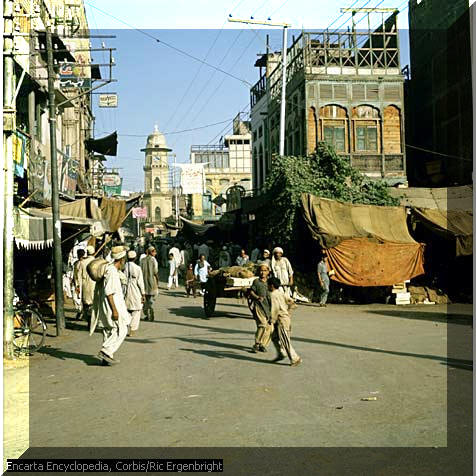
traditional terminus of caravans from Afghanistan. Industries include handicrafts and the manufacture of processed food, footwear, silk, and cotton textiles. Peshāwar University was established here in 1950. Also in the city is Peshāwar Museum, which houses important collections of sculpture of the ancient Gandhara civilization. An ancient trading center known as Purushapure, the city was a target for invaders of the Indian subcontinent because of its strategic location near the pass. In the early 19th century Peshāwar came under the control of the Sikhs, and in 1849 it was captured by the British. It has been the capital of the Pakistani North-West Frontier Province (except for 1955-70) since 1947. Population (1998) 988,005. The North-West Frontier Province spans an area of 74,521 sq km (28,773 sq mi). The province is mostly mountainous and rocky, and is crossed by several mountain ranges, including the Hindu Kush in the northwest, the Himalayas in the northeast, and the Sulaimān and Safed Koh ranges in the west. The province’s climate is extremely diverse. Near Dera Ismāīl Khān in the south is one of the hottest areas in the Indian subcontinent, while across the mountain region to the north the weather is temperate in summer and intensely cold in winter. Canals irrigate the province. Much of Pakistan’s trade with Afghanistan passes through the province, and Peshāwar, the province’s capital city, serves as a market center for goods brought by traveling Afghan merchants. Peshāwar is also the seat of Peshāwar University, founded in 1950. The province’s inhabitants, who are mostly Pashtuns, speak the Pashto language, which is also spoken in Afghanistan. The province’s culturally varied past is evident throughout the region. Roman and Hellenistic influence flourishes in the popular style of Buddhist art called Gandhara, and Hindu influence is reflected by Mahayana Buddhism, which had its origin in the North-West Frontier Province and from there spread to Central Asia and East Asia. Many important Buddhist relics have been found in the region.
Near Peshāwar, the Khyber Pass—the most important mountain pass in the region—has long served as the gateway between North-West Frontier Province and India for trade and for invasion. Several major military figures throughout history have annexed the region to their empires. Because of these frequent, often short-lived invasions, the area has had a turbulent history. After passing for centuries from ruler to ruler, the region was conquered by the Muslims of Ghaznī Province in the 11th century. In the wake of this Muslim invasion, Pashtun tribes entered the territory. By the end of the 12th century fresh invaders were pouring in, but the Pashtun rulers primarily held the area until Babur, founder of the Mughal dynasty and India’s first emperor, incorporated it into his kingdom in the 16th century. In the 18th century the region became part of the city of Kābul, in Afghanistan. Still later, the North-West Frontier Province became part of the Sikh kingdom. The province’s turbulent history continued into modern times. The British annexed it to their Indian empire in 1849, but that failed to bring peace. The province was at war with the British until the British evacuated the region in 1947, when it became a province of Pakistan. Population 2,547,800 (1998 estimate)
|