Back to the birdpage Back to the Tedki
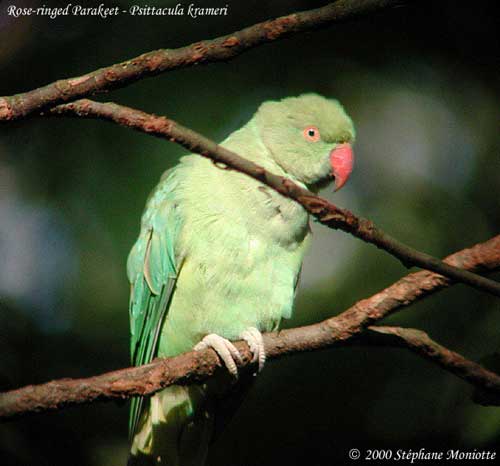
Rose-ringed Parakeet
Genus Psittacula Cuvier
Location where spotted : Commonly seen, often in flocks flying over the tekdi
Marathi name : Keer Popat
Medium-sized, predominantly green parrots with a long, strongly graduated tail, in which the feathers, particularly the long central pair, are narrow. Many species have a dark collar and or a colourful head in the m but this is less conspicuous in the f. The bill is heavy and robust with a distinct notch in the upper mandible. Cranially, there is a wide interruption to the eye ring and a large postfrontal process arches ventrally (downward).
It is one of the most widely distributed of all parrot species. Several extinct species of Psittacula are known from the Mascarene Is, while the only extant representative of the genus there, is the endangered Echo Parakeet (P. echo) of Mauritius. They occupy a wide range of habitats and naturally are secondary cavity nesters, although with urbanisation, they now also nest in buildings. Eggs are broad oval, white, and clutch size is large for a psittacine. Psittacula (Gr) = a small parrot.
Other Names (R366, SM382.3): Green Parakeet, Long-tailed Parakeet, Northern Rose-ringed Parakeet, Ring-necked Parakeet, Senegal Long-tailed Parakeet
Identification: 37-43 cm; 116-139 g; sexes dimorphic in plumage. Medium sized; long tail diagnostic. Ad m: Light green all over with upper mandible dark red tipped black, lower black chin and malar area curving and narrowing into a half-collar on the side of the neck, where it is bordered below by a narrow rose pink line that extends over the nape, and above by distinct mauve-blue extending onto hind crown. Flight feathers dusky green above, grey below. Tail bluish green on the central feathers, ochrish below. Ad f: F lacks the blue, pink and black on the head but can show an emerald collar. Juv: Like f but yellower, with no or an indistinct collar. Eyes yellowish white, bill coral red, legs and feet greenish slate. Imm: Similar to f but bill slightly paler, eyes greyish; m acquires collar in third year. Confusing species: None.
Voice: Very vocal, especially at communal roosts, exhibiting a wide range of shrieks, whistles and other sounds. Characteristic calls a shrill, rather harsh kee-ak, kee ak; a rasping kreh kreh kreh kreh from flocks; a chattering cheechee in flight, especially when approaching the nest; ak ak ak issued as a warning; and quiet trilling and whistling notes when feeding and in courtship.
Distribution: Occurs in much of s Asia. Generally common throughout their range in a wide range of habitats. Flocks of hundreds may concentrate at food sources incl crops of sorghum, millet and lentils.
Population and Demography: Common and widespread. No data on population size. Age of first breeding, survivorship and longevity unknown.
Movements: Unknown.
Habitat: Very adaptable habitat generalist. Occurs in a variety of woodland types from light secondary moist forest, riparian woodland, and mangroves through savanna grassland, and open farmland with scattered trees to parks and gardens in urban areas, usually below 2000 m.
General Habits: Highly gregarious species especially outside the breeding season, forming large noisy flocks. Usually observed in small flocks or in groups of up to 50 birds, but occasionally hundreds. Flight is rapid and high. Roost communally.
Feeding and Food: A variety of cereals, grain, weed and tree seeds, berries, wild and cultivated fruits, nuts, flowers and young shoots; nectar taken. Composition of the diet varies seasonally; specific items incl. Ziziphus, Tamarindus, Acacia buds and pods, Adansonia, Psidium, Slassus, Faidherbia albida, and insect larvae.
Breeding: Monogamous. Non-territorial and sometimes loosely colonial when breeding. Degree of mate fidelity likely less than in Poicephalus species. Unknown aspects of breeding biology incl geographical/ seasonal variation in clutch size, incubation shift lengths, and plumage and morphological development of young. The courtship display is elaborate (Forshaw 1989). Uttering a low, twittering note, the hen spreads her wings slightly, moves herself from side to side, and rubs bills with the m. The m struts towards her, feeds her by regurgitation, draws himself to full height and repeatedly raises 1 foot. This display continues for some minutes and is followed by copulation. Laying dates: In Africa, breed from Aug-Nov (Mackworth-Praed & Grant 1952, Cunningham-van Someren 1969). Nest: Nests in a natural tree cavity up to 10 m above ground, or enlarged hole of another bird species, a rock crevice or building (Juniper & Parr 1998). Eggs: Usually 3-4, but up to 6. Eggs rounded, white. Size: (n=3) 27.3 x 24 mm. Number of breeding attempts likely exceed 1/yr for the feral populations. Incubation: Starts with the laying of the first egg. Period 28 d (n=2) by f predominantly. Development and care of young: Newly hatched young undescribed. Nestling period 40-58 d (n=2) in captivity (Maclean 1985). Post nestling dependence period lasts for several months after fledging, at 6-7 wk of age. Breeding success: No data.
Conservation: Outside s Africa, thousands of birds are caught annually for the bird trade and information on the effects to local populations would be informative, although it is a common pest of cultivated crops.
Geographical Variation: 4 subspecies are known worldwide, 1 occurring in region. P. k. krameri from India, P. k. parvirostris from Africa and P. k. borealis and P. k. manillensis from Asia.
Measurements: wing (9 m) 170-177 (173.9), (8 f) 170-175 (172.4); tail (9 m) 226-253 (239.2), (8 f) 211- 230 (220); tarsus (9 m) 17-18 (17.7), (8 f) 18-19 (18.3); culmen (9 m) 22-25 (23.2), (8 f) 21-24 (23) (Maclean 1985); mass (m & f) no data.
missing data
Population and demography
Age of first breeding
Survivorship
Longevity
Movements
Fresh egg mass
Geographic variation in clutch size
Seasonal variation in clutch size
Incubation shift lengths
Description of the newly-hatched young
Plumage and morphological development of chicks
Chick weights
Interactions among young
Chick behaviour
Distraction displays
Breeding success
Moult: Timing and nature
Mass (male and female)
Please note the following:
These texts have not yet been reviewed and therefore might contain factual inaccuracies.
The accounts are published purely for public review and may not be quoted in any shape or form.