
INTRODUCTION & INTERPRETATION
TABLE OF CONTENTS |
Preparing for his death, Peter exhorts the recipients to maintain their knowledge of inspired Scripture. That knowledge will be used by God to keep them from following the coming false prophets who want the recipients living ungodly lives.
- Like 1 Peter, the text of 2 Peter reveals that the Apostle Peter was the human author (2 Peter 1:1).
- In 2 Peter 1:13-14 the author recalls the Lord's prediction of Peter's death in John 21:18-19.
- The writer states that he was present during our Lord's transfiguration (2 Peter 1:16-18). Matthew 17:1-8 records the presence of Peter, James, and John the son of James.
- The author indicates an intimate relationship with the Apostle Paul in 2 Peter 3:15. Paul first visited Peter sometime between AD 36-38 (Galatians 1:18-19; John Stirling, An Atlas of the Acts, page 5).
- There is no information given that identifies the location where Peter wrote the Epistle (Edwin A. Blum, 2 Peter, The Expositor's Bible Commentary, volume 12, page 262).
Most commentators believe 2 Peter was written after 1 Peter and to the same recipients. However, this is not certain.
- Since Peter wrote this Epistle, it had to be written before his death. “First Clement 5:4-7 names Peter and Paul as victims of persecution. The common understanding is that the passage refers to the persecution by Nero at Rome . . . which began after the disastrous fire in the city of Rome on 19 July 64 (Edwin A. Blum, 1 Peter, The Expositor‘s Bible Commentary, volume 12, page 212).”
- Second Peter 1:14 indicates the time of Peter's death was near.
- If 2 Peter is the second letter to ". . . Pontus, Galatia, Cappadocia, Asia and Bithynia . . .(1 Peter 1:1)," it had to be written after 1 Peter.
The text provides some clues:
- Second Peter 1:12 may indicate that the previous paragraph (2 Peter 1:3-11) is a summary, an exhortation to progress in their present tense sanctification.
- Second Peter 3:1 indicates that both 1 and 2 Peter have as their purpose, ". . . stirring up your sincere mind by way of reminder, that you should remember the words spoken beforehand by the holy prophets and the commandment of the Lord and Savior spoken by your apostles (NASV)."
- See interpretation below.
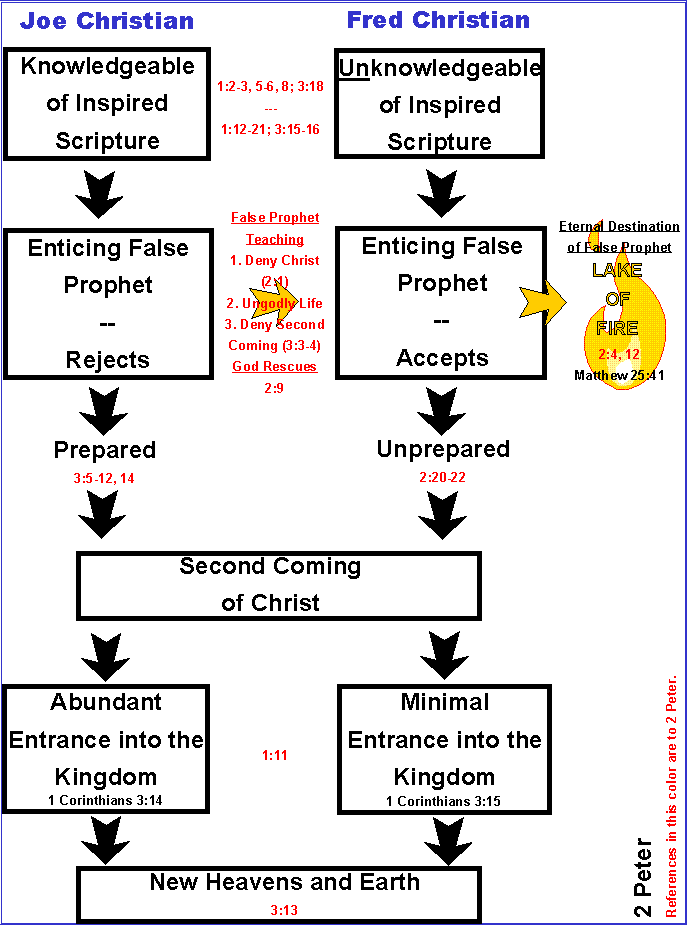
- Introduction (1:1-15): to teach/believers/that they need to know how to live a godly life (3-4) by becoming knowledgeable of Jesus (5-11) and His promises (8-11) because Peter's life is coming to an end (12-15)
- Author (1:1a): to identify/for the believers/the Apostle Peter as the author of the letter to establish its authority
- Recipients (1:1b-2): to identify/believers as the recipients of the letter and as qualified to receive grace and peace through their knowledge Jesus Who is God
- Godly Life (1:3-4): to teach/believers/that they may live a godly life by becoming knowledgeable of Jesus and His promises [NIV reflects the Greek here more literally than NASV.]
- to teach/believers/that knowledge of Jesus, Who called them to His glorious goodness, is the conduit through which they receive empowerment to live a godly life (1:3)
- to teach/believers/that Jesus has given them promises through His glorious goodness because they can participate in His goodness and escape the corruption of the world brought on by evil desires (1:4)
- Virtues: to command/believers/to cultivate their faith with moral excellence, knowledge, self-control, perseverance, godliness, brotherly kindness, and love (1:5-11) . . .
- . . . because these virtues make them fruitful in the knowledge of Jesus (8) rather than stuck in their former sins (9), . . .
- . . . because the virtues will confirm their salvation (10a), . . .
- . . . because the virtues will keep them from stumbling (10b), . . .
- . . . and because the believers will receive great reward when they enter Jesus' kingdom (11)
- Peter's Death (1:12-15): to teach/believers/that Peter wants them to know these things so that they will have the information after he dies
- Prophets (1:16-2:18a): to exhort/believers/to be familiar with inspired Scripture because its teachings can be used to keep believers from the enticement of false prophets and thus prepared for the return of the Lord
- True Prophets (1:16-21): to exhort/believers/to pay attention to Scripture (19) because Its human authors were eyewitnesses of Jesus' ministry (16-18) and because God inspired Its words rather than being devised by man (20-21)
- False Prophets (2:1-18a): to teach/believers/that they will need God's help in rescuing them from unrighteous persons because false prophets will come to entice the believers
- The Coming of False Prophets (2:1a, 2-3a): to teach/believers/that false prophets motivated by greed (3a) will arise among them (1a) so that they might be exploited (2b, 3b) with heresy, including a false teaching about how to be saved (1b), and sensuality (2a)
- God's Oversight (2:1c, 3c-9): to teach/believers/that God knows how to rescue them and jail the false prophets because in the past He has rescued the godly from temptation and incarcerated the unrighteous until their judgment (1c, 3c, 9):
- He jailed unrighteous angels (4). The unrighteous angels are perhaps those mentioned in Genesis 6:1-6 and Jude 6.
- He jailed the unrighteous citizens of the world at the time of the flood but rescued righteous Noah and seven others (5).
- He jailed the unrighteous citizens of Sodom and Gomorrah but rescued righteous Lot. Lot was tormented daily by the citizens' sins (6-8).
- The False Prophets' Conduct (2:10-18a): to teach/believers/that the false prophets have certain characteristics so that the recipients will be able to identify the false prophets who will be punished with eternal death (12b-13a, 14e, 17b) and not be duped by them (14c, 18b)
- They indulge the flesh (10a).
- They despise authority (10b).
- They revile angels (10c-11). They "scold" angels.
- They are like unreasoning animals (12a).
- They carouse (13b).
- They commit adultery (14a).
- They continually sin (14b).
- They entice unstable persons by fleshly desires, sensuality (14c, 18a).
- They are greedy (14d, 15-16).
- They are not whom they pretend to be (17a).
- They speak arrogant vanity (18a).
- They live in error (18c).
- They are slaves of corruption (19).
- Dupes (2:18b, 20-22): to exhort/believers/that they should not fall to the enticements of the false prophets because the backslidden condition will be worse than their unsaved state in this life (20-22) -- There is a lot of controversy over this section in the commentators.
- First, who are the subjects of the verses? Does the "them (NASV)" of verse 20 refer to the false prophets or to Christians who have fallen to the false prophets' enticements? Edwin A. Blum believes the subjects are the false prophets (2 Peter, The Expositor's Bible Commentary, volume 12, page 282).
- This controversy is easily decided by following the antecedents of the pronouns. The antecedent chain goes through the appearances of "they" in verse 20, of "them" and "they" in verse 19, and of "those" in the latter part of verse 18.
Notice that the verse 18 "those" are the ones enticed by the "they" in the first part of verse 18. The "they" refers to the false prophets who are described in the preceding verses. The "those" are the ones the false teachers have affected negatively.
- Also note that the word, "knowledge," in verse 20 is always used of Christians in 2 Peter (1:2-3, 5-6; 3:18). It is not used of false prophets or of non-believers. This is a knowledge that believers have had.
- The purpose of 2 Peter is to warn believers, not non-believers, to maintain their knowledge so that they will not fall to the teachings of false teachers (3:17-18).
- Thus, the subjects of verse 20 certainly are those who have been enticed by the false prophets.
- Second, does the text indicate that the persons, who have fallen to the false prophets' enticements, have lost their salvation or were never saved?
- The text never indicates that the persons are going to Hell, eternal suffering, the Lake of Fire, etc.
- Some teach that they are going to hell because they are compared to ceremonially unclean animals (verse 22). For example, see William MacDonald, Believer's Bible Commentary, page 2300, and Kenneth O. Gangel, 2 Peter, The Bible Knowledge Commentary, New Testament edition, page 874. However, this teaching is wrong:
- "Notice that the dog and pig are said to have been free from their filth. Only believers are free of their sins. Surely the reader of 2 Peter would harken back to 1:9 where Peter refers to his readers as being purged from their old sins (Bob Wilkin, Does Hell Await Those Who Fall? 2 Peter 2:18-22)." The original readers were Christians (e.g., 1:1).
- With the advent of the New Covenant, Peter no longer recognized anything as unclean (Acts 10:28).
- The question in 2 Peter is not who will be able to enter the Kingdom, but who will have an abundant entrance into the Kingdom (1:11). Those who fall to the enticement of the false prophets will have a minimal entrance. See also 1 Corinthians 3:14-15.
- Christians do not loose their deliverance from hell (e.g., John 10:28-30; Romans 8:28-39).
- See also paragraphs a-ii and a-iii above that support the understanding that the successfully enticed subjects will not go to hell.
- 2 Peter does not teach that the erring subjects of 2:18b-22 will be eternally destroyed. See also Duane A. Dunham, An Exegetical Study of 2 Peter 2:18-22, Bibliotheca Sacra, January-March 1983, page 51.
- True Prophecy (3:1-13): to command/believers/to remember the teachings of the prophets and the apostles so that the believers will be prepared for the day of the Lord by living a godly life, because false prophets will teach that it will not take place and because the believers do not know when it will happen
- to teach/believers/that this is the second letter Peter has written to them because he wanted to remind them of the teachings of true prophets and apostles of the Lord (1-2)
- Note that when the Apostles speak they are as authorative as the Lord (2).
- to command/believers/to understand that the heavens and earth will be destroyed by fire because false prophets will come who will teach on their own authority that the heavens and earth will continue uninterrupted by God's judgment (3-7)
- Notice the supposed intellectual superiority that is carried by the idea of "mocking (3-4)."
- Peter reminds the readers that God destroyed the whole world once before (5-6) and implies He can do it again, this time by fire (7).
- to command/believers/to understand that the Lord is being very patient with executing His judgment so that non-believers might have ample opportunity to believe (8-9)
- to exhort/believers/to conduct themselves with godliness and holiness now because they will not know when the current heavens and earth will be destroyed and replaced with new ones in which righteousness prevails (10-13)
- ". . . the day of the Lord. An extended period of time, beginning with the tribulation and including the events of the second coming of Christ and the millennial kingdom on earth (Ryrie Study Bible, NASV, page 1809)."
- Conclusion (3:14-18): to command/believers/to work hard at being spotless and blameless (14) because they need to be presentable when the Lord comes again (14-16); because unprincipled, false prophets will attempt to dupe them (17); and because the Lord has given them sufficient grace in which to grow godly by providing them with knowledge (18)
INTERNET SITES WITH INFORMATION ON FALSE TEACHERS
Apologetics Index: http://www.gospelcom.net/apologeticsindex/
Christian Apologetics & Research Ministry: http://www.carm.org/
Christian Research Institute: http://www.equip.org/
Midwest Christian Outreach: http://www.midwestoutreach.org/index2.html
 Ó 2003, Ken Bowles -- March 02, 2003,
Edition
Ó 2003, Ken Bowles -- March 02, 2003,
Edition
Advertising appearing in conjunction with this page is not endorsed.