The Nautilus and The Human Embryo
and the Golden Ratio

The Nautilus
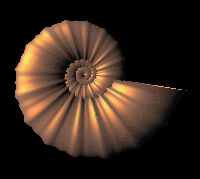
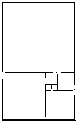
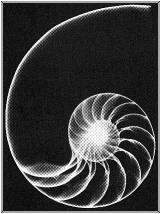
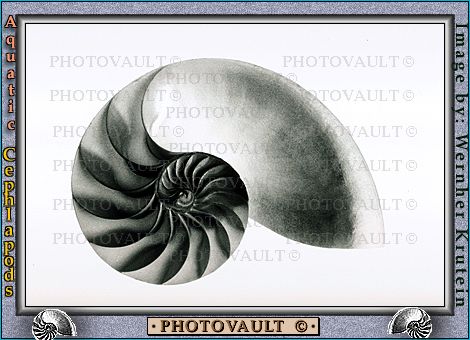
The first diagram is of the outside of a nautilus shell. The second diagram shows that a spiral can be drawn by putting together quarter circles, one in each new square. This is the golden spiral. This is present because the growth of the nautilus is proportional to the size of the organism. A similar curve to this occurs in the shape of a nautilus shell. The Fibonacci rectangles spiral increases in size by a factor of Phi (1.618..) in a quarter of a turn, the nautilus spiral curve takes a whole turn before points move a factor of 1.618... from the center. The third diagram is a cross section of a nautilus shell, in which the golden spiral can be seen. This pattern is also known as the Logarithmic Spiral.
The Human Embryo

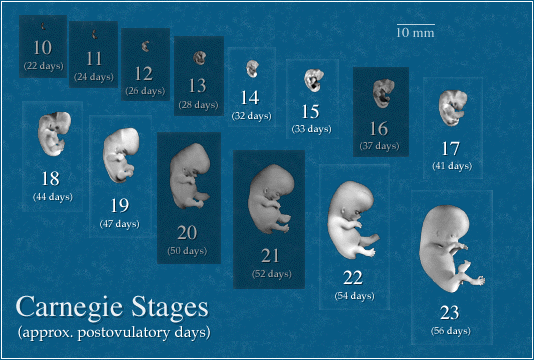
As the human embryo develops, it slowly unfolds itself in a pattern similar to the way the golden spiral unfolds itself as it spins farther and farther away from its center. This pattern is present because the growth of the organism is proportional to the size of the organism This pattern is also known as the Logarithmic Spiral.
Logarithmic Spirals
The spiral shapes of a nautilus are called Equiangular or
Logarithmic spirals. If P is any point on the spiral then the length of the spiral
from P to the origin is finite. In fact, from the point P which is at distance d from the
origin measured along a radius vector, the distance from P to the pole is d sec a.
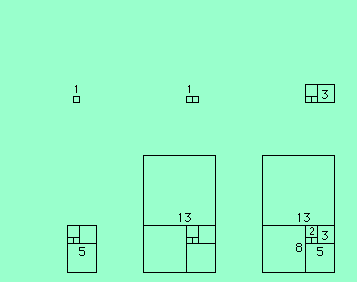
The Fibonacci sequence relates closely to the golden ratio and to
logarithmic spirals. Logarithmic spirals are simply spirals that increase at a logarithmic
rate. The golden ratio, however, is a special fraction equivalent to about 0.618. A
logarithmic spiral can be generated by subdividing a golden rectangle into increasingly
smaller squares and golden rectangles. This subdivision begins by fitting a square within
the golden rectangle. The remaining space forms a new, smaller golden rectangle. By
repeating this process, the spiral form soon becomes evident. Furthermore, the subdivided
sections can be thought about as Fibonacci numbers.
One reason why the logarithmic spiral appears in nature is that it
is the result of very simple growth programs such as:
 Grow 1 unit, bend 1 unit
Grow 2 units, bend 1 unit
Grow 3 units, bend 1 unit
And so on...
Any process which turns or twists at a constant rate but grows or moves with constant acceleration will generate a single logarithmic spiral.
Formulas
Let alpha be the constant angle.
Parametric: {E^(t Cot[alpha]) Cos[t], E^(t Cot[alpha])
Sin[t]}
Cartesian: x^2 + y^2 == E^(ArcTan[y/x] Cot[alpha] )
Polar: r == E^(theta Cot[alpha])
Pedal: p == r Sin[alpha]
Whewell: r == s Cos[alpha]
Cesaro: rho == s Cot[alpha]
Properties
Pursuit Curve
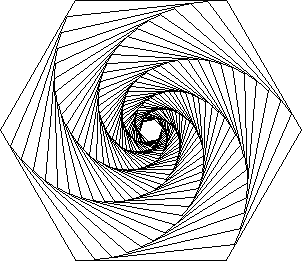
Pursuit curves are the trace of an object chasing another. Suppose
there are n bugs each at a corner of a n sided regular polygon. Each bug crawls towards
its next neighbor with uniform speed. The trace of these bugs are equiangular spirals of
(n-2)/n * Pi/2 radians (half the angle of the polygon's corner). The figure on the left
shows the trace of four bugs, resulting four equiangular spirals of 45 degree. The figure
on the right has six objects forming a chasing chain. Each line is the direction of
movement and is tangent to the equiangular spirals so formed.
Catacaustic
Catacaustic of an equiangular spiral with light source at pole is an
equal spiral. Proof: Let O be the
pole of the curve. Let O' be the reflection of O through the normal of a variable point P
on the curve.
The locus of O' is then an equal spiral since distance[O,O']/distance[O,P] is constant for
any P and
equiangular spiral remain unchanged by scaling. Now the reflected ray PO' is just the
tangent of O'.
Evolute
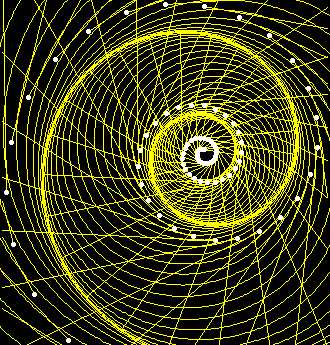
The evolute of an equiangular spiral is an equal spiral, so is its
involute. The left figure shows
osculating circles of the curve and their centers (white dots). The right figure shows the
curve's
envelope of normals. The original curve is an 80 degree equiangular spiral.
Radial
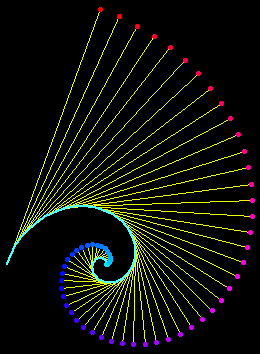
The radial of an equiangular spiral is itself scaled. The figure on the
left shows a 70 degree
equiangular spiral and its radial. The figure on the right shows its involute, which is
another
equiangular spiral.
Inversion
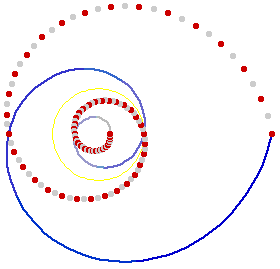
The inversion of an equiangular spiral with respect to its pole is an
equal spiral.
Pedal
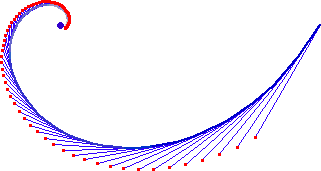
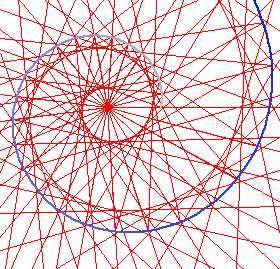
The pedal of an equiangular spiral with respect to its pole is an equal
spiral. In the figure, the lines
from pole to the red dots is perpendicular to the tangents (blue lines). The blue curve is
an 60 degree
equiangular spiral. The red dots forms its pedal.
Geometric Sequence
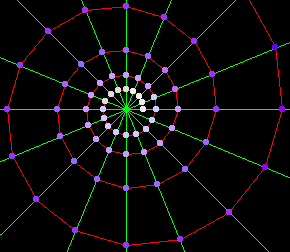
If any part of the curve is scale up or down, it becomes congruent to
other parts of the curve.
Lengths of segments (red lines) cut by equally spaced radii (green lines) is a geometric
sequence.
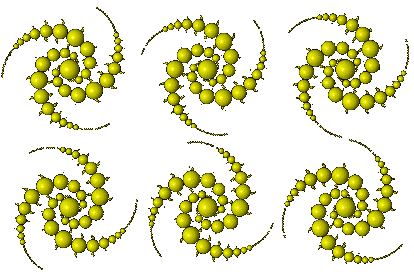
Segments of any radius vector cut by the curve is also a geometric sequence, with a
multiplier of
E^(2 Pi Cot[alpha]). In the figure, the dots are points on a 85 degree equiangular spiral.
 Go back to the
Biology and the Golden Ratio page
Go back to the
Biology and the Golden Ratio page
Go back to the Golden Ratio page