Pinecones and Sunflowers
and the Golden Ratio

The prescence of the golden spiral in sunflowers and pinecones is similar.
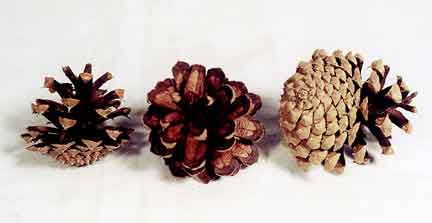
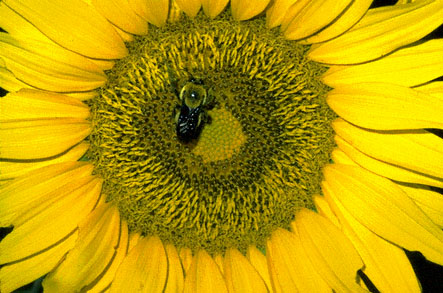
� The golden spiral can be seen in the seedheads of pinecones and sunflowers.
 You can see that the seeds
in pinecones seem to form spirals, curving both to the left and to the
You can see that the seeds
in pinecones seem to form spirals, curving both to the left and to the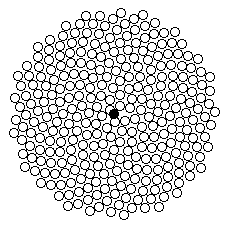 right. If you count
the spirals going to the right there are 34.� There are 55 spirals going to the
left.� These two numbers are neighbours in the Fibonacci series. To the left is a
picture of a pinecone with the left and right spirals drawn.� To the right is a
picture of a sunflower's seed head. �
right. If you count
the spirals going to the right there are 34.� There are 55 spirals going to the
left.� These two numbers are neighbours in the Fibonacci series. To the left is a
picture of a pinecone with the left and right spirals drawn.� To the right is a
picture of a sunflower's seed head. �
The reason this spiral is present seems to be that it forms an optimal packing of the
seeds so that, no matter how large the seedhead, they are uniformly packed, all the seeds
being the same size, no crowding in the centre and not too sparse at the edges.
 This pattern is not perfect in many
sunflowers, but if you had a very good specimen it would form superposed right and left
handed spirals. � The seeds grow into the head of the sunflower along these spirals,
so that the seeds are always equidistant from each other. This arrangement is also said to
allow for the best use of the surface area, maximizing the number of seeds on the curved
surface. The tendancy of leaves on plants to follow the spiral makes for efficency in
gathering both light and water.� Also, the rows of petals of sunflowers� are in
pairs of 21 and 34, 34 and 55, and 55 and 89.
This pattern is not perfect in many
sunflowers, but if you had a very good specimen it would form superposed right and left
handed spirals. � The seeds grow into the head of the sunflower along these spirals,
so that the seeds are always equidistant from each other. This arrangement is also said to
allow for the best use of the surface area, maximizing the number of seeds on the curved
surface. The tendancy of leaves on plants to follow the spiral makes for efficency in
gathering both light and water.� Also, the rows of petals of sunflowers� are in
pairs of 21 and 34, 34 and 55, and 55 and 89.
��� In addition, heliotrope (sunflower) is derived from Greek words meaning "sun turning." From the same root comes the word helix, meaning a whirl, curl, or spiral.
Once a seed is positioned on a seedhead, the seed continues out in a straight line pushed out by other new seeds, but retaining the original angle on the seedhead. No matter how large the seedhead, the seeds will always be packed uniformly on the seedhead.

If you count the spirals near the center in both directions, they will both be Fibonacci numbers. The spirals are patterns that the eye sees, "curvier" spirals appearing near the center, flatter spirals, and more of them, appear the farther out you go.� The above pictures illustrates this concept.
Phyllotaxis
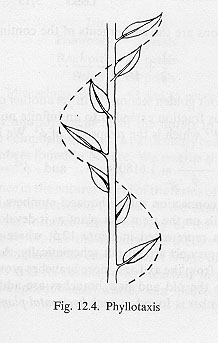 ��� Phyllotaxis is the
botanical term for a topic which includes the arrangement of leaves on the stems of
plants.
��� Phyllotaxis is the
botanical term for a topic which includes the arrangement of leaves on the stems of
plants.
Many plants show the Fibonacci numbers in the arrangements of the leaves
around their stems. If one looks down on a plant, the leaves are often arranged so that
leaves above do not hide leaves below. This means that each gets a good share of the
sunlight and catches the most rain to channel down to the roots as it runs down the leaf
to the stem.�
The Fibonacci numbers occur when counting both the number of times one goes around the
stem, going from leaf to leaf, as well as counting the leaves one meets until one
encounters a leaf directly above the starting one. If one counts in the other direction,
one gets a different number of turns for the same number of leaves. The number of turns in
each direction and the number of leaves met are three consecutive Fibonacci numbers.
� When one divides the number of turns by the number of leaves, one will find the
Golden Ratio.
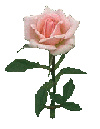
��� Some of the most common arrangements are in ratios of alternating
Fibonacci numbers: 2/5, found in roses and fruit trees, or 3/8, which is found in
plantains, or 5/13, found in leeks, almonds, and pussy willows.� In addition, the
number of times one has circled the stalk will be another Fibonacci number.
The Meristem and Spiral growth patterns�
 Plants grow from a single tiny group of cells
right at the tip of any growing plant, called the meristem.� There is a separate
meristem at the end of each branch or twig and it is here that new cells are formed. Once
formed, they grow in size, but new cells are only formed at this growing point. So cells
earlier down the stem expand and so the growing point rises.� Also, these cells grow
in a spiral fashion, as if the stem turns by an angle and then a new cell appears, turning
again and then another new cell is formed and so on.� These cells may then become a
new branch, or perhaps on a flower become petals and stamens.
Plants grow from a single tiny group of cells
right at the tip of any growing plant, called the meristem.� There is a separate
meristem at the end of each branch or twig and it is here that new cells are formed. Once
formed, they grow in size, but new cells are only formed at this growing point. So cells
earlier down the stem expand and so the growing point rises.� Also, these cells grow
in a spiral fashion, as if the stem turns by an angle and then a new cell appears, turning
again and then another new cell is formed and so on.� These cells may then become a
new branch, or perhaps on a flower become petals and stamens.
���  The interesting fact is that a single
fixed angle can produce the optimal design no matter how big the plant grows.� Once a
seed is positioned on a seedhead, the seed continues out in a straight line pushed out by
other new seeds, but retaining the original angle on the seedhead. No matter how large the
seedhead, the seeds will always be packed uniformly on the seedhead.� And all this
can be done with a single fixed angle of rotation between new cells.� The fixed angle
of turn is Phi cells per turn or phi turns per new cell.
The interesting fact is that a single
fixed angle can produce the optimal design no matter how big the plant grows.� Once a
seed is positioned on a seedhead, the seed continues out in a straight line pushed out by
other new seeds, but retaining the original angle on the seedhead. No matter how large the
seedhead, the seeds will always be packed uniformly on the seedhead.� And all this
can be done with a single fixed angle of rotation between new cells.� The fixed angle
of turn is Phi cells per turn or phi turns per new cell.
Here are some quicktime videos illustrating the golden spiral in seed heads.
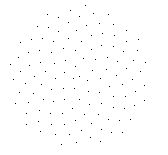 Click here for a
movie of 120 seeds appearing from a single central growing point.� Each new seed
is 0.618 of a turn from the last one. Or, equivalently, there are 1.618 seeds per turn.
The animation shows that, no matter how big the seed head gets, the seeds are always
equally spaced. At all stages the Fibonacci Spirals can be seen. ���
Click here for a
movie of 120 seeds appearing from a single central growing point.� Each new seed
is 0.618 of a turn from the last one. Or, equivalently, there are 1.618 seeds per turn.
The animation shows that, no matter how big the seed head gets, the seeds are always
equally spaced. At all stages the Fibonacci Spirals can be seen. ���
�
�
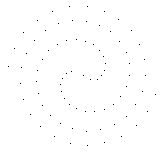 Click here for
a movie of� 0.48 of a turn between seeds. The seeds seem to be sprayed from two
revolving "arms". This is because 0.48 is very close to 0.5 and a half-turn
between seeds would mean that they would just appear on alternate sides, in a straight
line. Since 0.48 is a bit less than 0.5, the "arms" seem to rotate backwards a
bit each time.������������������������
Click here for
a movie of� 0.48 of a turn between seeds. The seeds seem to be sprayed from two
revolving "arms". This is because 0.48 is very close to 0.5 and a half-turn
between seeds would mean that they would just appear on alternate sides, in a straight
line. Since 0.48 is a bit less than 0.5, the "arms" seem to rotate backwards a
bit each time.������������������������
���
�
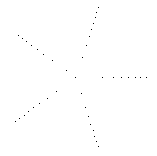 Click
here for a movie of what will happen with 0.6 of a turn between successive seeds.
� Notice how the seeds are not equally spaced, but fairly soon settle down to 5
"arms".� This happens because 0.6=3/5 so every 3 turns will have produced
exactly 5 seeds and the sixth seed will be at the same angle as the first, the seventh in
the same angular position as the second and so on. The seeds appearing at every third arm,
in turn, round and round the 5 arms.
Click
here for a movie of what will happen with 0.6 of a turn between successive seeds.
� Notice how the seeds are not equally spaced, but fairly soon settle down to 5
"arms".� This happens because 0.6=3/5 so every 3 turns will have produced
exactly 5 seeds and the sixth seed will be at the same angle as the first, the seventh in
the same angular position as the second and so on. The seeds appearing at every third arm,
in turn, round and round the 5 arms.
���
 Go
back to the Biology and the Golden Ratio page
Go
back to the Biology and the Golden Ratio page
Go back to the Golden Ratio page