


 When Dr. Conan Doyle at length relented (as in time he did) it was not, however, one of the problems mentioned by Watson that he chose to present. It was the famous "Hound of the Baskervilles," still perhaps the most celebrated of the many adventures of Sherlock Holmes. As a matter of fact, it was the one story that got me started.
But, to bring the dead to life is an achievement. And Doyle had killed his hero, in "The Final Problem," with a finality that was appalling. Was he at all troubled in his mind about it? At the time of writing, not a whit. But it is impossible not to believe that, tardily, he felt regret. It is impossible not to feel certain that, in later years, after the murderous impulse of moment had long passed, he wished it had been otherwise. At the very least, one can imagine him as thinking, he might have left the death of Holmes in doubt. There was Arabia to which he might have been sent, instead of Switzerland. Men disappeared for years in the Arabian Desert, then turned up safe and whole with manuscripts beneath their arms.
Yet the truth, when he established it, was as simple as falling off a porch. Holmes was not dead at all. Never for a minute had he been dead. Sir Arthur, like all the rest of us, had been mistaken; deceived by Watson's error at the brink; misled, no doubt, by Watson's later silences.
Watson himself had known since 1894, which was the year that "all London was interested, and the fashionable world dismayed, by the murder of the Honourable Ronald Adair, under most unusual and inconceivable circumstances." The crime was of considerable importance in itself, but it was its "inconceivable sequel" that lent it interest and importance to the doctor (who was by this time a widower, his wife having passed away some time during the years of Holmes's absence).
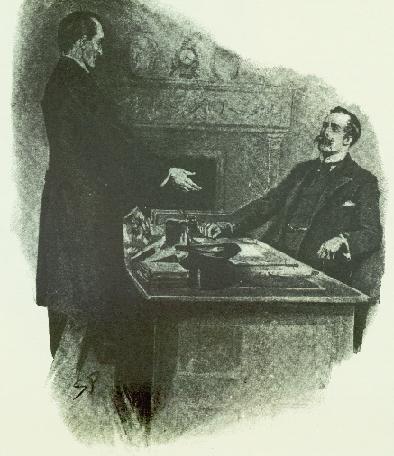 It was not to be supposed that after the passing of his two associates Watson would settle down with no further interest in crime; and we have his word for it that he did nothing of the sort. In point of fact, he never failed to read with care the various problems that came before the public; and more than once he even endeavoured to employ the familiar methods of his mentor in their solution. For his personal satisfaction only, of course, and always--as he tells us--with indifferent success. The case of Ronald Adair, as it happened, had made a strong appeal to him--so much that six o'clock, one evening, he found himself one of a group of curious idlers staring up at a window in the dead man's house. Turning to leave the scene, he collided with an elderly, deformed man and jostled a number of volumes from the man's hands.
 There is no need to continue the account. The world has long since known the truth of that eventful meeting. The crippled bookman was Sherlock Holmes himself. And what more natural than his explanation, a little later, to the bewildered and delighted Watson? "My dear fellow . . . about that chasm. I had no serious difficulty getting out of it, for the very simple reason that I was never in it."
Moriarty alone had fallen to his doom! "O frabjous day! Callooh! Callay!" I, of course, am not quoting Watson literally; but it is all there between the lines--his joy, his affection, and his satisfaction. And so once more Mr. Sherlock Holmes was free to devote his life to examining "those interesting little problems, which the complex life of London so plentifully presents."
For sensible reasons he had sent not even Watson word of his survival. The trial of Moriarty's sinister gang had left two of its most dangerous members at large--criminals who would leave no stone unturned to bring about the death of Holmes, once it became known that he had returned to London. Silence, a long vacation, had seemed the wisest course. For two years he had traveled in Tibet, and for a time had conducted a laboratory at Montpellier, in France. Then the Park Lane Mystery had drawn him home--the murder of the Honourable Ronald Adair, which offered him peculiar personal opportunities. He was again in Baker Street, and all was as it ever had been and ever shall be.


