(Return for more funnies)
(Pictures and games to tickle your funny bone!)
88 ways to know if you're Chinese…
Comments please!
(Constructive or abusive appreciated!)
Molecules With Unusual Names
Believe it or not, some chemists do have a sense of humour, and this page is a testament to that. Here we'll show you some real molecules that have unusual, ridiculous or downright silly names.
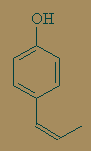
Anol
Anol is a synonym for 4-(1-propenyl)phenol, and it is apparently used in the flavour industry. Are compounds that bond strongly to this molecule called 'anolly retentive'?
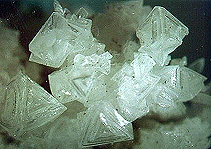
Arsenolite
This is a naturally occurring mineral, whose correct name is cubic arsenic trioxide (As2O3). It is also the primary product whenever arsenic ores are smelted, and is used in industry as a glass decolourising agent.
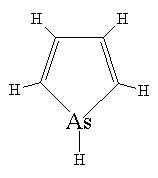
Arsole
Yes, believe it or not, there is actually a molecule called Arsole... and it's a ring! It is the arsenic equivalent of pyrrole, and although it is rarely found in its pure form, it is occasionally seen as a side group in the form of organic arsolyls. Contrary to popular belief, however, the arsoles are not aromatic...
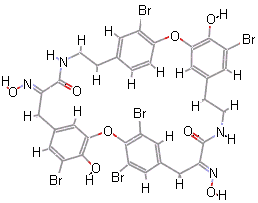
Bastadin-5
This is just one of a number of bastadins, which are molecules isolated from the marine sponge Ianthella basta. They possess antibacterial, cytotoxic and anti-inflammatory properties.
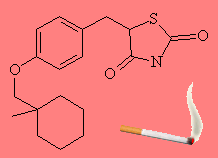
Ciglitizone
I don't know much about this molecule, but its name sounds like the places reserved for smokers to light up.
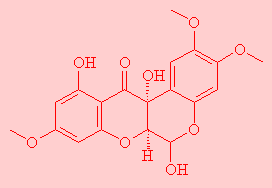
Clitoriacetal
This gets its name from the root of the Clitoria macrophylla plant, and is a constituent of the Thai drug "Nan-tai-yuk".
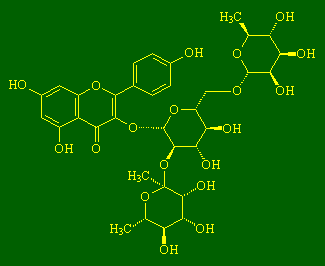
Clitorin
I don't know much about this molecule either, but I've heard it's touch sensitive ;-).
Constipatic Acid
This is a constituent of some Australian lichens, but I don't know how it got its name. Derivatives of this are protoconstipatic acid, dehydroconstipatic acid, and methyl constipatate.
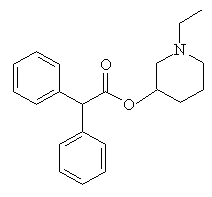
Crapinon
Crapinon (also known as Sanzen) is another molecule with an excellent name, and is apparently used therapeutically as an anticholinergic. These are drugs that dry secretions, increase heart rate, and decrease lung constriction. More importantly, they also constipate quite strongly - so 'crappy-non' is most appropriate. It would be nice to think that this molecule could find an alternative use as a toilet cleaner (as in "Who's been crapinon the seat?").
Cummingtonite
This mineral must have the silliest name of them all. Its official name is magnesium iron silicate hydroxide, and it has the formula (Mg,Fe)7Si8O22(OH)2. It got its name from the locality where it was first found, Cummington, Massachusetts, USA.
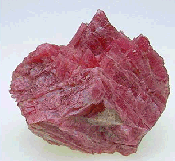
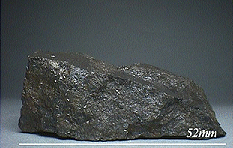
A sample of pyroxmangite, with white pieces of cummingtonite visible toward the lower left
Dickite
Dickite, Al2Si2O5(OH)4, is a (kaolin) clay-like mineral which exhibits mica-like layers with silicate sheets of 6-membered rings bonded to aluminium oxide/hydroxide layers. Dickite is used in ceramics, as paint filler, rubber, plastics and glossy paper. It got its name from the geologist that discovered it around the 1890s, Dr. W. Thomas Dick, of Lanarkshire, Scotland.
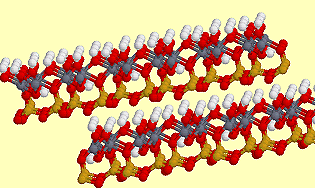
2 layers of dickite
Fornacite
This is a mineral that is composed of a basic chromate-arsenate compound of Pb and Cu with the formula: (Pb,Cu2+)3[(Cr,As)O4]2(OH). If it could be polished into a gemstone, it sounds ideal for a ring that a cheating husband might buy his mistress.
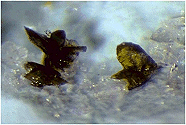
Fucitol
Although this sounds like what an undergraduate chemist might exclaim when their synthesis goes wrong, it's actually an alcohol, whose other names are L-fuc-ol or 1-deoxy-D-galactitol. It gets its wonderful trivial name from the fact that it is derived from the sugar fucose, which comes from a seaweed found in the North Atlantic called Bladderwrack whose latin name is Fucus vesiculosis. Interestingly, there are a few articles in the Journal of Biochemistry throughout 1997 concerning a kinase enzyme, which acts on fucose. The creators of these articles were Japanese, and seemed to have missed the fact that fucose kinase should not be abbreviated as 'fuc-K'.
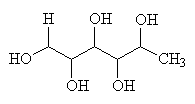
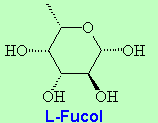
Fucol
This sugar sounds like it doesn't do very much! Actually the L-Fucol form is obtained from the eggs of sea urchins, frog spawn and milk. The L-fucol form also goes by the name of rhodeose.
Fukalite
This wonderfully named mineral gets its name from the Fuka mine in the Fuka region of southern Japan. It is very rare, and is a form of calcium carbonate, with formula Ca4Si2O6(CO3)(OH,F) 2.
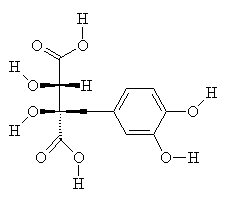
Fukiic Acid
This is the hydrolysis product from the plant Petasites japonicus, so I assume it was first isolated by a Japanese chemist named Fuki? Anyone know? Interestingly, further oxidation of this produces the wonderfully named Fukinolic acid...
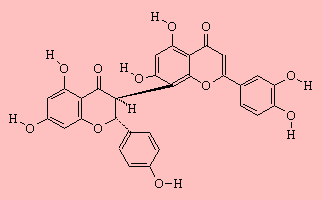
Fukugetin
This chemical with a most amusing name is also called Morellofavone, and is a constituent of the bark of the Garcenia species of tree. Its glucoside goes by the equally wonderful name of Fukugiside.
Kinoshitalite
Although it sounds like the trade name of a laxative, this is a type of mica found in Japan and Sweden, and has the formula (Ba,K)(Mg,Mn,Al)3Si2Al2O10(OH) 2. It is green and vitreous, and is about as hard as fingernails, apparently. Its name comes from the Japanese for "under the tree" (ki = tree; no = possessive particle; shita = under).
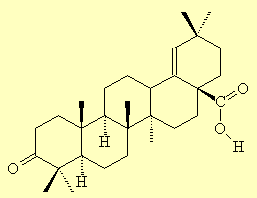
Moronic Acid
This is a triterpenoid organic acid that is found in Pistacia resin, and is therefore of interest to people studying archeological relics, shipwrecks and the contents of ancient Egyptian jars. But why it's called moronic acid is still unknown... Derivatives of this are called moronates, as in 'which moron-ate the contents of this jar?'
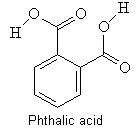
Phthalic Acid
This molecule is often pronounced with a silent 'th' for comic effect. I wonder if phthalyl side-groups have a shorthand symbol in chemical structures, in the same way that phenyl groups are shortened to -Ph? If so, would it be a 'phthalic symbol'... Again, adding an extra carbon makes homo-phthalic acid - say no more...
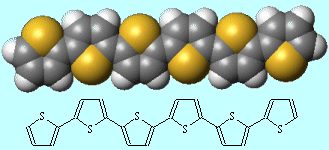
Sexithiophene
This is a 'sexi' molecule - which means it has 6 sub-units, in this case of thiophene rings. Because of its conjugated system of double bonds, this organic molecule conducts electricity quite well. As a result, it is one of a number of similar molecules being studied for possible uses in organic polymer electronics.
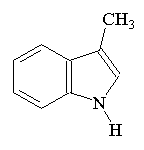
Skatole
This molecule's name comes from 'skatalogical', meaning concerning faecal material. Its proper name is 3-methylindole, but it gets its trivial name from the fact that it is a component of faeces. Surprisingly, it is also found in coal tar and beetroot (!), and can be obtained synthetically by mixing egg albumin and KOH. As you might guess, skatole consists of white to brownish scales, which are soluble in hot water.
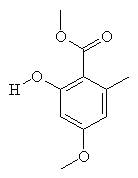
Sparassol
This molecule sounds like what you'd need the day after eating a very hot curry (spare-assol). Sparassol is an antibiotic produced by the fungus Sparassis ramosa.
Uranate
The uranium oxide anion goes by the glorious name of uranate. I wonder if unwanted reactions of this ion with certain compounds is called 'involuntary uranation'...?
Related to this, uranium nitrate is also known as uranyl nitrate, which sounds like the entry fee for a toilet after 8pm...

Urospermal
The European Union has standardised everything else (apple sizes, the shapes of bananas, etc...) and it now sounds like they're going even further (Euro-sperm-all). In reality, it gets its name from being a constituent of the roots of the Urospermum delachampii plant.
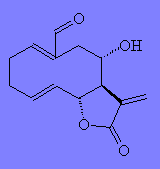
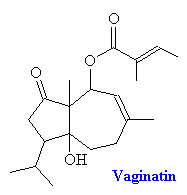
Vaginatin
I know you can get most things nowadays in a tin, but this is getting silly... Actually it gets its name from the plant Selinum Vaginatum. A related molecule is Vaginol, which also goes by the name Archangelicin.