"Happy mathematics!"
Golden Geometry
How to construct the Golden Rectangle…
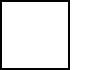
Construct a square.
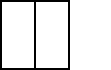
Bisect the square.
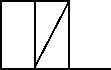
Draw a line from one end of the bisecting line to one of the opposite corners. Extend the baseline of the square.
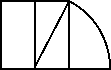
Using the diagonal line as the radius, drop an arc from the corner of the square down to the baseline.
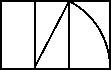
Draw a line from the point of intersection of the arc and the baseline, perpendicular to the baseline. Extend the top edge of the square to meet this line and form a rectangle.
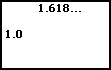
Congratulations, you have constructed the Golden Rectangle.
Did you know…?
Many books on oil painting and water colour will point out that it is better to position objects not in the centre of the picture but to one side or "about one-third" of the way across, and to use lines which divide the picture into thirds. This seems to make the picture design more pleasing to the eye and relies on the idea of the golden section being "ideal".

Comments please!
Constructive or abusive comments appreciated at:
The Golden Ratio
Golden Rectangle
The Golden Rectangle, alleged to be the most aesthetically pleasing rectangular shape possible, was first constructed by Pythagoras in the 6th century BC. It is defined as the rectangle which, when squared, leaves another golden rectangle behind. How does this work? Let's take a closer look at the rectangle itself.
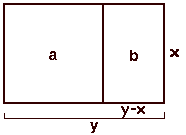
The rectangle shown here is a Golden Rectangle with proportions x/y. The section labelled "a" is a square drawn in the rectangle with proportions x/x. The section labelled "b" is another Golden Rectangle, this one with proportions (y-x)/x. In other words, the ratio of the lengths of the sides of section "b" is the same as the ratio of the length of the sides of the entire large rectangle. This is the characteristic of a Golden Rectangle. When you square it (inscribe a square with lengths the same as the length of the short side of the rectangle), you are left with another rectangle with the same proportions as the original.
Golden Ratio
The Golden Ratio, also known as the Golden Number or the Golden Section, is defined as the ratio of the lengths of the two sides of any Golden Rectangle. That is, if you take a Golden Rectangle and divide the length by the height, you will have the Golden Ratio. Traditionally, mathematicians have denoted the Golden Ratio by the Greek letter phi ( ).
).
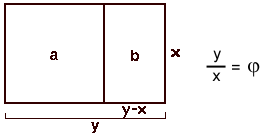
So how can we find these lengths that we need to calculate the Golden Ratio? In other words, what is the numerical value of y/x in the above diagram? We can easily calculate the exact value of the Golden Ratio with a little algebra.
Golden Ratio: Proof
We are looking for a way to calculate the value of , the Golden Ratio. All we know about is that it is the ratio of the length and height of a Golden Rectangle.
What do we know about a Golden Rectangle? Well, we know that it is a rectangle which, when squared, leaves behind another rectangle of the same proportions. That is, the ratios of the lengths and widths of the rectangles is the same.
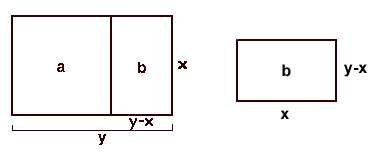
Based on this knowledge, we can set up a proportion, like so:
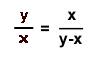
Before going any further, let's eliminate one of the variables by assuming that the short side of the larger rectangle (the value x) is equal to 1. As we are only looking for the ratio of the sides, this assumption will not alter the problem in any way. Our proportion now becomes:
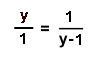
By cross-multiplying, we obtain:

Some simple algebraic moving about produces the quadratic equation
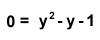
The next step is to solve for the value y by applying the quadratic formula. When we do, we obtain the following values:
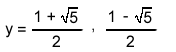
We can discard the second value because it is negative, and lengths of polygons can not be negative. Now we are left with:

All this so far has been done to find the value of , which is defined as y/x. We have found the value of y, and we said before we started that x was equal to 1. Therefore, the value of y/x is the same as the value of y (because y/1 = y), so:

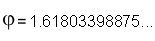
Note that this is only an approximation, because is actually an irrational number, meaning that it can not be expressed as the ratio of two whole numbers.
You can try this method again using different values of x, and you will always come out with the same value for .
Golden Spiral
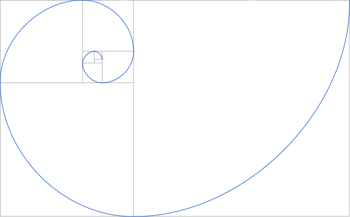
The Golden Spiral, sometimes called the Golden Round, is a spiral with proportions similar to the Golden Rectangle. It is constructed in a similar fashion to the Fibonacci Spiral, except that, rather than starting small and working out, you start large and work inward.
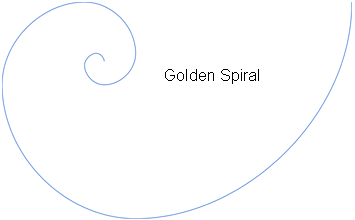
This spiral is actually only a series of quarter-circles drawn in squares. These squares have been inscribed in Golden Rectangles, as shown below. All rectangles in the diagram below are Golden Rectangles.