
"Bevan has extraordinarily fertile hands and can use them as sculptor, magician or lover - shaping, creating or caressing. He waits for the ball and flicks it into a gap before scampering a second run. Nothing is wasted, hardly a ball is missed, hardly a pad is struck. " - Peter Roebuck
What other game can you say that you bowled a maiden over, you glanced to fine leg, or you cracked one through the covers, and be talking perfectly and quite elegantly about the sport?
Comments please!
Constructive or abusive comments appreciated at:

Bevan's Masterpiece
(Extract from: The Age, Mark Fuller and John Polack, 30/01/2002)
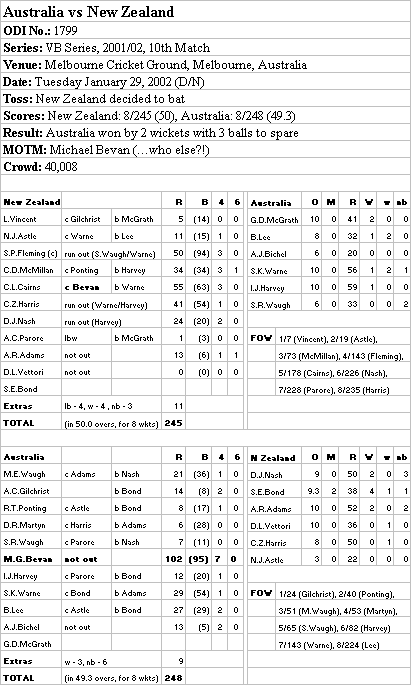
Michael Bevan last night saved Australia's reputation and reaffirmed himself as the best one-day batsmen in the world with a memorable, fighting century that led Australia to an improbable victory over New Zealand at the MCG. Bevan's brilliant unbeaten 102 from 95 balls propelled Australia's extraordinary come-from-behind two wicket win with three balls to spare over New Zealand in the teams' VB Series clash.
Bevan, rekindling memories of his matchwinning 78 not out at the SCG against the West Indies in 1995-96, played magnificently after coming to the wicket with Australia down and out at 4/53. New Zealand had Australia in desperate peril at 6/82 as it pursued an extremely distant 8/245, and a fourth straight victory over the home country in the VB series seemed a formality.
But the indomitable batting of Bevan (102*) - and brilliant support from Shane Warne (29), Brett Lee (27) and Andy Bichel (13*) - conjured a remarkable reversal. Not even the rehabilitation of that old limited-overs criminal - the bouncer - seems to have compromised the talents of the man often dubbed the world's greatest one-day batsman. For this was an astonishing innings, even by his own inimitable standards.
NZ captain Stephen Fleming, who has pulled some masterful strings this summer, seemed powerless to stem the flow as Bevan picked off twos with ease in the vast stadium. Waugh said before the match that he didn't mind losing, so long as his players put up a fight. Last night, through Bevan and his lower-order comrades, they did just that.
Despite the wonder of Bevan's fightback, it highlighted the culpability of the batsmen at the top of the order. The story of the match might have been the story of all of the preceding trans-Tasman rivals' battles in the series. The New Zealanders batted first and scrambled their way to an impressive total. Australia, having already portrayed chinks in its armour with the ball and in the field, was then harried into consistent error with the bat.
The home team's upper order was again suffering maladies for which there seems no antidote. As Adam Gilchrist (18) half-drove and half-cut, he chopped the ball into his stumps off an underedge; Ricky Ponting (8) snicked to second slip as he played off the deadly combination of the back foot and an outside edge; Mark Waugh (21) hooked off a top edge to deep backward square leg; and Damien Martyn (6) drove straight to cover point. At 4/53, matters were grim. Humiliation was then courted as Steve Waugh (7) fished at a ball leaving him and Ian Harvey (12) cut, and top edged, with economical movement of his feet.
With chances to attain a finals berth of their own rapidly passing them by, and with a number of their players' rights to a place in the side being ever more seriously questioned, it was an inauspicious time for the Australians to engage in another portrayal of vulnerability. Yet, with Bevan at the helm, the Australians instead became a model of invincibility.
Bevan lifted the tempo in a flash, spotting and seizing upon gaps in the field and hitting the ball into them with the precision of a surgeon and the accuracy of a laser beam. Where New Zealand suddenly dallied, Bevan suddenly hurried. Though his manipulation of the strike was outstanding, his confidence in his partners and his urgent running between the wickets were also lessons in one-day skill.
When he lost the assistance of captain Steve Waugh with the score at 65, and all-rounder Ian Harvey at 82, Bevan encouraged a remarkable rearguard action from the tail. He combined with Shane Warne in a stubborn 7th wicket partnership that yielded 61 runs from 92 balls. Another 81 runs from 66 balls flowed in an association with Lee for the 8th wicket, and placed Australia within 22 runs of a remarkable win with 15 balls remaining. In the process, Bevan also led an acceleration that saw runs plundered at a rate of better than eight an over during the concluding 11 overs of the contest.
When Bevan brought up his century in the 49th over on a Kiwi misfield, Australia needed eight runs from eight balls. Six runs were needed from the last over, with Shane Bond returning after earlier slicing through the Australian top order. Bichel slashed Bond's first ball of the final over through gully for four, played and missed at the second, then crunched the match-winning boundary to send the crowd into raptures.
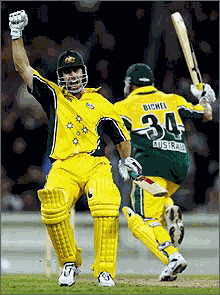
Victory dance: Miracle maker Michael Bevan, and his foil, Andy Bichel celebrate a remarkable victory against all odds.
Honourable Loss Was The Goal
(Extract from: The Age, Chloe Saltau, 30/01/2002)
When Michael Bevan went in to bat last night, it was not a question of lifting Australia to victory, but of dulling the immensity of its defeat. Indeed, Steve Waugh said, ''if we were going to lose we needed to lose by not a big margin''. ''I wasn't at any stage entertaining winning the match,'' Bevan said afterwards. ''I mean, it just seemed like too big a task. But one of the goals I set myself before today was to try to score 100 off 100, I suppose, and be there at the end of the match, which I hadn't been in the past three or four.''
By the end of the match, Bevan had not only surpassed his expectations, having scored 102 from 95 balls, but injected some spine and good sense into the Australian one-day batting line-up. The result, captain Steve Waugh said, was ''one of the greatest one day innings of all time'' and a victory to rival Australia's World Cup wins at Headingly and Edgbaston.
In 168 minutes, Bevan went from simply digging in, in a game rapidly sliding away from the Australians with the cheap dismissals of Adam Gilchrist, Ricky Ponting and Damien Martyn, to hitting freely to score seven boundaries and running twos where it seemed only a single was possible.
It exceeded his effort to steal victory with 78 not out against the West Indies on New Year's Day of 1996. Bevan said: ''They were both close finishes. I guess with this one we need to win our last two matches to get through to the final ... so it's good from that point of view. 'Today's innings was a little bit longer I guess, so it's always nice to score a big knock under pressure rather than a 50 or a 60.''
Bevan pressed quietly along with Shane Warne, deciding when to make a lunge at New Zealand's target. Around the 35th over, he cut loose, gradually lifting the Australians' run-rate from four or five an over, to six or seven. ''At that stage I was really just trying to give ourselves a chance. We were scoring three or four and over at that stage. Warney came to the crease and we put on a good little partnership there. We were just trying to gauge at what stage we were going to have a go for the runs,'' Bevan said.
Having got Australia within six runs of victory entering the final over and with Bichel straining at the strikers' end, Bevan told the tail-ender to hit cleanly through the line of the ball. ''You can't look too far ahead because you'll make it too hard for yourself,'' he said. ''What I try and do when the tail-enders come through is to get them thinking about rotating the strike and taking the pressure off themselves.''
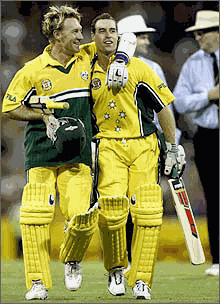
Andy Bichel and Michael Bevan embrace after their 9th wicket 24* run partnership clinched Australia's astonishing victory over the hapless Kiwis.