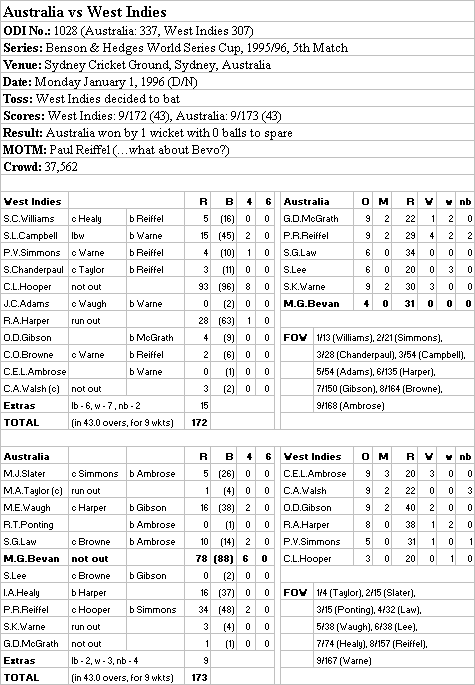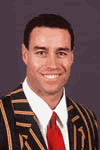
"We needed someone to stand up - it was one of the great one-day innings of all time." - Steve Waugh, after a classical Michael Bevan century guided Australia to a remarkable victory
After Michael Bevan's shock axing from the Australian Cricket Squad in April 2004, is the ultimate finisher finished?
Bevan bows out after a career he considers not quite fulfilled
Injuries force retirement of former world no. 1
The yobbo, native to Australian cricket grounds, thrives on the sound of leather on willow, and of ice-cold tinnies being opened! It is in this favourable environment that the yobbo will start his mating call, which will be mimicked by other spectators: "-(insert name)- is a wanker!", "You’re going home in the back of a divvy van!" and "We love you 'cos you're Victorian!"
Comments please!
Constructive or abusive comments appreciated at:
For the latest info in Australian cricket, visit Baggy Green
For the ultimate Michael Bevan Fan Page, visit FlickBevan.com by Jay Prathap of Chennai, the world's #1 "Bevo" Fan!
Bevan's Profiles
1994/1995: Bevan has been brilliant since scoring a hundred on his first-class debut. Lack of consistency and maturity have delayed his arrival at the top. A double century for NSW against WA last season was, though, a turning point. He was rewarded with selection for Sharjah and, later, Sri Lanka and Pakistan, after scoring more than 1,000 runs for the Blues. A spectacular fieldsman.
1995/1996: Bevan looked established in the Test eleven after scoring three half-centuries in Pakistan, narrowly missing a century in the Third Test. His form declined in the Ashes series, and he was dropped. Regarded as an exceptional batsman from the moment he made 100 on debut in Shield cricket, Bevan is a classic case of the confidence precipice. Rivalled by a group of star batsmen, he needs to score heavily, hoping for a place in the one-day side. Fans are waiting for his maturity. The sooner the better for Australian cricket.
1996/1997: Bevan batted brilliantly in the one-dayers last season. His straight driven boundary off the last ball from Roger Harper at the SCG is a powerful reminder of his skill and nerve in a tense finish. Transposing that confidence to Test cricket is his major ambition and doubters wonder if he can handle the short stuff flung by the West Indies' missile men. He is on the short list for a middle order place. Early form in the sub-continent, following a strong Yorkshire season, will be important as the selectors crunch numbers. His over-spinning left arm varieties add another dimension to the game, picking up useful wickets in one-dayers and probably in Tests this summer.
1997/1998: An impressive one-day record sits disturbingly alongside a chequered Test career. Failures against well directed short pitched balls in England forced his omission again, and there must be doubts about when and if he can regain a place. A brilliant stroke player and a brisk left-arm wrist spinner, Bevan could become a one-day specialist, which would be a serious short-changing of his talent. Dancing, yoga, footwork and relaxation may be the answer and prove to be a solution for this enigmatic left-hander.
1998/1999: Bevan has become a one-day specialist. His well-paced innings and challenging running between the wickets are at the core of Australia's success. His critics discuss footwork flaws and a wavering mental capacity that seem to have contributed to a mediocre Test career. There's no place for him until a combination of retirements, injuries and the selectors' renewed belief in his abilities conspire to force a reappearance.
1999/2000: Australia's cricket enigma, Bevan seems destined to become the first exceptional player to make his reputation solely in one-day cricket. His shot selection, placement and intimidating running are qualities that have forced opponents to try and counteract him by setting tighter "in the circle" fields. He's powerful enough to adapt his game, and if he can sort out his feet and his head against fast bowlers who sense he's vulnerable, then he should reemerge as a significant all-round Test cricketer.
2000/2001: The pundits' annual question - when will Bevan play another Test? - has become, will he ever play Test cricket again? His brilliant, wrist-cracking batting is a phenomenon of the one-day game, and his ability to control an innings with aggressive running can be intimidatory. Despite his prolific scoring in county cricket, the perception lingers that he's vulnerable against fast bowling.
2001/2002: Bevan's remarkable career continues exclusively in the one-day game. Few teams attack him early on, and it is surprising that no one has come up with a strategy to disturb his rhythm. He combines the requisite skills of running between the wickets, wrist-cracking power and improvisation; the model batsman for Australia's aggressive approach.
2002/2003: Bevan appears destined to be buried in a yellow uniform, but he'll probably do so as Australia's greatest exponent of the one-day game. He thrives on precarious situations and seems happiest when the wicket tally exceeds that of runs scored, as displayed during his match-winning - although ultimately fruitless- inning against New Zealand at the MCG last season. He's the consummate one-day specialist: a Carl Lewis between the wickets, an innovative and adaptable batsman, and often tricky change bowler and panther-like fieldsman. He harbours a desire to play Test cricket again, but his excellence in the abbreviated game his possibly perished that dream.
2003/2004: It's testament to Australia's depth that Bevan is unlikely to ever wear the baggy-green again, despite his ferocious talent. Of course, it's much to do with Bevan being typecast as an ODI specialist (he averages more than 50 with the bat), and a lagging perception that he's susceptible to short-pitched bowling - something that privately grates. After a relatively quiet World Cup with the bat by his lofty standards, expect the shoulder blades to be opened this summer.

(assessed by Jim Maxwell - ABC Cricket)



My Favourite Cricketer
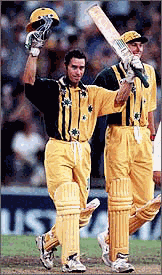
Michael Bevan's career highlight. Read on…
Michael Gwyl Bevan
Born:
08 May 1970, Belconnen, Australian Capital TerritoryBatting Style: Left Hand Bat
Bowling Style: Slow Left Arm Chinaman
Test Debut:
vs Pakistan at Karachi, 1st Test, 1994/95Test Finale: vs South Africa at Sydney, 2nd Test, 1997/98
ODI Debut: vs Sri Lanka at Sharjah, Australasia Cup, 1993/94
ODI Finale: vs Sri Lanka at Colombo (SSC), 5th ODI, 2003/04
Statistical Record:
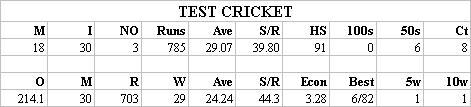
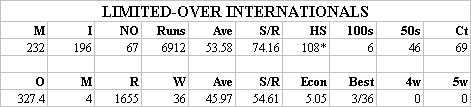
4th most capped player for Australia in ODIs
4th leading run-scorer for Australia in ODIs
6th most catches taken for Australia in ODIs
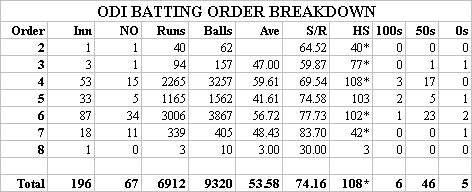
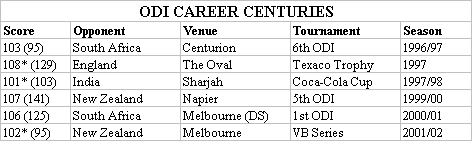
Michael Bevan remained an enigma in international cricket. A matchwinner for Australia in limited-overs internationals, he assuredly guided Australia to victory during the final, tense overs of countless one-day games. Destined to replace Allan Border's no. 6 batting position in the Test team, his vulnerability to pace, especially the short ball, curtailed his Test career.
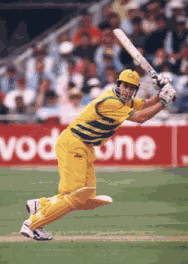
However, this was just a minor setback in a wonderful career that had cricket critics describing Michael Bevan as the best Limited-Overs cricket player in the world. These comments were backed up by his statistics, with the highest batting average in the history of Limited-Overs cricket. And you know, statistics never lie!
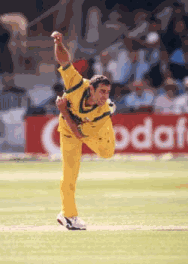
Not only was Michael Bevan a superb batsman, he was also an underestimated bowler, having taken 10 wickets against the West Indies in a test match at Adelaide in 1995/96. His left arm "Chinamen" had been criticised as being erratic at times, but as a fellow trundler of the trade, I know for a fact that it is a very difficult skill to master. (At least he didn't suffer the indignity and humiliation of receiving abuse from his teammates regarding the number of successive wides he conceded!)
Michael Bevan's Finest Moment
Michael Bevan's matchwinning capabilities were exemplified in the dramatic and memorable New Year's Day Limited-Overs International against the West Indies at the SCG in 1996. In a game interrupted by rain, Australia were set a competitive target of 173 off 43 overs by the West Indies. However, Australia had slumped to 6/38, and the mere score of 43, the lowest completed innings score in Limited-Overs Internationals (compiled by Pakistan), seemed to be wishful thinking.
However, with Michael Bevan (the last recognised batsman) at the crease, Australia still had hope. What followed was pure poetry in motion. The SCG resembled a boiling cauldron, and when the pressure seemed to build, Michael Bevan would release the steam by piercing the field with contemptuous ease, scoring boundaries at will. Paul Reiffel provided great support for Michael Bevan, sharing an 83-run match-winning partnership for the 8th wicket.
So, it came down to the final ball of the match. Australia required 4 runs to win, with Michael Bevan to face Roger Harper's off spin. In a dramatic conclusion to a majestic performance, Michael Bevan danced to leg, straight drove past Roger Harper's desperate hands, and the ball rocketed to the boundary.
Michael Bevan finished with an unbeaten 78. A classic finale.
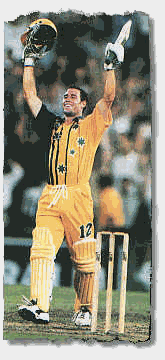
Michael Bevan, the matchwinner on a steamy Sydney night.