Dhaka Products
What
is dhaka?
Dhaka
is an exquisite cotton fabric hand woven in numerous colours with an
infinite and unlimited number of patterns. The duration of weaving
and price is dependent on the complexity of the pattern. The more
complex the pattern, higher the price; the simpler the pattern, the
lower the cost.
The
unique art and craft of dhaka has its roots in an eastern Nepali
village 'Terathum'. Started by 'Rai' and 'Limbu' women, dhaka is a
truly indigenous traditional form of artistic expression reflecting
Nepali mastery of craftsmanship.
Dhaka
has a history of more than one thousand years and has numerous
turbulent experiences. With the introduction and development of
power-looms, dhaka suffered a major setback and nearly lost out to
cheaper fabrics. But the efforts by villagers to preserve the art
brought the dhaka back to life.
Part
of the skill training & income generating activities program
involves training underprivileged women to weave traditional textile
'dhaka' which is famous both locally and internationally. WF also
takes responsibility for marketing 'dhaka' products on behalf of the
weavers within Nepal and abroad.
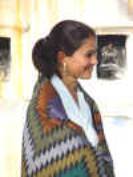
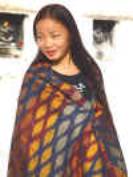
Dhaka,
a brightly patterned cotton weave made on hand looms in the
eastern and western hills, has long been used to make topi
(men's caps), cholo (women's half-length blouses) and shawls.
Palpali dhaka, the preferred make for topi, comes from
Tansen (Palpa). Women's cooperatives are now producing dhaka
in colour schemes and patterns aimed squarely at Western tastes, and
turning it into scarves, ties, placemats, jackets, handbags - you
name it.
Other
cotton weaves, including khadi (traditional homespun) and
many forms of sari material, are produced locally all over Nepal.
These, too, turn up in innovative incarnations - block-printed,
quilted and hand-stitched - from pot holders and tea cosies to
cushion covers and bedspreads.
pricing
the cloth
Our
cloth pricing may seem arbitrary because some items of the same size
have a different price. We would like to explain here how our items
are priced and present our price list so that you will know exactly
what you are paying for.
The
price of each item takes three production considerations into
account. First, the cost of the material is calculated. This is
naturally based on how much thread is used to make a certain
product. The bigger the product, the more expensive it will be.
Second, the amount of time it takes to weave a particular piece of
cloth. Dhaka with more complicated or densely woven patterns will
cost more than dhaka with simple or sparse patterns. Third, items
that have been sewn also have associated tailoring fees. Bags with
many pockets or a patchwork type design will take more time to sew,
so will be more expensive. Once the production cost has been
calculated, we try to take an additional 35% of that cost for
profit.
distribution
of proficts
In order
to better understand how an NGO shop works, and feel more
comfortable supporting one, we would like to explain a little bit
about how profits are distributed.
definitions
"Gross
profit": The price that an item sells for.
"Net
profit": Gross profit minus production costs
the
production process
All of
SDI's dhaka items are produced in a similar way. We'd like to
describe the process so that you can better understand what goes
into making our products.
- buying
the thread
The
first step is buying the thread. SDI buys coloured thread for dhaka
shawls. SDI goes to the whole seller & tries to by
cheapest threads & finds more resources to reduce the raw
material cost.
- warping
the looms
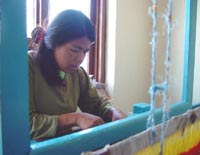 The
second step is warping the looms, which actually happens in two
stages. In the first stage, the various spools of thread, usually
the same color but sometimes different colors, are loaded onto a
wall-sized rack. All of the threads are attached to one large
warping wheel that is hand-cranked. Then, while one person turns,
others align the threads and make sure that they are lying in the
correct position. In this way, all of the thread is spun onto the
warping wheel. The
second step is warping the looms, which actually happens in two
stages. In the first stage, the various spools of thread, usually
the same color but sometimes different colors, are loaded onto a
wall-sized rack. All of the threads are attached to one large
warping wheel that is hand-cranked. Then, while one person turns,
others align the threads and make sure that they are lying in the
correct position. In this way, all of the thread is spun onto the
warping wheel.
With the
thread properly loaded, the second stage of warping begins. Each
loom has a long axle that holds the basic loom color, and dispenses
it as the cloth is woven. Essentially, raw thread is fed from a
dispensing axle and finished cloth is rolled onto a take up axle. In
between the women weave the cloth.
So, in
the second stage of warping, the thread that was rolled onto the
warping wheel must be taken off, and loaded onto individual loom
dispensing axles. Loading the dispensing axles is exactly like
loading the warping wheel, except in reverse. The warping wheel is
turned backwards while a dispensing axle takes up all the thread.
When the dispensing axle is loaded, it is attached to the loom, and
the loom is strung for weaving.
- weaving
the cloth
When a
loom has been strung, it looks like a piano. The threads are
stretched tight across a rack, giving the weavers a flat surface to
work on. There are actually two levels of thread, one on top, and
one an inch or two below. The weaver passes a "shuttle", a small
piece of smooth wood with thread attached, between these two layers
of thread. If she is making a pattern, she will manually loop thread
through the stretched strings to create one "line" of the full
pattern she is creating. Once the shuttle has been passed and any
strings have been added to create a pattern, she pulls a large piece
of wood down against the cloth to tighten the weave. As the cloth is
woven, she rolls it onto a take up wheel at the base of the
loom.
- cutting
the cloth
When the
take up roll is full, it is taken off the loom and brought to
another room where the cloth is cut apart. Between each "piece" of
dhaka, the weaver leaves a small gap of unwoven string. This is cut
in half, giving each piece of cloth its tasselled ends. The shawls
retain these tassels in the finished stage.
- sewing
the cloth
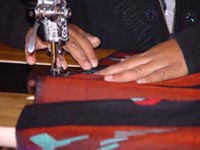 Shawls
and some other items do not require any sewing; they are finished
when they come off the loom. However, many of our products do need
to be sewn. The group of women who do the sewing is different from
the warping and weaving group, but they have also been trained by
WF. Many of the women who sew WF products have started their own
businesses or work for a tailor, and are using their work experience
as well as the skills they learned in training when making the final
products. Shawls
and some other items do not require any sewing; they are finished
when they come off the loom. However, many of our products do need
to be sewn. The group of women who do the sewing is different from
the warping and weaving group, but they have also been trained by
WF. Many of the women who sew WF products have started their own
businesses or work for a tailor, and are using their work experience
as well as the skills they learned in training when making the final
products.
| 
