


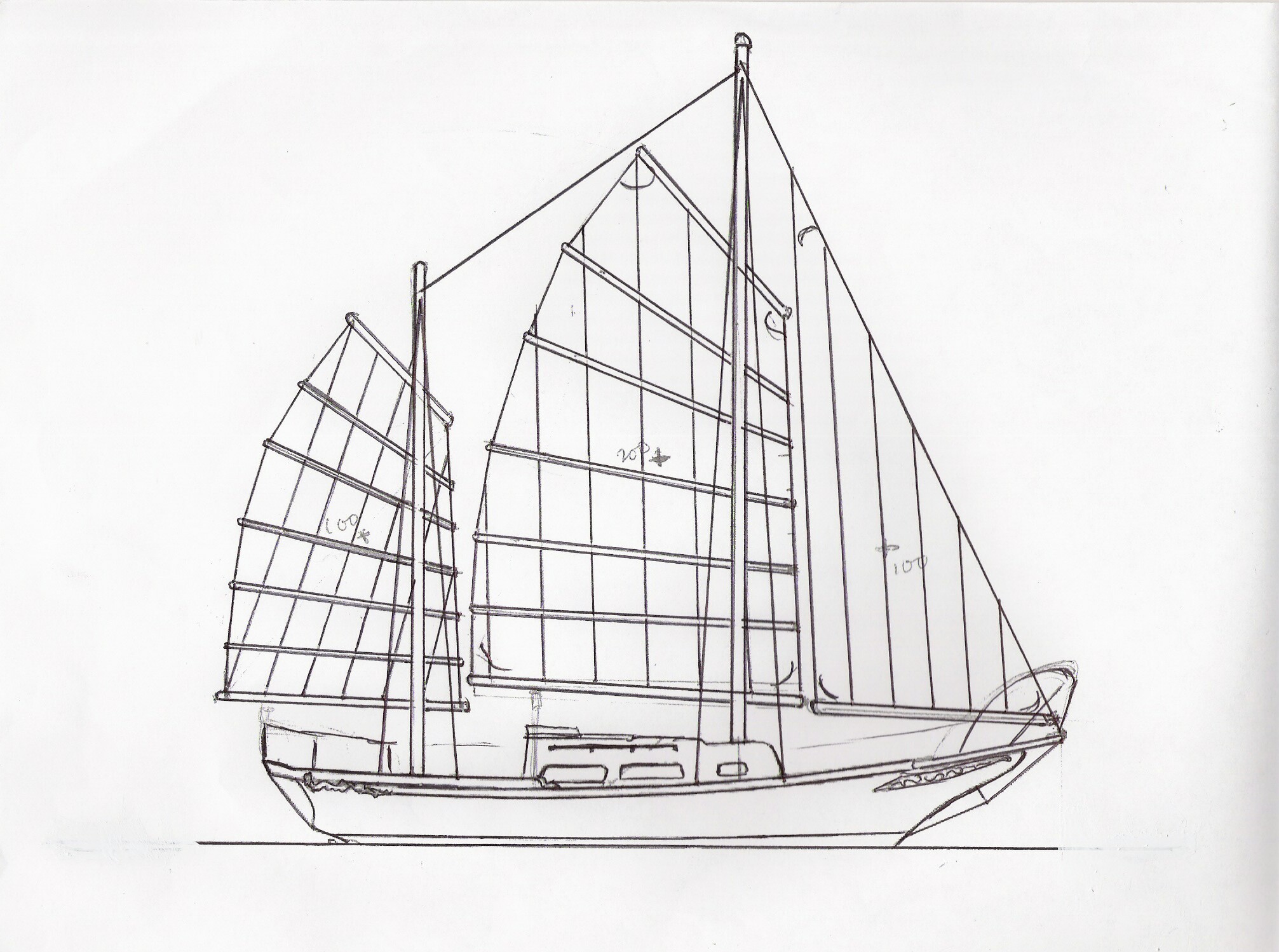
FEI YEN is a hybrid junk sailing vessel. It differs from a pure junk in that it has a Western forestaysail (jib) instead of a third lugsail. The rig is a direct descendant of the schooner version designed by Thomas Colvin for his GAZELLE, many sisters of which have been built by their owners. FEI YEN started life as a bermudian ketch, the Privateer 26, designed by Thomas Gillmer. (For the original sail plan, go here.)
I bought her in 2005 with the intention of completely restoring her and converting her to the junk configuration. The conversion is now complete, as well as the interior restoration (see the restoration page). The 2007 project is to restore the exterior.
Masts and booms
Masts are Sch. 40 aluminum pipe. The main is 4" diameter x 26.5' height above deck, 1/4" wall. The mizzen is 3.5" x 20'. They were sanded, etched, given two coats of zinc cromate and painted white with single part polyurethane. The yards and booms are 2.5" aluminum tubing with 1/8" walls, finished in the same way.
Sails
The sails (made by Leitch & McBride, to my design) are 5 oz. dacron with bolt ropes all around. The jib is a standard bermudian type, but cut flat. The main and mizzen are fully battened lugsails. The battens are straight grain Douglas fir and made in two parts: 3/4" x 1.5" on the mast side of the sail, and 3/8" x 1.5" on the other side. They were also painted white and are bolted through the sail, which is reinforced on both sides with full length, 4" batten patches. The bolt holes were seared and sealed by means of a round nib soldering iron. The patches were made wide so as to accomodate the parrel and sheetlet grommets.
Running rigging
All running rigging is 3 strand dacron; 3/8" for the sheets and 5/16" for the lazyjacks, sheetlets, parrel and lacing lines. Chinese lugsails can be made self tending by doubling the sheets, one to weather and one to the lee. Which is which depends on which tack you're on--they swap roles on each tack or gybe. A continuous sheetlet, one on each side of the sail, runs from each batten through a Chinese block known as a euphroe, which attaches to the sheet blocks by means of a short strop. Sheetlet and parrel lines eye splice around the battens, through the grommets in the patches.
Most of the lines belay on pins made from hardwood dowels; the pinrails are made of Douglas fir, as are the boom gallows.
Standing Rigging
The shrouds are 1/4 inch 7 x 19 stainless, looped over the masts in pairs, with a nicropress fitting to make the loop at the top. At the bottom, they end in deadeyes which I turned to a 3" diameter out of purpleheart, a less expensive alternative to lignum vitae. These are oiled with a combination of tung and teak oil, as are all of the Chinese blocks. The lanyards are 1/2" nylon, with a Matthew Walker in each of the upper deadeyes. The shrouds are wormed, parcelled and served with tarred nylon siene line where they loop the masts and deadeyes. Since I had them left over from the old rig, I also added 1 x 19 stainless centre shrouds to the main, and aft shrouds to the mizzen. These are made fast with rigging screws. The triatic stay is also 1 x 19, similarly fastened. For more detail about the rig, consult Tom Colvin's classic books, Cruising As a Way of Life and Coastwise and Offshore Cruising Wrinkles.