 |
|
|
|
|
|
|
|
|
|
|
|
|
|
|
|
|
|
|
|
|
|
|
|
|
|
|
|
|
|
|
|
|
|
|
|
|
|
CHITTAGONG HILL TRACTS
FIGHTING FOR OWN RIGHTS Home Contact Site Directory Privacy/Seciruty |
|
| Welcome to All Jummas ! |
|
| ... |
|
| .. |
|
|
BACKGROUND OF THE CHT |
|
|
CHT |
|
|
|
|
|
CHT Background |
|
|
|
|
|
|
Rangamati |
|
|
|
4. Arrests, Tortures and Kidnapping: |
|
|
|
|
Khagra Chari |
|
|
|
|
|
|
In the name of counter-insurgency the Jummas have often been detained and tortured by the army. Thousands have perished in the armed encounters, extra-judicial executions, tortures, rapes and so on. Bangladesh security forces often resorted to mass detention and torture of the helpless villagers and left many of them crippled for life. For further consolidating their authority over the villagers, security forces have uprooted villages and forcibly kept them in so called "cluster villages" (known as concentration camps), where they live under constant supervision of the military. |
|
|
|
|
Bandarban |
|
|
|
|
|
Jumma Network |
|
|
|
|
|
Massacres |
|
|
|
|
|
Genocides |
|
|
|
|
|
Abduction & Rapes |
|
|
|
|
|
|
Jumma Refugees |
|
|
|
5. Bangladeshi Settlers: |
|
|
|
|
Refugees Rehabilitation |
|
|
|
|
|
|
Bengali Settlers |
|
|
|
Military Resistance |
|
In the late 1970s President Zia sponsored migration of Bangladeshi settlers into the CHT, providing land grants, cash and rations. This programme was not made public at the time, and its existence was denied by the representative of the government. Now the government acknowledges that there was a programme of sponsored migration. Bangladeshi settlers, with the connivance of the almost totally Bengali administration, have been able to take over land and even whole villages from the Jummas. By 1981 the Bangladeshis made up nearly one third of the total population of the CHT. |
|
|
|
|
UNPO Documents |
|
|
|
|
|
EU Declaration |
|
|
|
|
|
Human Rights |
|
|
|
|
|
Peace Conference |
|
|
|
|
|
|
6. Forcible Conversion and Religious Persecution: |
|
|
|
|
JUMNAPA |
|
|
|
|
|
Discrepancy |
|
|
|
|
|
|
Peace Treaty |
|
|
|
Forcible conversion is considered as a state sponsored method of assimilation. Al-Rabita, a Saudi government funded NGO, is the main Islamic missionary organisation active in the region, backed by the military, it is entrusted with the Islamisation of the region. The Jammat-i-Islam, an Islamic fundamentalist party works actively with the military in the CHT. The number of mosques and madrashas(Islamic schools) are rapidly increasing in the area. Apart from proselytisation, there have been religious persecution in the form of violation and destruction of religious places of the Jummas by the Bangladesh military. In 1986, within a period of eight months 54 Buddhist temples have been destroyed and 22 Hindu temples were burnt down by the Bangladesh military. |
|
|
|
|
Anmesty International |
|
|
|
|
|
Foreign Aid |
|
|
|
|
|
Sign-up |
|
|
|
|
 |
|
|
|
|
7. Massacres: |
|
|
|
Since 1980 there have been 13 major instances of massacre of the Jummas by the Bangladeshi settlers and the Bangladeshi security personnel. These are: |
|
|
|
Kaukhali-Kalampati Massacre, 25 March 1980 - Bangladesh Army and the Bangladeshi settlers gunned down 300 Jummas. |
|
WANT TO DOWNLOAD
BEAUTIFUL LANDSCAPE
Click here
|
|
|
|
|
Banraibari-Beltali-Belchari Massacre, 26 June 1981: - Bangladeshi settlers under the protection of the Bangladesh Army, murdered 500 of Jummas. |
|
|
|
Telafang-Ashalong-Tabalchari Massacre, 19 September 1981: - The Bangladesh Army and the settlers invaded the Jumma villages of Feni valley and murdered thousands of Jummas. |
|
|
|
Golakpatimachara-Machyachara-Tarabanchari Massacre, June-August 1983: - The Bangladesh Army and the settlers executed months long campaign against the Jumma villages and murdered 800 Jummas. |
|
|
|
Bhusanchara Massacre, 31 May 1984 - the massacre was carried out jointly by the 26 Bengal Regiment of the Bangladesh Army and the Bangladeshi settlers. At least 400 Jummas were killed. Many women were gang raped and later shot dead. |
|
|
|
Panchari Massacre, 1 May 1986 - hundreds of Jummas (actual number not known) were killed and injured by the Bangladesh Army. 80,000 Jummas fled across the border to India. |
|
|
|
Matiranga Massacre, May 1986 - The Bangladesh Army gunned down at least 70 Jumma civilians in reprisal to fighting with the Shanti Bahini. |
|
|
|
Comillatilla, Taindong Massacre, 18-19 May 1986 -the Bangladesh Rifles (a paramilitary force) intercepted 200 Jummas while fleeing across the border to India and opened fired on them. |
|
 |
|
|
|
|
Hirarchar, Sarbotali, Khagrachari, Pablakhali Massacres, 8,9,10 August, 1988 - The Bangladesh Army along with the Bangladeshi settlers killed hundreds of Jumma civilians and gang raped Jumma women. |
|
|
|
Langadu Massacre, 4 May 1989 - the Bangladeshi settlers murdered 40 Jummas, dead bodies never recovered. |
|
|
|
Malya Massacre, 2 February 1992 - the Bangladeshi settlers murdered another 30 Jummas. |
|
BEYOND REALITY
Click here |
|
|
|
|
Logang Massacre, 10 April 1992 - 400 Jummas killed by the Bangladeshi military and the Bangladeshi settlers. |
|
|
|
Naniachar Massacre, 17 November 1993 - about 100 Jummas killed by the Bangladeshi settlers. |
|
|
|
8. The CHT Treaty: |
|
|
|
The Jana Samhati Samiti (JSS), the political platform of the Jumma people signed a treaty with the Bangladesh government on 2 December, 1997. The treaty failed to safeguard the survival of the Jumma people. The Bangladesh government did not have the sincere desire to solve the problem of the CHT. The treaty had rather been used by the Bangladesh government as a facade to impress the donor countries. The treaty does not address the fundamental problem of the Bangladeshi settlers and the militarisation of the CHT, it rather legalizes the settlers in the CHT. |
|
|
|
More: |
|
|
|
People of the CHT
Genesis of Jumma Nationalism
Early History of the CHT
British Rule in the CHT (1860-1947)
Incorporation of CHT into Pakistan (1947)
Greatest Blunder of Partition
Pakistani Rule in the CHT (1947-1971)
Emergence of Bangladesh and the CHT
Undeclared War in the CHT (1972-1997)
The World and CHT
The Chittagong Hill Tracts:Post Accord Situation
Background of the Peace Agreement
Provisions of the Peace Accord
Peace in CHT:The other view
Foreign reaction and concluding remarks
Text of the Peace Agreement on CHT, Bangladesh
Summary of proceeding of International Conferenc |
|
|
|
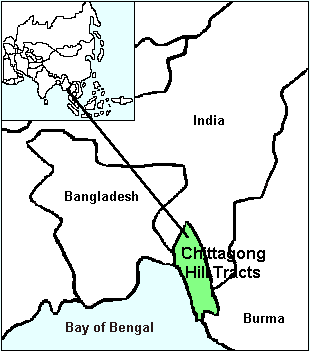 |
|
 |
|
|
|
|
|
|
|
 |
|
 |
|
|
|
|
|
Copyright 2000, Chittagong Hill Tracts, All right reserved
Developed and designed by Sugata Talukder |
|