 July 1970 -
Page 34
Turn the page
July 1970 -
Page 34
Turn the page
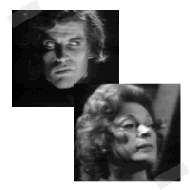
Now the evil has a face—a face that haunts me even as I sit here now, in the relative safety of the Old House. Although he was only visible for a few moments, the unadulterated hatred in his features was conveyed quite effectively. I can feel the evil embodied in his presence much more acutely than before, which was his intention, I’m sure. I don’t understand his motives, but I do know he is the one responsible for the attempt on my life, and undoubtedly for the destruction of Collinwood itself. Barnabas commented on his arrogance. There is arrogance, yes, but so much more. If only I could make him understand. I was grateful Barnabas was with me when he appeared, as I find my courage has abandoned me as of late. It’s unlike me to be so helpless, yet I can think of no logical explanation for my behavior. To look at it objectively, I suppose I am not yet fully recovered from my ordeal at the hands of Angelique. And yet, somehow, I know it is more than physical and emotional exhaustion that is causing me to act as I do. For the life of me, I can’t seem to shake the feeling that we’re being toyed with like pawns some sinister game, a game we can’t possibly win. I can’t dismiss how I feel, and it’s frustrating that Barnabas does not fully perceive the depth of evil that we’re up against. It's so strong, so all encompassing, like nothing I've experienced before. Everyone we’ve met in this time—Carolyn, Mrs. Johnson, the sheriff, Eliot, and now Quentin—has felt the evil as strongly as I do, and I find that oddly reassuring. Barnabas believes that his not-truly-human status provides him with some sort of immunity from what the rest of us feel, and I’m inclined to agree. I’m certain that if Barnabas could only feel half of what I do, he’d give up this quest of his and return to our own time, armed with the knowledge we already have. It’s not that I don’t share his concern for his family—I do. But my instincts tell me that our presence here will not lead us to the answers we are desperately seeking, but rather serve to hasten our own destruction. But for now, Barnabas refuses to leave until we unravel the mystery of what happened in 1970 that caused the destruction of Collinwood. And I, of course, will stand by him as I always do, though it is against my better judgment. I sense our presence here is a terrible mistake, but I have neither the strength nor the will to oppose him.
The more inquiries we make, the more the mystery deepens, leading me to believe the circumstances surrounding the catastrophe are more complex than I’d imagined. Everyone we have met thus far have been so hostile, most notably Carolyn. But I suspect that underlying that hostility is a deep rooted fear—fear that has silenced not only her, but the entire community as well. I’ll begin with Carolyn. Eliot believes she holds the key to this entire mystery locked away in her mind, and from what I’ve seen, I agree. But her mental in competency has thrown a roadblock in our path, one we haven’t yet been able to circumvent. Given my training, I should be able to make some progress with her, but I fear we do not have that much time. Given the fact that even the mere sight of Barnabas or me agitates her, I don’t know what good it will do to continue to question her. Perhaps Eliot will have more success. I’m relieved that he’s finally agreed to help us. Eliot—a trusted friend and ally. Always tenacious and steadfast, if not a bit obstinate. That’s why, in a way, his reaction to us has been the most puzzling of all. I have never known him to back down and admit defeat as he has evidently done here. I was dismayed to learn that he was away in Europe at the time the disaster occurred, and apparently does not know a great deal more about it than we do. Upon his return from Europe he found the house in much the same state as it is now, with David dead, Carolyn and Quentin insane, and the rest of the family missing. He felt the suffocating presence of evil consuming the house, as I do now. Eliot evidently attempted an exorcism that was not only unsuccessful, but very nearly fatal to him as well. I can only hope that his involvement with us now does not lead to his demise, as it did to Mrs. Johnson. Mrs. Johnson—poor Mrs. Johnson. I should have done more to help her—stopped her from leaving the Old House last night at the very least. She’d come to us to help, to tell us what she knew, and had paid for it with her life. Carolyn accused us of causing her death. A rational thought from an irrational mind, but I am forced to agree. Nonetheless, something Mrs. Johnson said before she ran from the house has given us a clue of sorts. She mentioned a playroom, the children’s playroom, she called it—and I’m sure that mysterious room somehow played a very crucial role in what happened twenty-five years ago. Quentin’s reaction to the room has only served to confirm my suspicions. Quentin—the one member of the family who knows the truth about Barnabas, the one person who has always helped us without reservation—has been reduced to a frightened child, confined to a mental institution since 1970. Even with my background in psychiatry, it is unnerving to see him this way—cowering, submissive, incoherent. And above all Quentin is afraid, as the others are, of whatever it is that now has control of Collinwood. Fortunately, however, one thing has remained constant—Quentin’s portrait has remained intact. Barnabas and I stopped him from destroying it tonight, its destruction apparently the motive behind Quentin’s escape from the mental institution. Although he doesn’t appear able to give us any details of the disaster, one thing is clear—Quentin carried an enormous burden of guilt over what happened in 1970, and his inability to prevent it. Now about that room—the one they refer to as the children’s playroom. Mrs. Johnson mentioned it by name, and both Carolyn and Quentin obviously know if its existence. It hardly seems possible that this room existed in 1970. Both Barnabas and I are familiar with the west wing—more familiar than most of the family—and yet neither of us have any recollection of it. But exist it does, and in this time, almost as an entity in and of itself, wholly intact, amidst the destruction and decay that surrounds it. But strangely, it does not look like a room from this time, or any time in the recent past. The furnishings, the toys, and everything about it appear to be from another era entirely. Yet that room holds the key to the entire mystery, I’m more convinced of that with each hour that passes. Whenever I enter the room, I swear I feel a presence—sometimes more than one. The time we followed Carolyn there, I thought I actually saw two people, but their images faded almost instantaneously as we stepped through the door. Later, I found a note, a card actually, that may shed some light on Carolyn’s strange behavior. It was a birthday card, a new card—with the names Tad and Carrie written inside. Two more names we do not recognize, yet names that have obvious significance to Carolyn, and therefore undoubtedly related to the fate of Collinwood. Another mystery about the room has been the unexpected
appearance of David, or more precisely David’s ghost, there.
We saw him, plain as day, just a few hours ago when we
returned to the room with Quentin.
His presence caused Quentin to run away from fright, but
Barnabas and I remained, even talked to him—but the eerie
thing was that there wasn’t even a hint of recognition as he
looked at us. It was
David, I’d swear it was.
But why didn’t he recognize us?
Later, Quentin said that it was Tad that we had seen, not
David. Just who is
this Tad? Nothing
makes sense. Have
our frequent comings and goings somehow disturbed the delicate
fabric of time itself? Has
our own past already been irrevocably altered?
Too many questions, and I fear there will be no answers
forthcoming. Exhausted
as I am, I fear sleep, for I know it will be his
face that I see—that evil presence—the man who tried to
kill me. I have the
uneasy feeling I will be seeing more of him soon—much more.
It was inevitable, I know that now. I guess I have since the moment we arrived. In just one terrifying, eternal second, it was over. The spirit that controls Collinwood now controls me, and I exist now solely to serve him. I cannot fight him, my will is no match for his. The evil embodied within him is too overwhelming. I was lured to the playroom by that girl, the one we saw with David, or rather the boy Quentin referred to as Tad. Although I knew she was no more than a spirit, I felt compelled to follow her. She led me once again to the playroom and to—Gerard. That is his name, though I dare not speak it except in his presence. Gerard’s will has become my own, and I am powerless to change it. Not since Tom Jennings have I felt so violated. But as horrible as Tom’s control over me was, Gerard’s is far worse. Tom Jennings was driven by an instinct, a heinous instinct, yet the acts he committed were not truly of his own free will. Gerard—Gerard is driven by unmitigated hatred and evil, and every thought, every act is calculated and deliberate. I watch myself as if from a distance, talking to Barnabas, to Quentin, to Eliot—speaking words that are not my own, my body responding only to Gerard’s will, Gerard’s commands. As a defense mechanism, I suppose, I have tried to detach myself totally from my own consciousness, but he will not allow it. I hear Gerard’s hideous laughter echoing endlessly in my ears until I fear I will go mad—as mad as Carolyn and Quentin. Could they have suffered a similar fate? It seems possible to me, but of little consequence now. I have discovered though, that while Gerard is in control of my mind and actions, the strength of his influence is variable, due, I believe, to his proximity to me. Once, as I felt his influence waning, I was nearly able to warn Barnabas about him—but Gerard appeared to me, threatening me, and once again his suffocating grip on me tightened. Another time, I was able to ask (actually practically beg) Barnabas to return to Angelique’s room with me, and escape to our own time. But, although he has become suspicious of the change my demeanor, Barnabas was unable to sense the urgency I tried to interject into my voice, and the opportunity was lost. I have also confirmed that Barnabas’ assumption is
correct—Gerard cannot physically harm him.
But Gerard does mean to eliminate Barnabas, that much I
have been able to gather through the link we now share.
He knows Barnabas is the one person who could thwart his
plans, and that is why he needs me.
He is using my relationship with Barnabas to keep track
of him, what he’s doing, exactly what he knows.
Gerard, at the moment, has decided to use me for this
purpose, to sabotage any progress Barnabas might make toward
solving the mystery. But
Barnabas has become suspicious of me, and Gerard is not pleased
with that development. He
warns me to be careful, I must not be found out.
Not yet—not until the proper time.
I don’t understand what he means, but I’m afraid I
will soon enough.
Through the fog that clouds my mind, I’ve seen that Barnabas and Quentin have discovered the presence of Daphne, yet another spirit under Gerard’s control. Although Daphne is in league with Gerard, I suspect her intentions may not be as evil as his. She apparently holds some significance for Quentin (he seems absolutely enamored), but he’s been unable to tell us just how she fits into the puzzle. Her presence is heralded by the scent of lilacs in the room, just as Gerard’s is by the haunting carousel music. She attempted to warn Barnabas of another impending death, and unfortunately it didn’t take too long for us to find out whose it was. Carolyn had apparently regained enough of her memory to recall what had happened twenty-five years ago—and was willing to tell Barnabas what she knew. Why she went to Collinwood, I’ll never know, it was a terrible mistake—one that cost Carolyn her life. When Barnabas and I arrived, she was already dead, murdered by Gerard. I was selfishly relieved that I had no prior knowledge of his plan, as I don’t think I could have endured knowing, powerless as I am to help her. Another death at Collinwood—Carolyn, Mrs. Johnson, and David gone. Roger and Elizabeth and missing, and Quentin hopelessly insane. Why can’t Barnabas see that our continued presence here is futile? I am no longer able to warn him, and can only stand by helplessly as Gerard plays his vile game. Before Carolyn died, she was able to write down six events related to the catastrophe twenty-five years ago. I wonder whether she did this to remind herself—her mental status being so tenuous—or did she somehow know that she would never be able to tell us herself? They make no sense to Barnabas or to me, but I must write them down now, lest Gerard erase them from my memory. --the night of
the sun and the moon Cryptic references to unknown events, yet events that undoubtedly heralded the final disaster that destroyed the Collins family. What could they possibly mean? Will Barnabas and I ever decipher their significance in time to prevent the catastrophe from occurring? In my present state, my mental faculties are woefully lacking, but yet I must try.
Now I know what I must do, what Gerard wants me to do. Oh God, how I prayed it would not come down to this. I tried in vain to appeal to Gerard, but my silent pleas were met only by his sarcastic laughter. He knew I was the only one who could do it. This is ultimately what he wanted me for. After I do what I must—betray Barnabas—my usefulness to Gerard will be over. The sun has risen and Gerard has allowed me to leave Collinwood. I must go now, to find the sheriff. Gerard says I will find him at the Old House. I only hope Gerard will allow me to die, for I cannot live with what I am about to do.
The events of this night have proven to be more terrifying, yet more astonishing than any other since our strange journey into this time. I don’t think I will ever forget how I felt when I heard the shot, knowing I was as responsible for it as the man who pulled the trigger. The sheriff had come just before dusk, as I had instructed him, armed with a gun with silver bullets. He’d gone down the stairs while I remained in the drawing room, with Gerard—waiting, just waiting. Barnabas had not given me his love, but he had, finally, unconditionally given me his trust. It had been hard won, the battle filled with regret and personal sacrifice, but it had been mine—and unequivocally my most prized possession. And now, Gerard had managed to steal even that from me. I heard Barnabas call out for me—a cry of desperation—then moments later, the shot. I could not go to him even then for Gerard made sure he was right beside me, my suffering providing him with some sort of primal satisfaction. In those few seconds, I closed my eyes, praying Barnabas would die quickly. Would he know it was me who had betrayed him? But seconds after I heard the shot, as I wished only for the solace of death, I was startled back to reality as Barnabas appeared before me. For a moment I thought it must be his spirit, but it was him—really him. Somehow he’d escaped the sheriff’s bullets. I later learned that it had been the appearance of Carrie that had allowed Barnabas to gain the advantage over the sheriff. Seeing Barnabas standing there—alive—my immediate impulse was to run to him. But the knowledge of what I’d just done—and what I’d do again—halted me in my tracks. My next thought was to run, not to him, but away from him, to get as far away as I could manage. I watched the shock register on his face, followed closely by disbelief and hurt, as the reality of my betrayal became evident. I desperately tried to make him understand he was not safe with me, that I would only betray him again and again. The hurt in his eyes was replaced by understanding and tenderness as he asked me if I had been with him, referring to Gerard. His manner was one of a forgiving husband confronting a philandering wife. And, ironically, at that moment that was exactly how I felt. Then, he said it. I can still hear the words, and his exact intonation and inflection when he spoke them. He said he wouldn’t leave without me. “Never without you” were his exact words. Three simple words. Certainly not the three words I’d longed to hear him say, but somehow, it was enough. The gentleness in which he held me, the tenderness in his voice always reserved for another, was there for me, and me alone this time. But once again, as is our history, the situation was too critical for me to seize the moment. I knew the threat from Gerard was far from over, but having the truth between us once again gave me some peace. Barnabas swore he wouldn’t leave me alone this night, and his words became my lifeline during our final hours in this time. Another séance, Barnabas’ idea. I wish I had been stronger in my objections to it. Gerard allowed it to happen as a means to eliminating one more person—Eliot. Poor Eliot, he knew it was a foolhardy idea, yet he agreed to participate, knowing full well it had little chance of success. I hadn’t even gotten a chance to examine Eliot before Gerard summoned me, but I knew he was dead, just like Carolyn and Mrs. Johnson. It turns out Barnabas found me just in time. I had outlived my usefulness to Gerard, and my close relationship with Barnabas had now become a liability to him. When Gerard handed me the knife, I could sense the perverted anticipation he felt at my impending death. Barnabas’ entrance into the room must have surprised Gerard, for his control over me weakened momentarily, and my mind became their battleground. Barnabas’ will won out temporarily and I dropped the knife, but Gerard had one last trump card, and he played it. With a mere touch of his fingers to my forehead, I felt the life begin to drain out of me. The rest is somewhat of a blur. That girl, the one with the blonde hair, Carrie—led us to a hidden stairway behind the wall of the playroom. Barnabas helped me (actually practically carried me), along its length. I don’t remember much about it, but the configuration of it was odd, precise—as though each angle had been carefully and deliberately predetermined. Though I was still weak, I felt my senses returning the farther along we went. We stepped out into the west wing once again, relieved to have escaped Gerard for the moment, but unaware that we had just traveled back to our own time.
It is a relief to find all is as it was when we left, but both Barnabas and I know that the unusual calm in the house is deceptive. As we told our story to Elizabeth and Quentin, it was frustrating to watch the skepticism on their faces. Apparently no time has elapsed since we left parallel time, yet somehow Barnabas and I spent several days in 1995. Quentin thinks that perhaps our experiences in parallel time, then subsequently future, might have produced some sort of hallucinatory effect on us both. Under other circumstances I’d be inclined to agree with Quentin’s theory, but I know for certain that what we experienced was real. Barnabas and I found Daphne and Gerard’s gravestones in the cemetery, the date of their deaths 1841. To me, it is proof enough that our experience was real. But it is not enough to convince the others. Indeed, all we are left with are the clues that Carolyn wrote
down before she died, precursors to the destruction of
Collinwood. I fear
we face an uphill battle in our attempt to convince the family
of the veracity of our story.
It is a relief to be back, among loved ones again, and
away from Gerard, but I cannot shake the feeling that time is
short, and we must act soon.
The epitaph on Gerard’s grave is a chilling reminder of
the evil I felt so strongly—IN DARKNESS HE DID LIVE AND DIE.
|


 |
 |
 |
 |
 |
 |
Turn the Page| Home | back to B&J Forever |