
Storm
Alerts | WeatherSat
Animated |
WeatherSat Java | 7.5
cent long-distance | News

06:22
a.m. PST; Tuesday, January 19, 1999
Michelle
Malkin / Seattle Times Staff Columnist
THE aroma in Tacoma still lingers, but don't blame pulp mills or garbage dumps. The public stench comes from a retaliatory lawsuit filed by Pierce County government against one of the state's most effective civic watchdogs.
The David in this David-and-Goliath battle is CLEAN, a grass-roots, nonprofit organization that stands for "Citizens for Leaders with Ethics and Accountability Now!" The group includes an eclectic mix of Reform Party members, libertarians, Republicans, Democrats and independent community activists who volunteer their time to fight for term limits, against corporate welfare, and in defense of open meetings, public disclosure, fair elections, ethical standards and whistle-blower protection.
Prominent CLEAN leaders include veteran campaign consultant Sherry Bockwinkel of Tacoma, anti-corporate welfare lawyer Steve Eugster of Spokane, 1998 state Supreme Court candidate Kris Sundberg of Mercer Island, and public-interest lawyer Shawn Newman of Olympia.
CLEAN members helped expose illegal spending practices by the state's taxpayer-subsidized political caucuses. Their vocal complaints led to changes by the state attorney general's office, which ended blanket confidentiality orders in settlements that arose from the caucus scandal. Public pressure by CLEAN also led to the creation of the state Executive Ethics Board.
Although the group's shoestring efforts to stop construction of the publicly funded baseball and football stadiums in Seattle have been unsuccessful, CLEAN's tenacious campaign has raised invaluable public awareness of the state's constitutional prohibition on the lending of public credit to private business - and the willingness of the Legislature and state Supreme Court to thwart the law. On a related front, CLEAN's pro bono lawyers Eugster and Sundberg challenged the cities of Seattle and Spokane over dubious taxpayer funding for private garages.
CLEAN's most notable achievement in forcing government accountability may be its aggressive monitoring of election practices in Pierce County. In 1996, the group won a cease-and-desist order from the state Supreme Court that stopped Pierce County from counting absentee ballots more than a week before election day. CLEAN showed that the Pierce County Auditor's office - run by Cathy Pearsall-Stipek - was breaking the security envelopes, removing the ballot and re-marking ballots.
Last year, an investigative report by KING-TV, which was prompted by CLEAN, found that Pearsall-Stipek's office had apparently rigged ballot positions for local incumbents. The positions are supposed to be drawn randomly. But of 11 races, including her own, Pearsall-Stipek drew the incumbent's name for the top ballot position 11 times. The auditor dismissed this as "an amazing coincidence." KING-TV noted that the chances of this result were 12,000 to 1 and concluded that the auditor had used marked cards in drawing the positions.
CLEAN's success in exposing Pierce County's election shenanigans has exposed its members to financial, legal and physical risks. Last summer, CLEAN was sued by Pierce County government and an individual Pierce County deputy sheriff, Jim Loeffelholz, for defamation and malicious prosecution. CLEAN lawyer Shawn Newman calls the suit a politically motivated SLAPP (Strategic Lawsuit Against Public Participation) to punish the group for publicizing a disturbing election-related incident.
The seeds of the retaliatory suit were planted in late October 1996, when CLEAN members Susan Coffey (a former schoolteacher and Tacoma Parks commissioner) and Bockwinkel discovered an apparently illegal vote-counting warehouse. State law requires the public to have access to facilities where absentee ballots are tallied. When Coffey and Bockwinkel tried to view the vote-counting activity, Loeffelholz ordered a 300-pound county election worker, Billy Joe Arends, to eject the women.
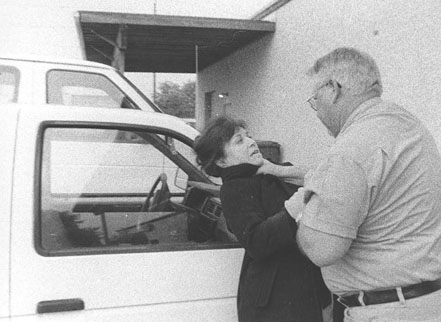
Bockwinkel, a former newspaper photojournalist and editor, captured Arends' assault of Coffey on film. (The clear and graphic pictures can be viewed on the CLEAN Web site at http://www.clean.org/photos/photo1.html ). In one photo, Arends is choking the petite Coffey in a parking lot; her body is rammed against a pick-up truck. A federal jury agreed with Coffey's complaint of excessive force by Arends, but U.S. District Court Judge Jack Tanner dismissed the suit and declined to award damages.
That case is on appeal in the 9th Circuit. In the meantime, Loeffelholz and Pierce County teamed up against CLEAN (which was not a party in the original federal lawsuit) for publishing a scathing opinion piece about the incident written by Coffey's husband, Tom Richeson. In an effort to prove that CLEAN has waged a "campaign of malicious harassment," the county is demanding that CLEAN disclose the names, addresses and telephone numbers of all current and past members of the watchdog group; correspondence, e-mails, and information about the construction and maintenance of CLEAN's Web site; and a list of all persons who receive e-mail, regular mail, or any other correspondence from CLEAN or its Web site.
This legal maneuver smacks of government bullying by a county with deep pockets and obvious incentives to encroach on CLEAN members' freedom of speech, association and privacy rights.
This week, CLEAN is scheduled to go to court to argue against the county's motion and to move the case to a neutral venue in Thurston County. Any fair-minded jurist will take one whiff of Pierce County's attempt to slap down dissident citizen watchdogs and come to one conclusion: It stinks.
Michelle Malkin's column appears Tuesday on editorial pages of The Times. Her e-mail address is: [email protected].
Copyright © 1999 Seattle Times Company
Pepper spray suit features dramatic tape
Officers use torture in logging protest
SAN FRANCISCO (AP) -- A dramatic videotape released Thursday shows officers dabbing pepper spray into the eyes of four female anti-logging protesters, then spraying them with it during a sit-in at a congressman's office.
The tape, played for reporters at a news conference announcing a lawsuit, showed protesters sitting around a tree stump, screaming as deputies pulled back their heads, opened their eyes and applied the burning substance to their eyelids with cotton swabs.
After repeated demands that the women release each other, an officer is shown squirting the spray into a protester's eyes at close range.
The suit said the tape was made by police Oct. 16 at the Eureka offices of Rep. Frank Riggs, R-Napa. A second, similar tape showed events in the lobby of Pacific Lumber Co. headquarters in nearby Scotia on Sept. 25.
Arms in metal sleeves
In both cases, demonstrators linked their arms inside metal sleeves and refused to let go until after the liquid sprayw was applied. The tape shows that the women were not chained together.
``It was like burning under your skin. . . . the worst pain I've ever felt,'' Maya Portugal, 16, of Eureka, told reporters.
At one point in the tape, a demonstrator pleads with officers to stop torturing her and a deputy replies, ``We're not torturing you any more.''
Macon Cowles, a lawyer for the demonstrators, likened the tactics to fire hoses used on civil rights protesters in the South.
``Now we've gotten more sophisticated and really more terrible, using chemical agents,'' he said.
The U.S. District Court suit said officers violated standard police practices as well as guidelines from the National Law Enforcement Policy Center for use of pepper spray. Those guidelines specify that the substance should not be discharged into the eyes at distances less than two feet, should not be used on people in restraints and should not be used as punishment, the suit said.
Suit seeks control of spray
The suit seeks damages for pain and suffering, punitive damages and a court order forbidding the use of liquid pepper spray by Humboldt County sheriff's deputies and Eureka police on ``peaceful, non-violent protesters who pose no threat to the safety of any person.''
Sheriff Dennis Lewis said pepper spray was the safest way to disperse the protesters.
``What we're trying to do is deal with the situation with a minimum of force and a minimum of hazard,'' Lewis told the Times-Standard of Eureka.
Beau Phillips, a spokesman for Riggs, said in a telephone interview from Riggs' Washington, D.C., offices that neither he nor Riggs was in the office at the time.
``I can't answer any questions on police procedures,'' Phillips said. ``They come up with their own procedures, obviously.''
The suit was filed on behalf of nine demonstrators who were protesting Pacific Lumber's plans to log old-growth forests and a proposed federal settlement, including public purchase of part of the Headwaters Forest, that the demonstrators considered inadequate.
Lawyers said the demonstrators were charged with trespassing and, except for two juveniles among them, were jailed for four days before being arraigned.
Mark Harris, another lawyer in the case, said he obtained the videotapes from the sheriff's office during pretrial exchanges of evidence in the criminal case.
Published
Friday, October 31, 1997, in the San Jose Mercury News
The Clintons' First Choice
Janet Reno and Voter Fraud
Miami
-- It was during Janet Reno's tenure here that the
city earned its well deserved nickname from a
highly-rated television show "Miami Vice."
Last year, Miami became the center of controversy
when a state court removed the sitting mayor
because of voter fraud. But, according to Reno's
former associate, voter fraud flourished while Reno
served as Miami's chief law enforcement officer.
Investigative reporters James Collier and Ken
Collier detailed in the 1992 book Votescam how
they uncovered pre-printed voter ballots in a
warehouse rented by a Miami political candidate.
Following the advice of their editor, they seized the
evidence and took the illegal ballots to the State's
Attorney, Janet Reno. Incredibly, Reno had the
journalists arrested, rather than investigate how a
candidate had pre-printed ballots in his possession.
http://38.201.154.108/articles/?a=1999/6/14/53841
Previous | Next | Index | 1 | 2 | 3 | 4 | 5 | 6 | 7 | 8 | 9 | 10 | 11 | 12 |
Storm
Alerts | WeatherSat
Animated |
WeatherSat Java | 7.5
cent long-distance |
News
Inference
Find | Ched's Web
Friends | Contact
Bob |