|
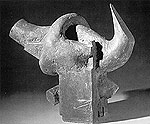
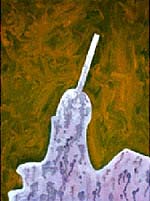
Reshaping Chaos The selection of works presented here traces back to the series of paintings made in the early 1980’s, while living in Prague. At that time and in that city I discovered the knotted forms. These forms became the leitmotiv of paintings incorporating, likewise, plastic elements randomly arranged grass, rain drops, landscape fragments, and clouds illuminated against the light. The knots, on the other side, reflect space illusion, with a generally oblique light and sharp color contrasts. The knotted forms fashioned a series of paintings that I worked on since the end of 1981 until well in the middle of the 1980’s. These paintings showed well-defined formal features: vertical settings, of a medium size, painted over a rigid support, employing a mixed technique made of an acrylic base and an oil finish. Adding complexity to complexity, also while in Prague, I modeled the first sculptures relating to that series of paintings. In fact, I always deemed the knots as particularly sculptural because of their peculiar barroquism. From 1987 that line of work geared toward the labyrinthine development of formerly knotted shapes, apart from any reference to nature, unraveling as one of the least representative series of my paintings. The spectrum of colors used narrowed to the point of becoming restricted to the mere use of almost primary colors, dwelling on chromatic dissonances. An energetic, almost violent technique was at work, often applying the color paste straight from the tube or with the fingers. One example of that way of doing is the painting “Resounding Grid”: a dyptich embodying all these features. However, on the right side of the painting, labyrinthine shapes straighten up as ascending straight lines, thus extending the color shapes at the picture left side. These straight lines, fleeing from the thicket, herald in 1990 a clear intent to put in order the baroque plastic labyrinth built up along the decade. In the summer of 1990, I left Madrid and moved to Paris, where I stayed for the next four years. When I resumed work, in 1991, I was positive about initiating into the path towards “reshaping chaos”, an expression used by Javier Rubio Nomblot to characterize some of my works at that time. That led me to resort to thematic options, tracing back to my early formative times, options that I ignored during twenty-five years. I took up again reviled traditional genres, like landscapes, figures, and still-lives; setting aside the random painting that I had been practicing since the Prague years. I would, nevertheless, preserve the former way of doing, thus lending seizable irony to the entire project. At that stage, in principle, the things or shapes that I intended conveying were hardly apparent, as shown by the set of paintings gathered under the title “Reshaping the Grids”. Progressively, however, the idea of resorting to representative plastic solutions became clear. As in the preceding stage, the way of doing consisted of vigorous brush-strokes, primary colors, and preserving composition rigor. In this way, the grid’s waving or broken lines evolved towards shaping images suggesting increasingly evident torsos or landscapes. That was my line of work during the early nineties. Its outcome were three well-defined series: “Torsos and Heads”, “New Landscapes”, and “Still-Lives”. The latest evolved into “Empty-Lives” in 1996, when the objects clearing was accompanied by an interest in their surrounding space and its rich texture. In 1997, a new transfer, to Washington DC this time, was accompanied by the usual work pause that goes with moving to a new place of residence. That might perhaps be the reason why along the late nineties, as a century-farewell, I took up again motives as traditional as “bathers” or “dancers”. A way to rememorate, in an ironic homage, the painters that, at the early years of the century, had produced pivotal works around such themes. These recapitulatory homage were joined by others, devoted to “musicians” and “the theatre” as well. Precisely in the triptych“Stage” and “North-american City” shows up again the idea of simplifying forms, putting aside excessive painting representativeness, pointing to the start of a new plastic stage. That was foreseen by Antonio Leyva, when in November 1998 wrote the poem entlited: “Soon, Juan Terreros, plumbline, knife, vase, water, seed, desolation and emptiness will become mere line”. Juan Romero de Terreros, Washington DC, 2002
|
“PARA L.M.1”, 1998 |