 HOME
HOMEChemistry - Table of Contents
The Lewis Theory of Acids and Bases
"I have attempted to give you a glimpse...of what there may be of soul in chemistry. But it may have been in vain. Perchance the chemist is already damned and the guardian the blackest. But if the chemist has lost his soul, he will not have lost his courage and as he descends into the inferno, sees the rows of glowing furnaces and sniffs the homey fumes of brimstone, he will call out: 'Asmodeus, hand me a test-tube.'"
Gilbert Newton Lewis
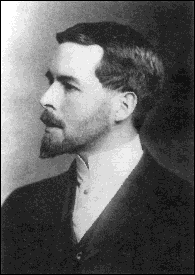 Gilbert Newton Lewis was nominated for the Nobel Prize in Chemistry over thirty times during his life, but his penetrating criticisms of ideas put forward by influential colleagues often generated resentment and animosity towards him, resulting a concerted effort on their part to prevent him from receiving the prestigous prize that many experts felt he was due. Unfortunately, Lewis died before he could be awarded the prize that he rightfully deserved.
Lewis sought to devise a general definition of acids and bases that was universal regardless of the chemical environment. Lewis believed that both the Arrhenius and the Bronsted-Lowry theories were insufficient for this task so, in 1923, soon after the publication of the Bronsted-Lowry Theory, he published his own Theory of Acids and Bases that addressed this problem.

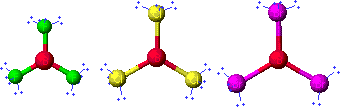
The empty orbital of Boron allows Boron Trihalides to act Lewis Acids 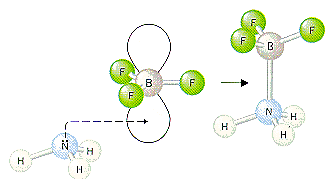
|
Unlike in Brønsted-Lowery Theory, Lewis Acids and Bases are described in terms of electron e- flow rather than proton p+ flow.
Lewis Acid:
- An ACID is a substance that is electron-deficient
or
exhibits low electron density. - Lewis Acid: an "electron-pair acceptor".
- A Lewis acid can be represented as: A
Lewis Base:
- A Base is a substance that is electron-rich
or
exhibits high electron density. - Lewis Base: an electron-pair donor.
- A Lewis base can be represented as: B:
Note that there are two important points: There are No hydrogen ions required and there is No solvent requirement.
Generalized Lewis Acid-Base Reaction
A + B: B+ + A:-
Where:
A is the Acid.
B: is the Base.
B+ is the Conjugate Acid.
A:- is the Conjugate Base
The Arrhenius Theory of Acids and Bases
The Br�nsted-Lowry Theory of Acids and Bases
Chemistry - Table of Contents
HOME