.GIF)
JTW's Chemistry Web Page
HOMEChemistry - Table of Contents
The Arrhenius Theory of Acids and Bases
Svante August Arrhenius (1859-1927) was the 1903 Nobel Prize Winner for Chemistry "in recognition of the extraordinary services he has rendered to the advancement of chemistry by his electrolytic theory of dissociation". In 1894 and 1899 he published two major papers concerning the nature of acids and bases. The first statement of his acid-base theory was put forward in his 1887 publication concerning the electrolytic dissociation theory.
Does H+ exist?
Is there any such thing as a "bare" proton?
H+ or p+, a bare proton, can not exist in isolation for very long, especially in water.
The proton affinity of H2O is about 799 kJ/mol. This is sufficient to drive the almost instantaneous formation of Hydronium Ions (H3O+).
The concentration of free protons in water has been estimated to be 10-130 M.
Arrhenius Acid:
- An Acid is any substance which
delivers Hydrogen ion H+ to the solution. - H+ shows up in aqueous solutions as Hydronium H3O+.

- HA is the representation for a generic Arrhenius Acid.
Arrhenius Base:
- A Base is any substance which
delivers hydroxide ion :OH- to the solution. - Mn+(:OH-)n is the generic representation of an Arrhenius Base.
Generalized Arrehenius Acid-Base Reaction
A molecule of Arrhenius Acid (Hydronium) reacts with and a molecule of Arrhenius Base (Hydroxide) to yield two Water molecules.
Acid + Base Water
Water

This is a reaction where the Acid and the Base react to neutralize each other.
A typical Arrhenius Acid would react like:

A typical Arrhenius Base would react like:
Problems with the Arrhenius' Theory
In nonpolar solvents, some acids do not act like Arrhenius acids. They do not dissociate in the same manner as they would in an aqueous solution. Aqueous HCl acts like an Arrhenius acid. HCl dissolved in benzene does not dissociate and therefore cannot deliver a proton to the benzene solution as an Arrhenius acid should. The nature of the solvent is critical in determining the acid-base properties of substances.
Arrhenius expected acid-base reactions between equivalents of acid and base reactants to produce neutral solutions. But this is not always the case. If equal amounts of a strong acid and a weak base are reacted, the resulting solution is slightly acidic. If equal amounts of a weak acid and a strong base are reacted, the resulting solution is slightly basic. The Arrhenius theory offers no explanation this of this phenomena. Apparently, he had not considered the possibility of strong and weak acids and bases where only partial dissociation of the reactants occur.
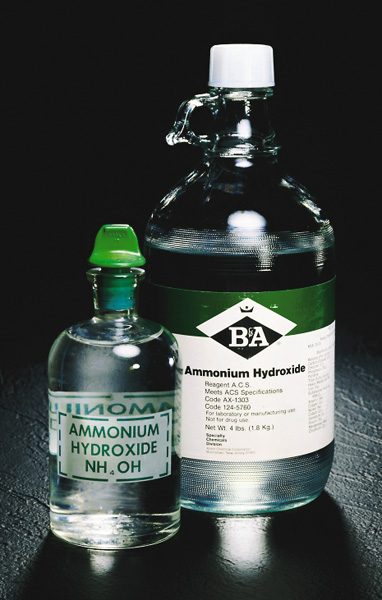
Ammonium Hydroxide ?
Or Ammonia ?
The requirement that, for bases, one of the dissociation products must be hydroxide ions (:OH-), led Arrhenius to propose NH4OH as the formula for aqueous ammonia, thereby drawing the mistaken conclusion that NH4OH is the base under these conditions. It is NH3 that is the base.
Acid + Base
 Conjugate Acid + Conjugate Base
H2O + :NH3
NH4+ + :OH-
Aniline
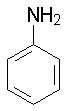 Several years before the Arrhenius theory, base properties had been demonstrated for solvents such as aniline, where, as in ammonia, hydroxide ions were not directly derivable from the compound itself.
The Bronsted-Lowry Theory of Acids and Bases
The Lewis Theory of Acids and Bases
Chemistry - Table of Contents
HOME