

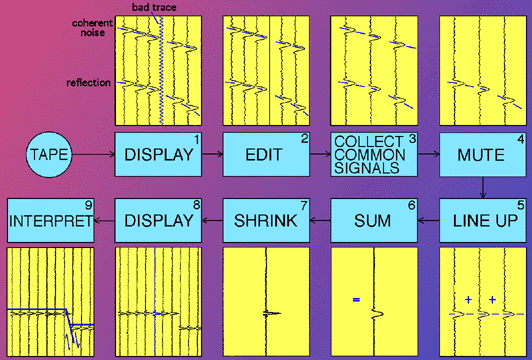
The data are read from tape and the shotrecords (i.e. all traces recorded for a given shot) are displayed (1). Bad seismic traces, due to noise or a short circuit in the recording equipment, are edited out (2). The traces are then reordered (3) so that each gather of traces belongs to a common reflection point, such as point P in Figure 1. Non-reflected arrivals, such as surface waves and direct arrivals, are removed by digital filtering and/or muting (zeroing of the data) (4). A correction is made for the time the reflected ray spends travelling laterally, so that the reflected arrivals now line up (5). These traces are then added to produce a single output trace (6). This process, referred to as stacking, cancels out random noise and reinforces the reflected signals. The waveform is then shrunk by frequency filtering or deconvolution to improve the resolution (7). Steps (4) to (7) are repeated for each common reflection point, and the resulting seismic traces are displayed as a seismic section (8) which is then interpreted (9).
(source: Lithoprobe Seismic Processing Facility)