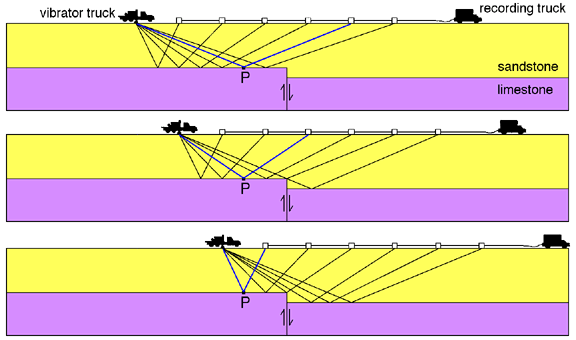
Seismic recording systems vary according to application but consist of same basic components: energy source, seismometers (geophones), cables and seismograph.
Energy Source � depends on cost, convenience and safety. Possible sources include:

(source: Lithoprobe Seismic Processing Facility)
2) weight drops
3) blasting caps or explosives
4) rifles or shotguns
5) earth compactors (Mini-Sosie).
Geophones � motion sensitive transducers that convert ground motion into velocity. Geophones measure the arrival time of the wave. Geophones are linked together by a cable to create an array. The cable is linked to a seismograph which records and displays the seismic signals. It is also equipped with a printer to give on demand hard copies of the data.
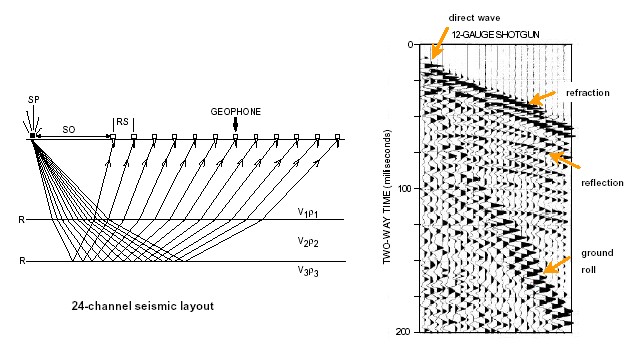
The figures below illustrate the collection of data and the output received. The figure on the left shows a simple method of collecting a seismic record. SP is the energy source (possibly a sledge hammer hitting a steel plate), SO is the distance between the sound source and the first geophone. Density contrasts at the boundaries of layers 1, 2 and 3 will determine what velocity is sensed by the geophones.
The figure on the right is an example of a shot record, showing, among other things, refraction events and reflection events. These events could be interpreted as layers in the soil. The direct wave at the top of the figure is the wave recorded by the geophone at the speed of sound - this wave moves directly from the sound/energy source to the geophone without going through the ground.