| Verkeer en Leefomgeving |
 |
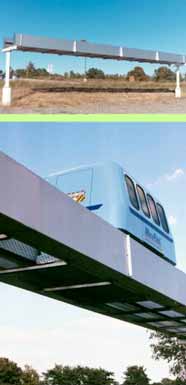
| The realisation of the quideway is the most difficult part of the system. Before the guideway cab can ride, kilometers of guideway must be made, and placed. Rails of the normal railway track are perfectly, but probably not use-able This is due to certain causes: - The safety system of the railways does not work at the light guideway cabs, converting of it, is almost making a whole new safety-system. - A second problem is the overhead line: the small guideway cabs would have huge pantographs. A solution for the supporting of the electrical energy could be the so-called third rail, like the underground railways. - A larger problem are the cross roads. The guideway cabs drive at very little haedway: they dive quite near to another. So the cross-roads are mostly closed. The costs to make all cross-roads to viaducts aree very high. A bit of solution however can be platooning of railway-cabs. But to much railway traffic doesn�t help this any more. - Just another large problem are the shunt rails for bypasses (characteristic 7): Most stations of the rail ways don�t have shunt railways. (an emplacement) but are only stops at the continuing track. (the free guideway). So the vehicles for bypassing must wait as a result, for stopping of the first one. That is a reason why does not leave intercity's shortly after a regional train, but instead of it: intercities leave short before the regional train: The intercity have a free rid to close to the next intercity station. - The largest problem however are the diverging junctions. Guideway cabs drive this close behind each other that there is not time enough to change the junctions. For this reason the guide way for the guideway cab have no railway-like junctions but road-like junctions. The direction of guideway cabs is stipulated by the vehicle himself, just like steering of all vehicles on the ordinary roads. How building guideways without huge prices? Build guideways as light as possible. By the only use of little light vehicles, the guideway is also little and light. Much lighter, narrower and cheaper than railway- and highway fly-overs. The light guideway are put on piles as a un-ending viaduct. The guideway can follow as a result, existing ways, without becoming an obstacle for all other traffic (animal traffic included). The same can be reached with undergrund guideways, if the society is preparedto pay the higher costs. Another way to decrease the building sosts is the use of special strips of asphalt or beton roads. These guideway strips are approximately as broad and strong as a bicycle path. The ParkShuttle use of this for instance. It is cheaper and at this time easier to built than than more sophisticated guideways. The advantages and performances to gain are however also lower. May be a combination of fly over guideways and sophisticated guideways at 0-level can work well. (at 0-level for instance parallel to canals.) Guideways exploit better Beside the use of guideway cabs on the guideway, is it possible to make the guideway useble to other transport means. A number of guideway types are devised especially for multimodal use of automatic transportmeans (MAT) freight: All systems enable efficient movement of smaller entities of goods. Because there is no driver necessary, the necessity expires to move goods in large entities. For example: 1 large sand truck can divide its cargo over 20 sand-carrying guideway cabs. Property of a guideway cab: (a guideway car?) The guideway car rides the same as an ordinairy guideway cab. And also stops at the same stations as guideway cabs. But after that the guideway car would be directed to the nearest automatic "park garage" and stored there. Not only MAT systems are suitable for this use. In principle all sytemen can be made suitable for this, by mooring automatic parking garages and by making stions with more than 1 guideway to arrive. With te use of two or more arrive guideways guideway vehecles don�t have to wait on eath other. At a station one can simply call its own guideway car. The car will come out of the park garage and rides to your station. The difference between the public guideway cab and the own guideway car is much less than the nowadays public transport and the own car. Without own car one is limited in its transport possibilities and that is a strong purchase motivation. Without the property of a guideway car, man is not limited in his transport possibilities. More strongly: the guideway cab is frequently more rapidly available than one�s own guideway-car. The pro�s of an owning a guideway-car is the possibility to change the interior to your own wishes. Guideway buses: The Danish RUF-system is designed to carry huideway buses. The astronaut Wubbo Ockels� Superbus is also a non-automatic guideway bus, when riding on its super fastway. A disadvantage of guideway buses is the more need for stronger guideways. And as a result of that, these guideways wil be somewhat more expensive. Guideway buses are especially suited for the larger streams of traffic. Dual vehicles: That are vehicles which both automatically can drive on the guideway, and by driver can ride on ordinary roads. These vehicles are on the guideway right to guideway cabs and guideway carriages, but outside the guideway them nearly right to electric cars is, electric taxi's and electric buses. But because dual vehicles must work in two types of environments (both guideway and road) dual cars has other disadvantages. Just as like a folding bike, who has to be able to handle two types of use. Pallet - vehicles: On a pallet vehicle an another vehicle can be placed. For instance cars. Pallet vehicles seems on the so-called car-sleep- trains, only split up in small entities. The advantages of the guideway cab will be lost, however, for a large part. But, possibly, pallet vehicles are a step from current transport resources to the guideway cab. |
 |
 |
|
|
|
|
|
|
|
|
|
|
|
|
|
|
|
|
|
|
| Last changed: august 2006 |
| The guideway in guideway cab: the guideway track |
 |