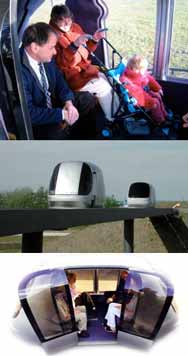
When the guideway cab is built, shall people; shall you; travel by guideway cabs?
There are good reasons for taking the guideway cab. And there are also reasons wich hurdle people to accept a ride by guideway cab.
Why shall people travel by the guideway cab?
- To cover the transport next after a train journey. So does for instance the Parkshuttle at Capelle to the IJssel.
- Faster travel, while guideways has no traffic lights and you don�t have to look for a parking place.
- No more stress during travelling (by upheaval, road safety, connections, dark, snow, black ice, etc.)
-For fine guts: Your own behaviour contributes to road safety and improvement of the environment and life surrounding. It contributes to a positive image.
- Travel time won�t be lost time anymore: the whole travel time can be used usefully, up to the signal that tells you that the guideway cab arrives some moments from now at the chosen station.
- No more troubels of the current public transport: to adapt own timetable to time tables and delays; to transfers and waitings at your connection. No more multiple stopping underway, cumbersome travellers. And, in the long run, stations come closer to your destination. (A lot of destinations will eventually have their own birthes)
- No more troubles of your own car. For instance: to buy, to refuel, oil refreshes, maintenance, de-icing the windows in winter mornings, to wash, to clean, to official car checks, to pay reckonings at traffic police, cold starts in the winter, overheated cars in the summer sun, to seek a parking place, paid park.
- Lower travel expenses, compared to the car.
- Independent travel of disableds and children as from approximately 6 years (with a preprogrammed travel card)
- Unmanned transport of goods possible because only humens are necessary at the departure and at the arrival of goods and with the settlement of goods.
- Less chance on involvement in traffic accidents. And also less change to get the resulting troubles: pains and labours. (The guideway traffic moves on a separate guideway, and traffel is no longer conducted by people who has different knowledge, consciousness, experience and human emotions.
Why won't people travel with the guideway cab?
- No faith in automatic transport resources (although elevators, however, are trusted)
- Lack of status (although it can be made possible that there come more than one cab providers. Competing cabs riding on the same guideway, which supply more or less status-raising vehicles.
- The travel aim; meeting or seeing other people -during your travel - is not really possible. (Although the guideway cab enables, however, to alter parking space into meeting places. And you can meet people at stations)
- Running or driving (with bicycle, car, scooter, rolskates) or let drive (taxi, bus, co-ride) to guideway stops is too much (especially in the beginning, when there are only few guideways for the guideway cab)
- The network of the guideway cab does not come close enouf to the disered destination. (Especially in the beginning, as the network is still in development. A guideway cab station in a train- or bus station will be very useful then.)
- Leaving the guideway cab without your luggage by mistake. (Maybe a guideway-car is a good alternative)
- The innovation in itself may form an obstacle: people have to find out how they can ride a guideway cab. This can be a problem, especially for older people. (although explanation, by experted teachers by expert, will help. So does the availability of travel cards with preprogrammed destinations.) |