
|
|


|

|

|

|

|

|

|
 |
|
|
|

|
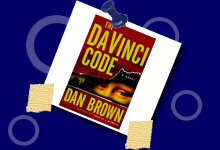
some shocking excerpts i read from the book: Many have made a trade of delusions and false miracles, deceiving the stupid multitude. -LEONARDO DA VINCI Blinding ignorance does mislead us. O! Wretched mortals, open your eyes! -LEONARDO DA VINCI "The Bible is a product of man, my dear. Not of God. The Bible did not fall magically from the clouds. Man created it as a historical record of tumultuous times, and it has evolved through countless translations, additions, and revisions. History has never had a definitive version of the book." Teabing "The fundamental irony of Christianity! The Bible, as we know it today, was collated by the pagan Roman emperor Constantine the Great." "He was a lifelong pagan who was baptized on his deathbed, too weak to protest. In Constantine's day, Rome's official religion was sun worship-the cult of Sol Invictus, or the Invincible Sun-and Constantine was its head priest. Unfortunately for him, a growing religious turmoil was gripping Rome. Three centuries after the crucifixion of Jesus Christ, Christ's followers had multiplied exponentially. Christians and pagans began warring, and the conflict grew to such proportions that it threatened to rend Rome in two. Constantine decided something had to be done. In 325 A.D., he decided to unify Rome under a single religion. Christianity." Sophie was surprised. "Why would a pagan emperor choose Christianity as the official religion?" Teabing chuckled. "Constantine was a very good businessman. He could see that Christianity was on the rise, and he simply backed the winning horse. Historians still marvel at the brilliance with which Constantine converted the sun-worshipping pagans to Christianity. By fusing pagan symbols, dates, and rituals into the growing Christian tradition, he created a kind of hybrid religion that was acceptable to both parties." "Transmogrification," Langdon said. "The vestiges of pagan religion in Christian symbology are undeniable. Egyptian sun disks became the halos of Catholic saints. Pictograms of Isis nursing her miraculously conceived son Horus became the blueprint for our modern images of the Virgin Mary nursing Baby Jesus. And virtually all the elements of the Catholic ritual-the miter, the altar, the doxology, and communion, the act of "God-eating"-were taken directly from earlier pagan mystery religions." Teabing groaned. "Don't get a symbologist started on Christian icons. Nothing in Christianity is original. The pre-Christian God Mithras-called the Son of God and the Light of the World-was born on December 25, died, was buried in a rock tomb, and then resurrected in three days. By the way, December 25 is also the birthday of Osiris, Adonis, and Dionysus. The newborn Krishna was presented with gold, frankincense, and myrrh. Even Christianity's weekly holy day was stolen from the pagans." "Originally," Langdon said, "Christianity honored the Jewish Sabbath of Saturday, but Constantine shifted it to coincide with the pagan's veneration day of the sun." He paused, grinning. "To this day, most churchgoers attend services on Sunday morning with no idea that they are there on account of the pagan sun god's weekly tribute-Sunday." "Jesus' establishment as 'the Son of God' was officially proposed and voted on by the Council of Nicaea." Constantine turned Jesus into a deity who existed beyond the scope of the human world, an entity whose power was unchallengeable. This not only precluded further pagan challenges to Christianity, but now the followers of Christ were able to redeem themselves only via the established sacred channel-the Roman Catholic Church." "The twist is this," Teabing said, talking faster now. "Because Constantine upgraded Jesus' status almost four centuries after Jesus' death, thousands of documents already existed chronicling His life as a mortal man. To rewrite the history books, Constantine knew he would need a bold stroke. From this sprang the most profound moment in Christian history." Teabing paused, eyeing Sophie. "Constantine commissioned and financed a new Bible, which omitted those gospels that spoke of Christ's human traits and embellished those gospels that made Him godlike. The earlier gospels were outlawed, gathered up, and burned." "An interesting note," Langdon added. "Anyone who chose the forbidden gospels over Constantine's version was deemed a heretic. The word heretic derives from that moment in history. The Latin word haereticus means 'choice.' Those who 'chose' the original history of Christ were the world's first heretics." "Fortunately for historians," Teabing said, "some of the gospels that Constantine attempted to eradicate managed to survive. The Dead Sea Scrolls were found in the 1950s hidden in a cave near Qumran in the Judean desert. And, of course, the Coptic Scrolls in 1945 at Nag Hammadi. In addition to telling the true Grail story, these documents speak of Christ's ministry in very human terms. Of course, the Vatican, in keeping with their tradition of misinformation, tried very hard to suppress the release of these scrolls. And why wouldn't they? The scrolls highlight glaring historical discrepancies and fabrications, clearly confirming that the modern Bible was compiled and edited by men who possessed a political agenda-to promote the divinity of the man Jesus Christ and use His influence to solidify their own power base." "What I mean," Teabing countered, "is that almost everything our fathers taught us about Christ is false. As are the stories about the Holy Grail." "Then perhaps you would indulge me this little game? Close your eyes if you would." Uncertain, Sophie closed her eyes. "Where is Jesus sitting?" Teabing asked. "In the center." "Good. And what food are He and His disciples breaking and eating?" "Bread." Obviously. "Superb. And what drink?" "Wine. They drank wine." "Great. And one final question. How many wineglasses are on the table?" Sophie paused, realizing it was the trick question. And after dinner, Jesus took the cup of wine, sharing it with His disciples. "One cup," she said. "The chalice." The Cup of Christ. The Holy Grail. "Jesus passed a single chalice of wine, just as modern Christians do at communion." Teabing sighed. "Open your eyes." She did. Teabing was grinning smugly. Sophie looked down at the painting, seeing to her astonishment that everyone at the table had a glass of wine, including Christ. Thirteen cups. Moreover, the cups were tiny, stemless, and made of glass. There was no chalice in the painting. No Holy Grail. "Exactly." Langdon smiled. "The Grail is literally the ancient symbol for womanhood, and the Holy Grail represents the sacred feminine and the goddess, which of course has now been lost, virtually eliminated by the Church. The power of the female and her ability to produce life was once very sacred, but it posed a threat to the rise of the predominantly male Church, and so the sacred feminine was demonized and called unclean. It was man, not God, who created the concept of 'original sin,' whereby Eve tasted of the apple and caused the downfall of the human race. Woman, once the sacred giver of life, was now the enemy." "I should add," Teabing chimed, "that this concept of woman as life-bringer was the foundation of ancient religion. Childbirth was mystical and powerful. Sadly, Christian philosophy decided to embezzle the female's creative power by ignoring biological truth and making man the Creator. Genesis tells us that Eve was created from Adam's rib. Woman became an offshoot of man. And a sinful one at that. Genesis was the beginning of the end for the goddess." Sophie examined the figure to Jesus' immediate right, focusing in. As she studied the person's face and body, a wave of astonishment rose within her. The individual had flowing red hair, delicate folded hands, and the hint of a bosom. It was, without a doubt... female. "That's a woman!" Sophie exclaimed. "Who is she?" Sophie asked. "That, my dear," Teabing replied, "is Mary Magdalene." |

|

|
  |
 |

|

|

|

|

|
|
|
|
|
|
|
© All rights reserved. All laws pertinent to Intellectual Property Rights apply. 2004. Jayson Bernard B. Santos |

|