From Buffalo to Alaska. Day 10. Page 2.
We landed in Watson Lake at 1:00, refueled, and then checked the weather. As we waited, another small plane joined us. It contained Bob and Skip Vasey, enroute from their home in Kansas to visit their son in Homer, Alaska. Bob was a retired large animal vet who had given up his practice 15 years ago and moved to Homer to be a bush pilot. They had since moved back to Kansas, but had flown this route a dozen times.
The weather forecast was for adequate ceilings (i.e. cloud height above the ground) all the way to Whitehorse, except for a shower at Teslin Lake, about 150 miles along the way. We could fly around the rain, but would have to leave the safety of the Highway. We expressed our reservations to Bob. He had planned to abandon the Highway completely, and fly the direct route over the river to Whitehorse. But after learning of our status as Highway rookies, he graciously offered to change his plans and fly the Highway route along with us as a guardian angel.
We took off, with us in the lead and Bob and Skip following. They stayed about half a mile behind us on this leg to Whitehorse, and we realized later that Bob found the trailing position to be much safer, since he could always see us and stay out of our way.
Since we'd never flown with another plane before, we spent the first 10 minutes after takeoff looking out the window trying to find them, instead of navigating. We ended up following the dirt road northwest to Dawson, Yukon Territories, instead of southwest along the Alaska Highway to Whitehorse. Bob politely pointed our navigational error out to us, and ten minutes later we met up with them, pointed in the right direction.
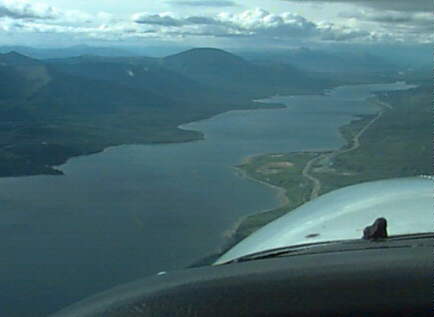
There were no significant mountain passes on this leg, so the mountains stayed a little further away from the wingtips than in the morning. On this leg, however, we passed one of the longest lakes in Canada -- Teslin Lake -- and flew along its shores for 50 miles.
We arrived in Whitehorse at 6 p.m., exhausted from the most exhilarating flight of the trip. We invited Bob and Skip to join us for dinner as a "thank you" for their help, and learned a lot about Alaska bush flying.
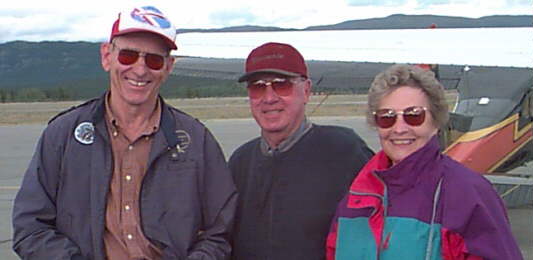
Bob and Skip were flying a Piper Pacer that Bob had built and rebuilt more than once. He told us the story of flying the plane when he was a bush pilot and it belonged to his boss. He landed it on a beach at low tide in the Kenai peninsula, but hit a small puddle on rollout after landing, and flipped the plane. He and his passenger weren't injured, but the plane had a bent propeller, a broken windshield and broken struts supporting the wings, and many holes in the fabric that covered the fuselage.
They realized high tide would cause their sandbar, and the plane, to disappear beneath 20 feet of water. So they disassembled the plane -- took off the wings, took out the engine, and carried the whole thing, in pieces, 100 yards down the beach to a small island that would stay above high tide.
They were rescued the next day by helicopter. Two days later Bob and his boss flew back to the beach at low tide with a welding torch and duct tape. Working in shifts during low tide, and flying out during high tide, in two days they had put the plane back together, straightened the prop by bending it against a tree, used steel bars and duct tape to splice the broken struts, put duct tape over the holes in the wings, and installed a new windshield (also with duct tape). The windshield was the most important, because if the wind could blow into the cockpit, it would blow through the hollow fuselage, and blow the fabric skin off the hull.
At the next low tide, Bob flew the damaged plane off the beach, and 50 miles over water back to the base at Homer.
Bob then bought the damaged plane from his boss, put the pieces in a two car garage in Homer, and over the next two years completely rebuilt it. That plane is the one in the following picture, and the one that followed us up the Highway.
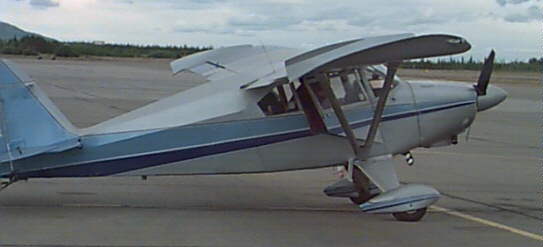
Don't know about you, but we were impressed.
Out the window of our restaurant across the street from the airport I saw the one man-made object I most wanted to see on this trip -- the DC 3 that had been converted by the folks of Whitehorse into the world's largest windsock. They sure do things on a large scale up here.
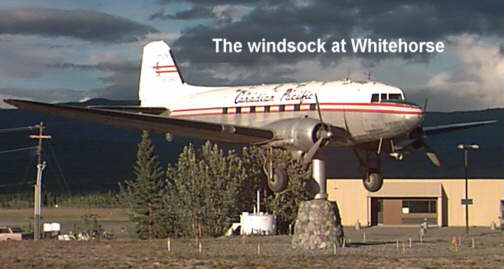
Weather doesn't look good for tomorrow, so maybe we'll see some of Whitehorse.
Sign Guestbook
View Guestbook
|  Previous day | Next day
  |
|  Return to home page|