|
Natural Disasters |
|
Calamities like typhoons, earthquakes, volcanic eruptions and tsunamis are natural forces of nature which is beyond the control of human beings. These powerful forces are unpredictable and may strike anytime and posses a tremendous effect that could kill and destroy the lives and habitat of plants, animals and human beings.
A natural disaster is the effect of a natural hazard which occurs naturally that is not brought about by acts of human beings. A serious disasters can lead to financial, environmental and human loss. The degree of strength in any calamities can be measured based on the vulnerability of the affected population , the amount and size of damage and the number of lives lost. |
|
“God can forgive, Human can forget but Nature cannot.” |
|
Geological Disasters |
|
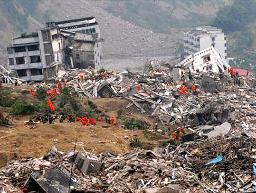
Earthquake Damage in Haiti, 2010. Source: New York Daily News |
|
An earthquake is a sudden shake of the Earth's crust caused by the tectonic plates colliding. The vibrations may vary in magnitude. The underground point of origin of the earthquake is called the "focus". The point directly above the focus on the surface is called the "epicenter". Earthquakes are measured using observations from seismometers or the Richter scale. |
|
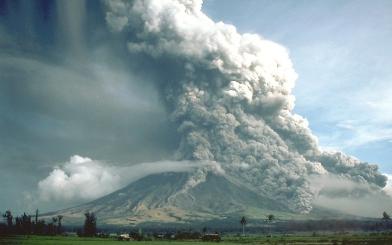
Mayon Volcano Eruption on September 23, 1984 |
|
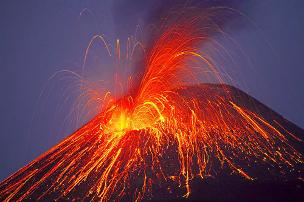
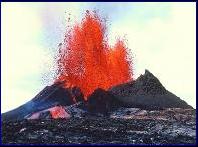
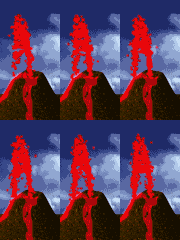
During a volcanic eruption, lava, tephra and various gases are expelled from a volcanic vent or fissure. |
|
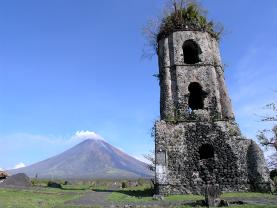
The church tower is what remains of the Cagsawa Church, which was buried by the 1814 eruption of Mayon Volcano. It withstood the damage done by Typhoon Durian in 2006. |
|
Tambora, Indonesia; eruption in 1815 killed 92,000 people |
|
Hydrological Disasters |
|
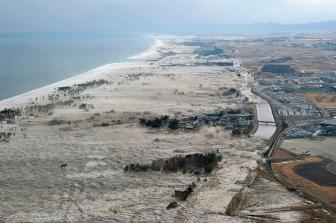
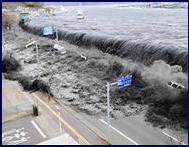
A tsunami is a series of water waves caused by the displacement of a large volume of a body of water, usually an ocean, though it can occur in large lakes. Tsunamis are a frequent occurrence in Japan. Earthquakes, volcanic eruptions and other underwater explosions (including detonations of underwater nuclear devices), landslides glacier calving and other mass movements, meteorite ocean impacts or similar impact events, and other disturbances above or below water all have the potential to generate a tsunami. |

|
Wave animation showing the initial "drawback" of surface water |
|
A massive tsunami hits coastal areas of Iwanuma, Miyagi, northeastern Japan, on March 11, 2011, after a powerful earthquake. (Kyodo,photo) |
|
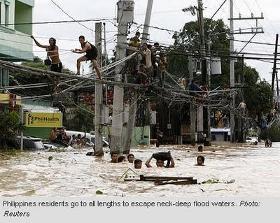
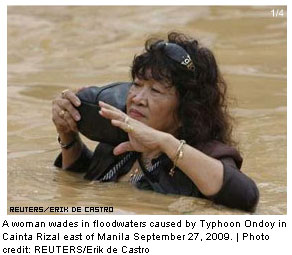
Some residents of Marikina climb the electric post just to escape the neck-deep flood brought by Typhoon Ondoy |
|
Meteorological Disasters |
|
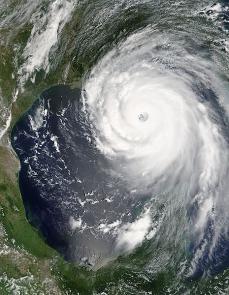
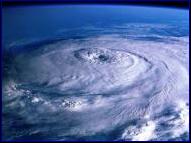
Hurricane Katrina August 28 2005 by NASA |
|
Hurricane Katrina was set to become one of the most powerful storms to strike the United States, with winds of 257 kilometers per hour (160 miles per hour) and stronger gusts. |

|
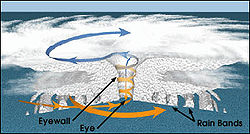
A tropical cyclone is a storm system characterized by a large low-pressure center and numerous thunderstorms that produce strong winds and heavy rain. Tropical cyclones strengthen when water evaporated from the ocean is released as the saturated air rises, resulting in condensation of water vapor contained in the moist air. They are fueled by a different heat mechanism than other cyclonic windstorms such as nor'easters, European windstorms, and polar lows. The characteristic that separates tropical cyclones from other cyclonic systems is that at any height in the atmosphere, the center of a tropical cyclone will be warmer than its surrounds; a phenomenon called "warm core" storm systems. |
|
Structure of a tropical cyclone |
|
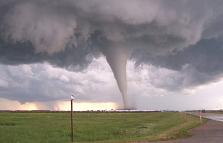
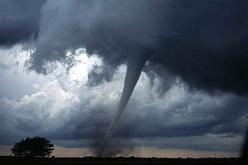
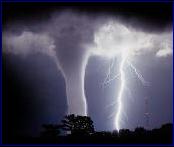
A tornado is a violent, dangerous, rotating column of air that is in contact with both the surface of the earth and a cumulonimbus cloud or, in rare cases, the base of a cumulus cloud. Tornadoes come in many shapes and sizes, but are typically in the form of a visible condensation funnel, whose narrow end touches the earth and is often encircled by a cloud of debris and dust. Most tornadoes have wind speeds less than 110 miles per hour (177 km/h), are approximately 250 feet (80 m) across, and travel a few miles (several kilometers) before dissipating. |
|
A tornado near Anadarko, Oklahoma. |
|
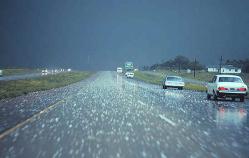
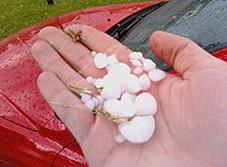
Hailstorm is a form of solid precipitation which consists of balls or irregular lumps of ice, that are individually called hail stones. Ice crystals, dust particles and chilled water get distilled to form hail. Strong wind blowing during hailstorm carries with hailstones of varying size. Hailstone can be as small as a pea. Bigger hailstone looks like a golf ball. Hail stones on Earth consist mostly of water ice and measure between 5 millimeters (0.20 in) and 150 millimeters (5.9 in) in diameter, with the larger stones coming from severe thunderstorms. |
|
Hailstorm |
|
The worst hailstorm reported on April 15, 1999 happened in Sydney Australia when hailstones rocked the country smashing through windows and roofs. The noise created by the huge hails was terrifying. In the coastal area of Dolans Bay, Guildford, a fisherman was struck by a lightning, killing him instantly. Meanwhile, motorists were stranded when hailstones created a huge roadblock in Royal National Park. |
|
Hailstones ranging in size from Pea to Nickel |
|
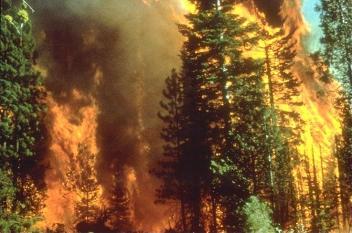
A wildfire in California, 5 September 2008 |
|
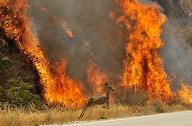
A deer escapes a wildfire in the Angeles National Forest near Los Angeles. |
|
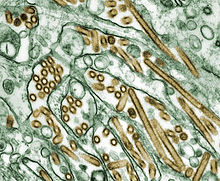
An epidemic is an outbreak of a contractible disease that spreads at a rapid rate through a human population. A pandemic is an epidemic whose spread is global. There have been many epidemics throughout history, such as Black Death. In the last hundred years, significant pandemics include: >The 1957-58 Asian flu pandemic, which killed an estimated 1 million people >The 1968-69 Hong Kong flu pandemic >The 2002-3 SARS pandemic >The AIDS pandemic, beginning in 1959 >The H1N1 Influenza (Swine Flu) Pandemic 2009-2010 |
|
The A H1N1 virus, which causes Avian influenza |

|
Works Cited |



|
Animated volcanic eruption |