The idea that Christians should believe in a "wall" of division between Church and state is an entirely false and innovative one. Christianity, even before the religion itself existed in the current form, has never been considered to be the sort of thing one could seperate from that other most dominant institution in the lives of man: government. In the Old Testament, even when God was not ruling directly through the Patriarchs, God's vicars on earth never hesitated from involving themselves in political matters, as the actions of the prophets Isaiah, Amos, Micah, Jeremiah and especially Samuel, who anointed for God the first two kings of Israel clearly show.
In the New Testament, Jesus Christ and His apostles made clear the distinctions between the secular and spiritual spheres, and which was the superior of the two, but never hinted in any way that these two should avoid each other or ignore each other. This was clearly carried out in the early history of the Christian Church. Rome's first Christian Emperor, Constantine the Great, played a major part in seeing to it that Christian doctrine was clearly defined and that compliance with it could be enforced. For some time, all of the Church councils were called by the emperors, rather than the bishops or the Pope, in order that the new and growing religion could organize itself and outline its teaching clearly.
From the other side, we also see how the Church, in the person of St Ambrose of Milan for example, continued to preach, teach, advise and admonish government figures and policies, even up to Caesar himself and so resulted in Emperor Theodosius the Great making Christianity the official religion of the entire Roman Empire. Starting with Constantine, the Church saw to it that government granted, for the first time, religious toleration and later on, with Theodosius, the government not only endorsed but established Christianity as a recognized, essential part of Roman society.
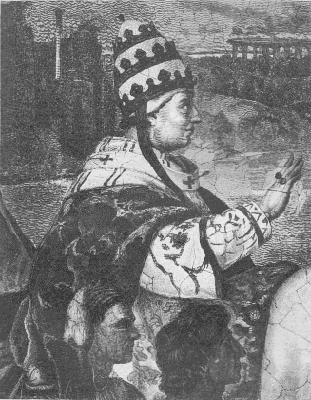
After the fall of the Roman Empire, Church and state were driven together even more closely by the simple reason of necessity. When all secular power had collapsed the Holy Church was the only institution which could carry on the civil duties previously handled by the government. Later on, as civilization recovered, the distinctions were restored between civil and spiritual, but the two were never isolated from one another. This is exemplified by St Leo III crowning Charlemagne Holy Roman Emperor, as was continued on by the successors of each, illustrating in a very powerful way the fact that the secular powers were given their authority by the spiritual powers. Early Christian artwork shows that this relationship was well-known and celebrated with a number of representations showing the partnership between the Emperor and the Pope and the bishops and the princes.
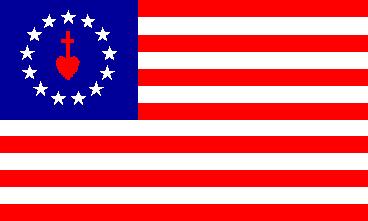
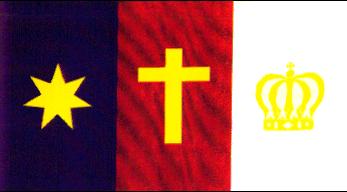
The role of religion can be seen bound up in all of the major nations of Western Civilization. This can be as simple and obvious as the flag of England bearing St George's Cross or the flags of Scotland and Russia bearing St Andrew's Cross, the flag of the ancien regime of France bearing the Marian symbol of the lilies or the angels bearing the crown of St Stephen on the old Hungarian flag. Then there were the numerous religious titles given by the Pope to the various kings of Europe; "Most Christian" for France, "Catholic" for Spain, "Apostolic" for Hungary and "Fidei Defensor" for the King of England. Pope Innocent III laid out in particularly direct language, that Church and state cooperation was essential, "For through this union is the Faith propagated, heresy overcome, virtue made to flourish, vices rooted out, justice preserved, iniquity held in check, peace secured, persecution abolished, and pagan barbarity subdued". |