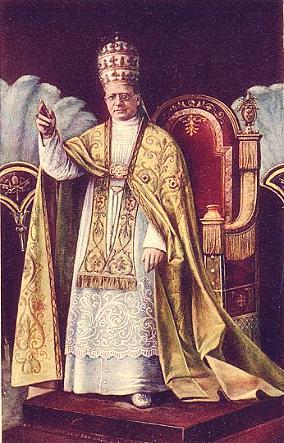
Before the American Revolution, seperation of Church and state was an unheard of concept, even in places, like the British North American colonies, where there was a number of religious denominations. For America, the results of seperation would be long-term rather than immediate damage, but soon after, in France, the world was presented with the grisly reality of a state that was not only seperate from religion, but hostile to it in the extreme. The French Revolution set the precedent, and throughout the 19th Century there were efforts to revive the idea of a secular state. The focus for these rebellions was always on the monarchies, which was no accident as they were the living embodiment of Church & state cooperation, heads of state who owed their position to "the grace of God", be they Catholic, Protestant or Greek Orthodox. The French monarchy again collapsed, Prussia, Austria, Russia and even the Papal States came under attack. By the end of World War I, monarchies with religiously based governments were no longer dominant in the world. The 20th Century was to be the century of Church and state seperation, and the consequences of this are only too easy to see.
Even in formerly staunch Catholic countries like Mexico and Spain, anti-clerical regimes came to power in the 20th Century and enacted horrific persecutions of Christians, often a prelude to Marxist dictatorships, revolutions and civil wars. Central Europe was torn apart as political factions fought each other in the streets, clinging to their political ideaologies as their new brand of "religion", a doctrine that was going to "put the world in order". In many ways, the world was reverting back to paganism, when each people had their own set of gods who they deemed superior to all others. The Church, therefore, had to start from scratch in re-converting the world to Christianity. Partly in response to this, Pope Pius XI instituted the Feast of Christ the King in order to emphasize that Christ was still the universal monarch, and regardless of what changes were made in governments, all Christians were to submit themselves to his divine rule and work to extend his reign outwards. |