Day 35 - Wednesday 1st August
Having chased the monsoons in India, that's more than
a month abroad. And now I'm back in London!
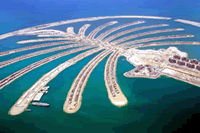 When I landed in Dubai , I was able to see The Palm and The World
from the skies, which was absolutely amazing. In fact, my uncle
told me that pilots flying to Dubai Airport were ordered to fly
over that location for all to see!
When I landed in Dubai , I was able to see The Palm and The World
from the skies, which was absolutely amazing. In fact, my uncle
told me that pilots flying to Dubai Airport were ordered to fly
over that location for all to see!
Day 34 - Tuesday 31st July
Today was my final day in 'God's Own Country'. I have
thoroughly enjoyed my trip to the UAE and India and have learnt
and especially, seen a lot. The trip has been a real eye opener.
Because of this trip I can now visualise India's economic development
and attach pictures to words that I have read.
For
the flights back I made sure that both were window seats! My flight
is actually early tomorrow morning at 4:45am but I had to leave
at around midnight.
Day 33 - Monday 30th July
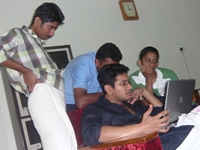 I
have managed to squeeze everything into my suitcase, which is
quite an achievement considering how much there was to pack!
I
have managed to squeeze everything into my suitcase, which is
quite an achievement considering how much there was to pack!
It
was time to say my goodbyes to everyone I had met over the last
month in India as I'll be leaving tomorrow (mid)night.
Day 32 - Sunday 29th July
Whenever I come to India, one of my favourites is the
'ball ice cream'. It's basically a small plastic ball the size
of a tennis ball with mouth-watering ice cream inside! Until today,
I had completely forgotten about it, but as soon as it came to
memory I was at a local shop to get the 'ball ice cream'. Delicious.
Indian
stocks fell sharply on Friday which saw the 30-share Sensex plunge
541.74 points. This is the fifth steepest fall in its history.
Many other stock markets also fell across the world amid concerns
over the US housing downturn.
On the surface, it seems that India is very much at the mercy
of global capital markets but investors in Indian equities should
not be frightened. Given the impact on profits of the appreciating
rupee, net earnings growth of 500 companies lies at around 25-30%.
In general, the Indian economy is also doing quite well.
Day
31 - Saturday 28th July
In the Economic Times of India, there was an article about the
effect of high corporate tax in India on FDI flows. It currently
lies at 35% whereas other Asian economies have lower rates of
corporate taxation, making them more attractive for foreign investments.
A
KPMG survey reports that many countries have lower rates of corporate
taxation. However, to offset lost revenue they raise indirect
taxes.
I
have started to pack a few things away today and am not too sure
everything's going to fit - it's going to be tight!
Day
30 - Friday 27th July
There are only a few days left of Chasing the Monsoons.
It hasn't rained that heavily in the last few days. It seems that
the monsoons have run away from me and have arrived in the UK
from what I've heard about the weather over the last week!
Day
29 - Thursday 26th July
I bought a copy of The Economic Times of India and it
only costs  Rs
4, which converted to the pound by the current exchange rate is
only about 4p! Today the exchange rate stands at Rs 82.87 to £1.
Rs
4, which converted to the pound by the current exchange rate is
only about 4p! Today the exchange rate stands at Rs 82.87 to £1.
I also bought a copy of the new Harry Potter book for my younger
brother and it cost Rs. 800 which would be £9.65, which
is around the same price as it is in the UK. On the front page
of The Economic Times, there is a small paragraph about some missing
pages in the new Harry Potter book. This has been the case for
a few hundred of the 12 million copies of the new Harry Potter
book. I checked whether the copy I bought had any missing pages
but unfortunately not!
There was also an article about a new $250m outsourcing contract
between Infosys and Philips (from the Netherlands). This is yet
another example of firms outsourcing work to India and in this
case Infosys BPO will be providing finance and accounting services
and the processing of purchasing orders.
Day 28 - Wednesday 25th July
The first Chief Minister and the man behind the Communist force
in 1957 is known by his initials, EMS, and I was very privileged
to meet his daughter today.
Yesterday, my uncle announced major tax changes in the amended
Finance Bill. It was passed by the Assembly by a two-thirds majority
which reduced taxes on flats and metal crushers. The New Indian
Express described it as a 'Robinhood style operation', which 'shifted
some of the middle class tax burden to the shoulders of the rich'.
Day 27 - Tuesday 24th July
I was surprised to find out how much of an impact fevers are having
on Kerala. It has affected about 150,000 in the last 45 days and
has knocked off about Rs 275 crore (10 million = 1 crore) from
Kerala pockets.
The Rupee reached a nine year high yesterday against the dollar.
Throughout the year, it has increased in value by 9.05 per cent.
Day 26 - Monday 23rd July
Today is the celebration of the 50th anniversary of the
Legislative Assembly and so I decided to visit the place again.
To mark it, there was a Student Assembly held in the old hall,
which acted out the first meeting in 1957. Each term lasts 5 years
and so we are currently in the 12th Legisla tive
Assembly.
tive
Assembly.
It was quite nice to see Aju and Siju again as they came over
again today with their parents.
Mosquito update: I was bitten yet again on the hand while eating
lunch!
Day 25 - Sunday 22nd July
We went to a place near Kovalam Beach today. I may have
visited this beach back in 2002. It was quite relaxing to just
sit there for a while in the evening and not do much!
Day 24 - Saturday 21st July
Weekends are always a bit quiet here so I got a bit of
time to do some reading.
I found an article from The Economist about the link between wealth
and happiness. The common aphorism says that money can't buy you
happiness. But a global opinion poll called World Poll which surveys
130 countries asks 'how satisfied are you with your life, on a
scale of nought to ten?' The richest areas generally are more
happier according to this poll. An Ipsos survey backs the World
Poll and shows that the 'elite' population are far happier than
the 'general' population in countries like Russia,
India and China (which are three
of the BRIC countries). In India, those 'satisfied
with the way things are going' lies at 46% of the elite population
but among the general population, only 9% are satisfied.
Day 23 - Friday 20th July
Mosquito update: I have just noticed that I didn't get
any bites this whole week while travelling from Bangalore to Kollam
and that's a new personal best for me!
I left Kollam today for Trivandrum. So that's the end of the one
week trip of the south of India!
Day 22 - Thursday 19th July
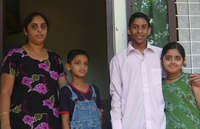 I
had to wake up at 4:30am to leave by 5 to see a couple of my cousins,
Claire and Francy, who I have not met before. We had to arrive
there early so that we could see them before they left for school.
But guess what? Because of the monsoon rains, school was cancelled!
I
had to wake up at 4:30am to leave by 5 to see a couple of my cousins,
Claire and Francy, who I have not met before. We had to arrive
there early so that we could see them before they left for school.
But guess what? Because of the monsoon rains, school was cancelled!
By about 11am, I had to leave to be in time for lunch at my aunt's
house in Kollam who has come from London on holiday. I've found
out that there is some sort of fever in this area which is transferred
through mosquitos, so it isn't really a good idea to stay here
for long seeing that mosquitos seem to have a liking for my blood
in particular!
I
visited my mum's house which is very near to my aunt's house.
For both times I visited India in 1998 and 2002, I stayed there
and so it was nice to see that house - lots of good memories with
my brothers and cousins there!
Day 21 - Wednesday 18th July
In Idukki, I was able to meet a few other cousins that
I hadn't met before - Donna and Diya and Jaiju Uncle's brother's
daughters, Della and Diana. I was also very happy to meet Jenny
Aunty too. It was the correct day to come on, as my cousins happened
to have a school holiday today!
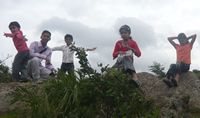 The
area that they live in is a very rural district and is located
in the hills of Kerala. In the afternoon we went on a short journey
and travelled further up the hills to an area called Ramakhallmaid.
We had a lot of fun up there, running around and trying not to
get blown off the edge of the hills!
The
area that they live in is a very rural district and is located
in the hills of Kerala. In the afternoon we went on a short journey
and travelled further up the hills to an area called Ramakhallmaid.
We had a lot of fun up there, running around and trying not to
get blown off the edge of the hills!
Today,
I saw the village side of Kerala, and just like in any other country,
there is a big difference between country life (like in Idukki)
and city life (like in Bangalore). It reminded me of the Ladybird
story of the Country Mouse and the City Mouse which was one of
my favourite books when I was younger - I'm definitely a City
Mouse!
My trip had previously been extended till 28th July but because
there are no tickets for that flight, I've been told that the
earliest flight available will be on 1st August! By the end, I
will have spent more than a month in India!
Day 20 - Tuesday 17th July
We went on a coach tour of most of Bangalore today, where
we stopped at many tourist locations. We visited places such as
the Iskon Temple, Vidhana Soudha (the Assembly), Tippu's Palace
and a science and technology museum.
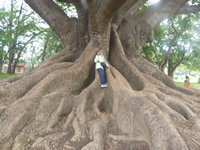 Bangalore
was often called the Garden City in the early and mid 20th century
and I found it hard to visualise a green Bangalore. But today
I was surprised to find a place called Lalbagh, which is an enormous
park in the heart of Bangalore. It has different species of trees
and plants from all over the world. There is one particular tree
which is absolutely massive - have a look at this picture!
Bangalore
was often called the Garden City in the early and mid 20th century
and I found it hard to visualise a green Bangalore. But today
I was surprised to find a place called Lalbagh, which is an enormous
park in the heart of Bangalore. It has different species of trees
and plants from all over the world. There is one particular tree
which is absolutely massive - have a look at this picture!
I finally conquered another form of transport in India: the city
bus! I was almost squashed by the scores of people surging in.
It was even worse than getting on the 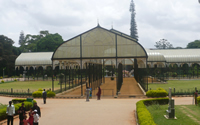 bus
home when I was at my old school - and I thought getting on a
bus couldn't get any harder!
bus
home when I was at my old school - and I thought getting on a
bus couldn't get any harder!
At 5pm, my tour of Bangalore drew to a close. The next part of
this week long tour of the south of India will be at Jaiju Uncle's
home, in a rural area called Idukki. But before that a 12 hour
coach journey lay ahead, which means that I will only reach Idukki
tomorrow morning at around 7am.
Day 19 - Monday 16th July
What a great day! Our flight on Kingfisher to Bangalore
was at 9am and I finally got a window seat!
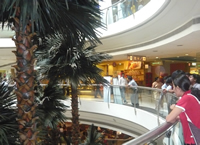 What
I find most amazing about Bangalore is the contrast between the
modern parts and the 'bad' parts. One minute, I'm in 'The Forum'
shopping complex (and would think that it is London) and then
the other, when I step outside I realise that it is still India.
Throughout Bangalore there are pockets of modern areas which are
sometimes surrounded by the slums. This is a microcosm of India,
which also is fairly similar but on a larger scale. It would have
been a good experience to go and walk through the slums but my
uncle said that it is far too dirty and cramped to do so. So far,
I've only read about Bangalore but only now after seeing it can
I really understand what I've read. There are even sheep and chickens
walking along some of the inner streets!
What
I find most amazing about Bangalore is the contrast between the
modern parts and the 'bad' parts. One minute, I'm in 'The Forum'
shopping complex (and would think that it is London) and then
the other, when I step outside I realise that it is still India.
Throughout Bangalore there are pockets of modern areas which are
sometimes surrounded by the slums. This is a microcosm of India,
which also is fairly similar but on a larger scale. It would have
been a good experience to go and walk through the slums but my
uncle said that it is far too dirty and cramped to do so. So far,
I've only read about Bangalore but only now after seeing it can
I really understand what I've read. There are even sheep and chickens
walking along some of the inner streets!
I had previously only read about the pollution problems in Bangalore
but only when I stepped into the streets of Bangalore did I realise
the full extent of the pollution in the air. In fact, the front
page headline of the Bangalore Mirror newspaper was 'Choking',
which highlighted the problem of pollution. By the end of the
day, my throat was paining from all the fumes inhaled. This is
definitely something you can't experience by reading a book!
At every junction you are met by heavy traffic and for a few minutes
many engines in that road would switch off. Expecting to stay
there for a while, most drivers switch off their engines and for
a short while sit through a rare Bangalore silence experienced
only on the roads!
Just like walking on many of the pavements of India, you have
to watch your step just in case you fall into the open drainage
system/sewage!
From what has been written above, Bangalore really does seem an
awful place. I suspect that this is a very distorted picture of
Bangalore and is not the image that  first
came to mind when I thought of this place. I have yet to see the
Silicon Valley side of Bangalore, which I hope to see tomorrow.
first
came to mind when I thought of this place. I have yet to see the
Silicon Valley side of Bangalore, which I hope to see tomorrow.
I had the opportunity to meet some of my uncle's friends in Bangalore
too, who just like him finished studying for a law degree.
Day 18 - Sunday 15th July
Another quiet day at home today. I had to pack to get
ready for the Bangalore trip tomorrow and I'm really looking forward
to it! One of my uncles, Jaiju Uncle, will be taking me around
for this week to Bangalore, Idukki and Kollam. He came at about
11pm and by that time I had already slept!
Day 17 - Saturday 14th July
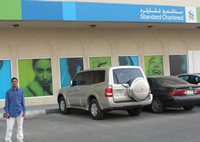 Today,
I decided to extend my adventure in India by a week till 28th
July as opposed to the 21st. This will give me more time for travel
and research, and possibly go to the Trivandrum Space Centre and
visit Amrita TV station for a day! After I come back from India,
I'll have one week at home and then I'll start my work experience
in the Economics Department of Standard Chartered Bank! While
I was in Dubai, I managed to spot a Standard Chartered branch
and took a snap of it! The bank gets 90% of its profits from abroad
in places like the Middle East and Africa, so it was not that
surprising to find one.
Today,
I decided to extend my adventure in India by a week till 28th
July as opposed to the 21st. This will give me more time for travel
and research, and possibly go to the Trivandrum Space Centre and
visit Amrita TV station for a day! After I come back from India,
I'll have one week at home and then I'll start my work experience
in the Economics Department of Standard Chartered Bank! While
I was in Dubai, I managed to spot a Standard Chartered branch
and took a snap of it! The bank gets 90% of its profits from abroad
in places like the Middle East and Africa, so it was not that
surprising to find one.
As it's the weekend, I stayed at home. Yesterday, my cousins Tom
and Chacko went to Allepey (another place in Kerala), so it was
a little boring! They'll only be back on Monday night and by that
time I'll be in Bangalore so I'll only see them next Friday when
I come back from the week long tour.
On Monday I'll be flying with one of my other uncles (I have many,
many uncles and aunties!) to Bangalore and will be staying there
for 2 days. On Wednesday we will travel to his house and then
to my mum's house on Thursday. I'll return back here on Friday.
Day 16 - Friday 13th July
A jam packed day today – went to CDS (Centre for
Development Studies), Technopark and a couple of museums.
 Arun
Rudran from the Energy Management Committee in Kerala (EMC) took
me around to these places today. I took the opportunity to find
out about what he did and discussed the possible solutions of
solving the energy problems that India suffers from. Firewood
is an essential part of domestic energy consumption, which is
now becoming scarce. This has prompted efforts to become more
efficient in energy usage, which is what the EMC aims to do, through
educating the masses.
Arun
Rudran from the Energy Management Committee in Kerala (EMC) took
me around to these places today. I took the opportunity to find
out about what he did and discussed the possible solutions of
solving the energy problems that India suffers from. Firewood
is an essential part of domestic energy consumption, which is
now becoming scarce. This has prompted efforts to become more
efficient in energy usage, which is what the EMC aims to do, through
educating the masses.
Another
issue in Kerala is that the domestic sector accounts for 50% of
energy consumption. The problem with this is that so much energy
is being used up in a process where there is not much output i.e.
if it were used for the production of goods or services by industries,
then output is being produced which may be exported to create
wealth in the economy.
Most
of the power in Kerala is from hydroelectricity (because of the
monsoons!). When I suggested to Arun the usage of nuclear energy
in Kerala he told me that Keralites were very conscious people
– in this instance, they are very environmentally conscious.
Many feel that the risks involved in nuclear energy far outweigh
the possible benefits from it.
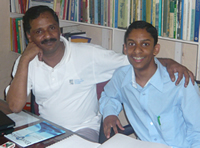 At
CDS, I met a fellow, Professor K J Joseph. We discussed the development
of the BRIC nations and he said that it was essentially a game
of catch up. There are two aspects of catching up - the ‘idea
cap’ and the ‘material cap’. The former is the
transfer of ideas and knowledge and the latter is the transfer
of tangible technology. However, he emphasised the learning and
knowledge part of development. Without the transfer of ideas and
knowledge from the knowledge producers (like CDS) to users (e.g.
the different industries), there is no use in such technology.
Dr. Abdul Kalam, the current President of India said that if knowledge
is not used for the development of society, then it is immaterial.
At
CDS, I met a fellow, Professor K J Joseph. We discussed the development
of the BRIC nations and he said that it was essentially a game
of catch up. There are two aspects of catching up - the ‘idea
cap’ and the ‘material cap’. The former is the
transfer of ideas and knowledge and the latter is the transfer
of tangible technology. However, he emphasised the learning and
knowledge part of development. Without the transfer of ideas and
knowledge from the knowledge producers (like CDS) to users (e.g.
the different industries), there is no use in such technology.
Dr. Abdul Kalam, the current President of India said that if knowledge
is not used for the development of society, then it is immaterial.
In
the context of immigration, Prof. Joseph also talked about globalisation,
which has led to the lowering of barriers to capital. But he points
out that at the same time, barriers to labour are being put up
– however, it is this resource that developing nations like
India have in abundance. I asked him the question that had been
asked in an article I had read a few days ago - would India attract
immigrants in their masses? He told me to wait 25 years and I’ll
see a long queue at the Indian embassy in London!
On
the question of sustainability, he argued that the sheer size
of the market in India meant that growth would go on for a long
time. But, education, a major part of growth continues to be a
huge problem. Many of India’s problems can be solved –
the resources are there, but they are not being used according
to Prof. Joseph. Inflation is one of the problems which could
threaten long term sustainability of Indian growth. It affects
the poor most, as rise in the price of essentials like bread will
lead to famine and deaths.
One
of the main resources that India has is people. Throughout my
travel so far I have been able to see India’s rural masses.
India is volume driven and I feel that this has to be tapped into.
Figures of telecom usage in rural areas shows the massive divide
between those at the top of the pyramid compared to those in villages
– telecom penetration is a mere 2% in rural areas (for 70%
of the population) compared to 40-50% among the rest of the population.
India’s comparative advantage lies in its size, just like
China. If it can tap into this potential, the Indian tiger will
roar on.
On
the issue of Kerala compared to other states in India, Prof. Joseph
said that Kerala was doing better. But it could be doing better
– he said that although Kerala is ‘God’s own
country’, God had to make some imperfections and that imperfection
is the people i.e. without Malayalees, Kerala would be much better!!
This reminded me of what Arun told me earlier; that Malayalees
are very conscious and that if this were not the case, then maybe
solutions like nuclear energy would be a real possibility.
I had read an article in The Economist a few weeks ago, which
said that local economists in India were far more optimistic about
their growth and its sustainability. People outside India are
more wary of its growth, but Prof. Joseph said that India was
doing very well and will continue to do so. This is the optimism
that The Economist writes about and whether this outlook is correct,
only time will tell...
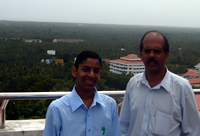 My
two elder brothers had visited Technopark a couple of years ago
and advised me to go there. It is a massive government managed
'park' with many equipped offices for primarily IT firms, making
it much easier for those firms to set up and flourish. There are
a few other Technoparks in India too. We had a guided tour conducted
by M. Vasudevan (a Sr. Manager of Technopark) who also took us
to see Mr. Abhilash Kumar (Associate Manager Facilities) of Infosys.
Mr. Abhilash Kumar showed me a video of the growth of Infosys
- one interesting fact I learnt was that it had taken 23 years
for Infosys to make its first $1bn and 23 months to make its second
$2bn!!
My
two elder brothers had visited Technopark a couple of years ago
and advised me to go there. It is a massive government managed
'park' with many equipped offices for primarily IT firms, making
it much easier for those firms to set up and flourish. There are
a few other Technoparks in India too. We had a guided tour conducted
by M. Vasudevan (a Sr. Manager of Technopark) who also took us
to see Mr. Abhilash Kumar (Associate Manager Facilities) of Infosys.
Mr. Abhilash Kumar showed me a video of the growth of Infosys
- one interesting fact I learnt was that it had taken 23 years
for Infosys to make its first $1bn and 23 months to make its second
$2bn!!
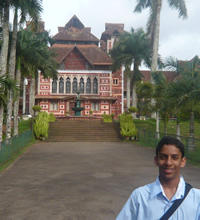 I managed to squeeze in a few cultural activities in the afternoon.
I went to two museums, one on the Maharajas of Travancore (the
old name for Trivandrum) and the other was an art exhibition of
the works of the famous Indian artist, Raja Ravi Varma. I don’t
really appreciate art work that much (apart from the famous pieces
we can see in London by artists like Van Gogh!) but seeing the
work of Raja Ravi Varma was enlightening. Till today, I had only
really seen Western art, but I was able to see artwork from a
different perspective.
I managed to squeeze in a few cultural activities in the afternoon.
I went to two museums, one on the Maharajas of Travancore (the
old name for Trivandrum) and the other was an art exhibition of
the works of the famous Indian artist, Raja Ravi Varma. I don’t
really appreciate art work that much (apart from the famous pieces
we can see in London by artists like Van Gogh!) but seeing the
work of Raja Ravi Varma was enlightening. Till today, I had only
really seen Western art, but I was able to see artwork from a
different perspective.
Day 15 - Thursday 12th July
It was a pleasant surprise to find in today's Financial
Express a special section titled 'The BRIC Page'. One article
focuses on China's move towards further innovation to 'move away
from the tag of being an imitator of global brands'. China holds
a reputation of persuing reduction in costs and exploiting economies
of scale rather than fostering innovation but it is clear that
attempts are being made to innovate. One example of this is the
creation of the third global standard for 3G mobiles called TDS-CDMA.
The main pillars of innovation are education, volume of R&D
activities, infrastructure and right policies. In terms of education,
China is very far ahead of India and spends 3.3% of its GDP on
it but India is much better in terms of higher education.
Tomorrow,
I'll be going to CDS (Centre for Development Studies) to talk
to some students and lecturers about various issues surrounding
India's economic growth and immigration. I will also be going
to a place called Technopark, which provides ICT facilities for
many companies like Infosys.
Day 14 - Wednesday 11th July
These mosquitos are really getting on my nerves now -
I was bitten by one on my thumb while eating!!
One of the main concerns surrounding the development of the Indian
economy is power, efficiency and capacity. If the problem of growing
shortages is not addressed soon, it will hinder India's economic
growth - in order to maintain a GDP growth of 9%, it will have
to 'increase its power generation five or six times over the next
few years'.
A solution to this problem would be to open up the energy industry
to the free market. At the moment the state government owns about
55% of power generation and the Central government owns about
32%. It is also fairly inefficient, where efficiency levels (in
terms of conversion to electrical energy) which lies at around
29% compared to European levels of about 40%. The government should
allow 100% FDI in nuclear energy in order to stimulate innovation
in this vital industry.
Problems
in providing power is one of the long list of problems that India
suffers from. During my trip so far, I have seen much poverty
and huge infrastructural issues. While driving through the town,
the bad state of the roads is highly visible. These were some
of the issues that the President of the North Malabar Chamber
of Commerce brought up on Sunday.
Day 13 - Tuesday 10th July
I've caught a bit of a cough, which is a bit annoying!
Apart from that, I'm quite tired from the last few days, as I
didn't get much sleep.
In 'The Financial Express' there was an article about immigration
from India, in particular doctors, in light of the recent Glasgow
jeep suicide incident of June 30. The prospects for Indian doctors
now seems grim, after Gordon Brown announced that there would
be background checks, which could curtail the number of Indian
doctors entering the UK. Currently, more than four-fifths of the
foreign doctors in the UK are of Indian origin. Indian immigrants
are renowned for their high level of education and professionalism.
The main point of the article is that we in the UK should not
let this one event frighten us.
The article also poses the question of when India will become
a place where people migrate to, which is a very good sign of
the state of the economy and country in general. This is one question
I will try to get answered in my time here.
Day 12 - Monday 9th July
After the whirlwind tour, I was dropped off at another
uncle's house, in Kottapurram, to spend the day there. I met two
of my other cousins, Nithin and Nigil for the first time too.
We visited a school called St. Anne's, which was the school where
my dad studied at when he was young.
In the afternoon, I had to leave to go back to Trivandrum, where
Tom Uncle's house is. It was another six hour journey back, but
this time during the day, which meant that I was able to see much
more from the window.
I
wasn't too pleased to find out that Federer had won Wimbledon!
I really wanted Nadal to win, maybe he'll win next year - 'Vamos
Rafa!'
Day 11 - Sunday 8th July
When I thought it can't get much busier for my uncle,
I was proven wrong - he made five different speeches today. It
was actually physically impossible to have made any more, unless
he was using a helicopter or some sort of Star Trek 'beam me up,
Scotty' device! Even though I couldn't understand them, I could
tell that they were pretty amazing speeches too from his performance
and the reaction from the crowd.
The last speech of the day at the North Malabar Chamber of Commerce
was in English!! The President of the Chamber, in his speech argued
for increased government support for private enterprises and said
that without it, there would be a slow decline in private enterprise
in the future. He compared North Malabar to Cochin and said that
Cochin was doing much better. In my uncle's speech he addressed
this issue and said that until Kerala's fiscal deficit is eliminated
(by 2011), the government's hands were tied. But he pointed out
that there is much scope for development in North Malabar and
in other places in Kerala, due to the existence of a new entrepreneurial
spirit among the younger generation. He also pointed out that
despite Cochin doing very well, it still suffered from many problems,
including not having a proper sewage system. He welcomed government
intervention in helping businesses and talked about drawing up
a 'vision' for the future.
This is the end of the hectic trip with my uncle, which I thoroughly
enjoyed.
Day
10 - Saturday 7th July
It's amazing to see how busy my uncle is! Tom Uncle made
two speeches today, one about a tax settlement and the other about
women's status in Kerala, albeit both were in Malayalam.
I was able to speak to one of Tom Uncle's previous students, called
Manju (Aunty!). Her work is mainly about decentralisation and
in particular does work on Jammu and Kashmir. I also spoke to
her about the impact of immigration on Kerala. Many Keralites
emigrate to places like the UAE and the UK, which is why I had
met a lot of Malayalees while I was in Dubai.
In the evening, I met a Med school student called Sankar while
my uncle was at a meeting. He was watching the Djokovic Vs Nadal
match - I was quite pleased to watch the match, as I had not been
able to see any this year because of my trip!
For the first time I travelled on an Indian train. We were in
the sleeper carriage as it was a six hour journey during the night.
Now, I have travelled on most forms of transport in India (car,
train, auto rickshaw, bicycle and motorbike), apart from a boat
and bus! But Chacko pointed out that I haven't been on a truck,
tractor and a tricycle!!!
Day 9 - Friday 6th July
Today, the whirlwind tour begins!
We left for Calicult by plane with Air India in the evening. Before
we got on the flight, I was very privileged to meet the Minister
for Health and the Minister for Industries and Commerce.
I also met a Member of Parliament based in New Delhi. I spoke
to him about my research in the UAE and he too pointed out
the phenomenal growth of real estate there.
The only programme that evening was to attend a wedding. With
the problems that I have had with spicy food, it was a bit annoying
to find that all the food on offer was spicy - so I just went
straight for dessert as my main course - ice cream and an Indian
delicacy, jilleby!
Day 8 - Thursday 5th July
I woke up yet again with more mosquito bites. My cousins,
Tom and Chacko who have come with me from Dubai didn't get any
bites! Seems like the mosquitos like me more!
In the morning, we went straight to the
Legislative Assembly to see a debate taking place, in which my
uncle was answering questions from members of the Assembly. I
had seen a few debates when I visited Kerala in 2002 and it all
sounded very much the same to me - the language spoken, Malayalam,
was way too complicated for me to catch which meant that I just
sat their silently and watched the performance!
We did a bit of clothes shopping in the afternoon and later played
a bit of badminton with my cousins and two other friends who live
nearby, Aju and Siju.
I did a bit of reading on the Indian economy. The phrase "Goldilocks
economy" has often been used to describe the American economy
but is sometimes used to describe the Indian one - it is one which
is neither too hot, nor too cold with strong growth and falling
inflation. Although economists in India are particularly optimistic
about the sustainability of its growth, outsiders are more sceptical
are about it, and with good reason too. There are many signs of
an overheating economy compared to that of China's. Inflation
is higher, share prices have risen twice as much from 2002 and
bank lending is growing at great speed. One of the problems is
lax monetary policy - many local economists believe that past
increases over the last year will suffice as they argue (and rightly
so) that monetary policy takes time to work. But 'The Economist'
magazine argues that further increases are required to keep the
economy in check. The Reserve Bank of India is however influenced
by politicians who are very reluctant to adopt anti-people policies.
Gordon Brown had made the Bank of England independent in 1997
to control interest rates with much success. Maybe the Indian
government should loosen its control over interest rates too?
Over
supper, Tom Uncle told me that he was going on a tour of Kerala
tomorrow afternoon until Monday to make some speeches and he invited
me to come along too!
Day 7 - Wednesday 4th July
Despite using a mosquito net while sleeping, the bugs
still managed to bite me a few times! After a bit of morning badminton
after breakfast in the court outside my uncle's house, I began
in full earnest on my research into the Indian economy.
 My
first line of action lay in reading 'The Financial Express'. The
outsourcing of business processes to countries like India is one
of my main interests and it was therefore very interesting to
read an article about BT outsourcing from India. BT's global services
president, Tim Smart, puts the reasons for a partnership with
Indian IT players concisely - "We want to take advantage
of capabilities in the developing world which is more efficient
and cost effective". But Smart, (quite smartly), also points
out another factor that had not come across my mind before - "our
customers are globalising". This highlights that it is not
only factors in the country to which business processes are being
outsourced (e.g. India) that compel firms to do so, but also factors
within countries like the UK.
My
first line of action lay in reading 'The Financial Express'. The
outsourcing of business processes to countries like India is one
of my main interests and it was therefore very interesting to
read an article about BT outsourcing from India. BT's global services
president, Tim Smart, puts the reasons for a partnership with
Indian IT players concisely - "We want to take advantage
of capabilities in the developing world which is more efficient
and cost effective". But Smart, (quite smartly), also points
out another factor that had not come across my mind before - "our
customers are globalising". This highlights that it is not
only factors in the country to which business processes are being
outsourced (e.g. India) that compel firms to do so, but also factors
within countries like the UK.
I also read an article about the fiscal policy of Kerala by my
uncle. He draws attention to the persistent revenue deficit -
Kerala has the highest deficit level among all the states in India
(May 2007 figures). But he argues that the state government will
aim to eliminate the deficit by 2010-11. The article criticises
the national government's policy of maintaining rigid 'mechanical'
targets at any cost. In order to reduce this deficit, it argues
for increased development in Kerala through 'large scale investment
in infrastructure' - this therefore calls for more flexibility
in borrowing for capital expenditure, as opposed to the Indian
government's tendency to aim for particular targets.
Day 6 - Tuesday 3rd July
I'm a few days behind in my blog because I didn't have
an internet connection readily available but now I've got one,
I've got lots of entries to type up...so here goes...
Once
I had finished the final bit of packing in the morning, I was
ready to go. Yet again, I did not get a window seat and so will
make it a mission to ensure that I get one when returning home!
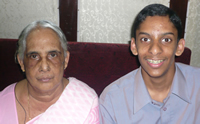 When
my cousins and I arrived in India were were picked up by our uncle
(who is the Finance Minister of Kerala) and were taken to his
house. We will be staying there with our grandmother for the next
few weeks. Throughout the blog I'll refer to him as Tom
Uncle (instead of calling him Uncle Tom, as you probably would
expect - it is in the culture to switch it around to make Tom
Uncle - don't ask why!!) Another funny thing - for someone around
my age or younger, anyone who's a quite a bit older than me is
also an uncle or aunty - I suppose it's just a sign of respect!
When
my cousins and I arrived in India were were picked up by our uncle
(who is the Finance Minister of Kerala) and were taken to his
house. We will be staying there with our grandmother for the next
few weeks. Throughout the blog I'll refer to him as Tom
Uncle (instead of calling him Uncle Tom, as you probably would
expect - it is in the culture to switch it around to make Tom
Uncle - don't ask why!!) Another funny thing - for someone around
my age or younger, anyone who's a quite a bit older than me is
also an uncle or aunty - I suppose it's just a sign of respect!
Unfortunately,
not much economics to talk about today!
Day 5 - Monday 2nd July
On the outside, the UAE looks great - Dubai is always associated
with the building of grand, modern buildings but today I was able
to see the real force behind this.
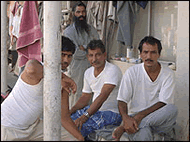 The
24 hour day for construction is based mainly upon South Asian
migrant workers who live in specially built 'Labour Camps'. These
workers live in extrememly bad conditions, with often 12 men in
one bedroom. While driving through the camps which covered a huge
area of land, I caught a glimpse of what these men were going
through. But for many, this is the alternative to poverty in their
home country - they should be able to send money home from what
they earn. However, workers are often not paid on time. On the
BBC website, I read that companies also 'lose' passports of their
workers so that they cannot return home.
The
24 hour day for construction is based mainly upon South Asian
migrant workers who live in specially built 'Labour Camps'. These
workers live in extrememly bad conditions, with often 12 men in
one bedroom. While driving through the camps which covered a huge
area of land, I caught a glimpse of what these men were going
through. But for many, this is the alternative to poverty in their
home country - they should be able to send money home from what
they earn. However, workers are often not paid on time. On the
BBC website, I read that companies also 'lose' passports of their
workers so that they cannot return home.
After seeing this first hand, the growth of Dubai does not seem
as glamourous as I had initally thought it was. The image that
the public see is quite different to the reality.
We managed to do a bit of shopping in town and I also got to experience
the traffic which has become such as problem in the UAE. Parking
is also a big problem - yesterday we spent 30 minutes going round
and round the car park to find a space outside the 'Gold Souq'!
Today was my last day here and I'll be flying off tomorrow
to Kerala at 3:05pm with a couple of my cousins, Tom and Chacko.
Day 4 - Sunday 1st July
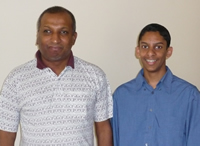 As
part of my research on the UAE, I was very grateful to meet up
with Dr. Siva Kumar Velayuttham, Head of the Accounting Department
of the University of Sharjah. He told me that much of UAE's economic
growth was based upon its oil reserves. But at the current rate
of production of approximately 2 million barrels per day, the
oil reserves are expected to run out in 122 years. When asked
about what would happen then, he said that it was too far into
the future to predict. This reminded me of what the great John
Maynard Keynes once said - 'In the long run we're all dead'!
As
part of my research on the UAE, I was very grateful to meet up
with Dr. Siva Kumar Velayuttham, Head of the Accounting Department
of the University of Sharjah. He told me that much of UAE's economic
growth was based upon its oil reserves. But at the current rate
of production of approximately 2 million barrels per day, the
oil reserves are expected to run out in 122 years. When asked
about what would happen then, he said that it was too far into
the future to predict. This reminded me of what the great John
Maynard Keynes once said - 'In the long run we're all dead'!
He
also pointed out that there was a slow movement towards more economic
liberalism. The Jebel Ali Free Zone (which I saw yesterday) is
one of the examples of this, where corporations have various business
and tax incentives.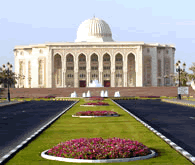
Although
the UAE is doing very well now, Dr. Velayuttham said that much
also depended on regional political stability in this post 9/11
era. Events occuring in the surrounding region has much bearing
on what happens in the UAE.
On the role of immigrants, it was interested to note that the
majority of the lecturers at the University of Sharjah are expatriates,
which highlights the magnitude of the immigrant labour force in
the UAE.
I was surprised by the size of the university and its grand buildings,
each one of them accompanied by a massive dome on top. The American
University was also in the same compound behind the University
of Sharjah.
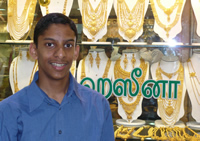 In the afternoon, I went to the 'Gold Souq', meaning 'Gold Market',
where there are endless amounts of jewellery shops and gold wholesalers.
I can't imagine how much the whole area would be worth in terms
of gold!
In the afternoon, I went to the 'Gold Souq', meaning 'Gold Market',
where there are endless amounts of jewellery shops and gold wholesalers.
I can't imagine how much the whole area would be worth in terms
of gold!
Sunday is in fact the first working day of the week and the weekend
is Friday and Saturday! I now only have a full day and will be
leaving on Tuesday afternoon to 'God's own country', Kerala in
India!
Day
3 - Saturday 30th June
Didn't feel that well today - a combination of all the spicy food
that I ate yesterday and the weather took its toll!
But I still managed to see various places in Dubai. We travelled
up to Palm Island, which is still under construction and from
a distance saw the iconic Burj Al Arab, which looks like a sailing
boat. Yet again, I was amazed to see the amount of construction
that is happening, which is representative of the diversified
nature of the UAE. Although the UAE has the fourth largest reserves
of oil, oil only represents a third of its GDP.
But
oil still represents a major part of its economy. The profits
have been used to finance government spending and investment flows.
Mohamed Shihab, in his analysis of the economic development of
the UAE says that, using oil profits it was able to leapfrog the
initial hypothetical 'stages' of growth.
I
also saw the Burj Dubai, the tallest building in the world (to
be) which is being contructed. But the actual size has not yet
been revealed.
Day 2 - Friday 29th June
After a 2 hour delay at Heathrow, I was off - initally, I was
disappointed by not having a window seat but it was somewhat satisfying
to know that at 10:30pm there was not much I was missing! Having
got over this initial disappointment, I enjoyed watching 'The
Persuit of Happiness' starring Will Smith.
One of the first observations I made in Dubai were the amount
of builidings - new ones too were springing up, as you could see
from the skyline which was scattered with cranes. After following
this up (by asking my uncle), UAE was the centre of a huge real
estate boom. Nearly all of the buildings apart from the occasional
shopping mall were flats. Unlike in the UK, where there is a culture
of home ownership, in the emirates, it is a different story. Most
people rent flats, but not because they particularly want a flat,
but because they usually can't get hold of property of their own.
In UAE, only nationals can own property.
Towards the end of the day I was at one of my cousin's 6th birthday
party, which I thoroughly enjoyed! These were just a few of the
many, many cousins to meet in India!
I
have got away with speaking English for the day, but when I reach
India, I may have to brave the embarassment of my accent in speaking
the local langauge, Malayalam...
Day
1 - Thursday 28th June
I'm
packed and ready to start chasing the monsoon! My flight's at
8:30pm. Next stop, Dubai!